The Falling Quarter
House of LeavesThe Falling Quarter is the key reversal in the rescue attempt inside the Navidson House. What begins as a practical signaling device becomes evidence of impossible distance: after Reston and Jed are lifted from the shaft, a quarter dropped from above falls for nearly an hour before reaching Will Navidson. Its eventual clatter does not confirm a safe connection to home. It proves that the stairway has stretched beyond the scale of the rescue operation and has transformed a recovery mission into an entrapment.
The Rescue Mechanism
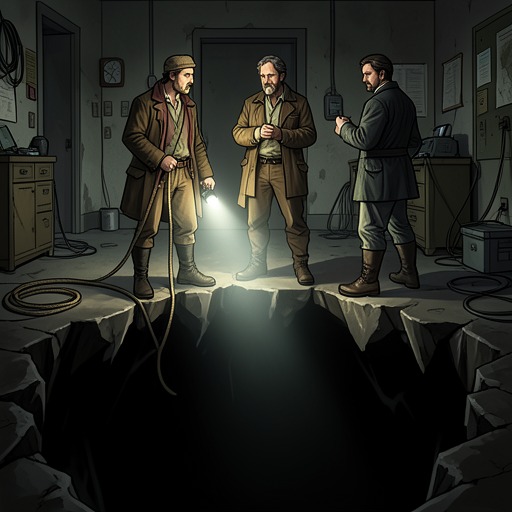
Within minutes of the rope’s arrival, Will Navidson and Billy Reston begin hoisting Kirby “Wax” Hook through the one-hundred-foot shaft. Navidson ties the rope around the bottom banister as a safeguard, so that the stretcher will stop several feet above the bottom if their grip fails. A quarter clattering onto the floor announces that Wax has reached the top, allowing the stretcher to be lowered again for the next load. Jed Leeder is then hauled upward, his body gathered into the same improvised system, and a second quarter marks his arrival.
The coins therefore serve an apparently simple logistical purpose. They are dropped from above to tell Navidson that each person has safely arrived and that the stretcher can be sent down again. Their ordinary weight and unmistakable sound make them effective signals in a place where voices, lights, and distances cannot be trusted. Yet the very practicality of the method prepares its later reversal: the coin is an object designed to measure completion, but it ultimately measures the failure of the space itself.
The Shaft Changes
Reston is next. He lights a green flare and jokes, “Going up like the fourth of July.” At first, the ascent proceeds smoothly, with Navidson drawing slack rope from the floor as Reston rises through the bore of the staircase. Halfway up, however, the excess rope begins to vanish. The section of rope in Navidson’s hands slips across his fingers with enough force to burn a gash into his palms, forcing him to release it. Reston does not fall; instead, his ascent accelerates, still marked by the green flare.
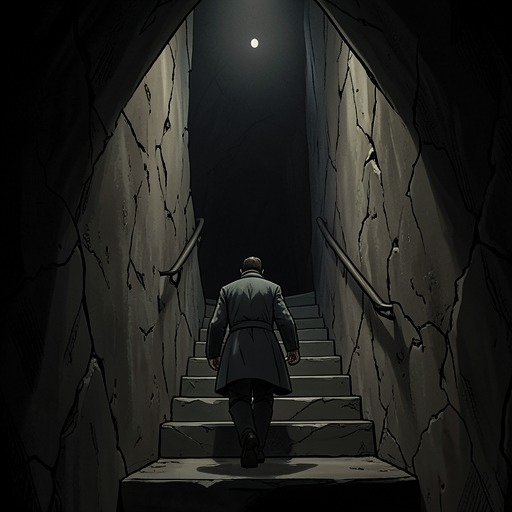
The apparent question of what is pulling Reston upward is answered through a spatial reversal. As the stairway grows darker, the circle of light above becomes smaller, and Navidson appears to be sinking—or the stairway appears to be expanding, dropping, and carrying the surrounding world with it. The distinction between a person moving downward and an architecture enlarging around him becomes impossible to secure. The rescue has not merely encountered a longer passage than expected; it has entered a structure whose dimensions actively defeat the assumptions on which the rescue depends.
Eventually the depth of the stairway exceeds the rope’s length. When Reston reaches the top, the rope is taut, but the staircase continues to stretch. Navidson makes a desperate attempt to seize the last connection to home, but the rope snaps about ten feet above the final banister. The break converts precarious contact into complete separation. Above him, Navidson hears a faint cry and then nothing—not even the smallest opening of light.
The Coin as Evidence
After the break, the quarter acquires a different status. In the account recorded by Will Navidson, he waits for almost an hour, rests, and hopes that something will change. Nothing does. Then a clatter comes from behind him. A third quarter lies on the floor, and Navidson holds it up as evidence. If Tom Navidson dropped it a few minutes after Reston reached the top, the coin has been falling for at least fifty minutes before arriving below.
The delay turns an everyday object into an instrument of impossible measurement. Navidson recognizes that he is at an “impossible distance down,” far beyond what the apparent dimensions of the shaft can accommodate. The accompanying calculation intensifies the contradiction: depending on the formula and acceleration used, the quarter would have fallen tens of thousands of miles, with one estimate exceeding the Earth’s circumference at the equator. The exact mathematics is left unstable, and a later note acknowledges that a more precise calculation was never completed, but the incompleteness does not weaken the event’s force. The coin’s sound is enough to establish that ordinary spatial reasoning has failed.
The quarter also exposes the material world as something no longer transparent or dependable. Initially, the coin is merely a signal, a disposable tool in a coordinated rescue. Once its fall lasts nearly an hour, its weight, trajectory, and sound become newly visible. It is no longer just an object used by the rescuers; it becomes a witness against their understanding of the house. The coin makes the unseen depth perceptible without making it intelligible.
Consequences for the Rescue
The rope’s failure and the delayed quarter leave Navidson below with no reliable route back. The pulley at the top has been torn from the banister, but Tom Navidson manages to catch Billy Reston as well as the rope before the entire apparatus plunges down the shaft. Reston later describes how the survivors needed several minutes to recover their bearings and still did not understand what had happened. The technical equipment has therefore survived only through improvisation, while the central connection between the trapped explorer and the people above has been destroyed.
Navidson then prepares to document his condition. He loads his Affiflex with one hundred feet of high-speed tungsten film, uses a five-minute ultra-high-intensity lightstick, and runs the Hi 8 to record sound. His supplies may last only a limited time: if he can locate his own pack and Jed’s, he expects water and food for at least three days, perhaps four days of batteries. The radio is dead, and he does not know how he will return. The rescue sequence has shifted from transporting injured bodies upward to recording the testimony of a man abandoned in an impossible depth.
Narrative and Thematic Significance
The Falling Quarter is both an event in the story and a demonstration of how the story’s evidence operates. The first two coins appear as controlled signals within a rational procedure; the third arrives after an inexplicable interval and changes the meaning of the entire sequence. A repeated action becomes a revelation. In narrative terms, the event moves from scene-level suspense to a documentary problem: the recorded object supplies proof, but the proof describes a reality that cannot be reconciled with the available measurements.
Its irony lies in the coin’s smallness. The rescue depends on ropes, pulleys, stretchers, flares, film, and disciplined labor, yet the most devastating information arrives through a quarter striking the floor. The sound is minor, almost banal, but it carries the scale of the void. By making an ordinary signal disclose an immeasurable environment, the event turns communication into separation and measurement into bewilderment. The coin does not show Navidson the way home; it tells him that home has become impossibly far away.