The Five and a Half Minute Hallway
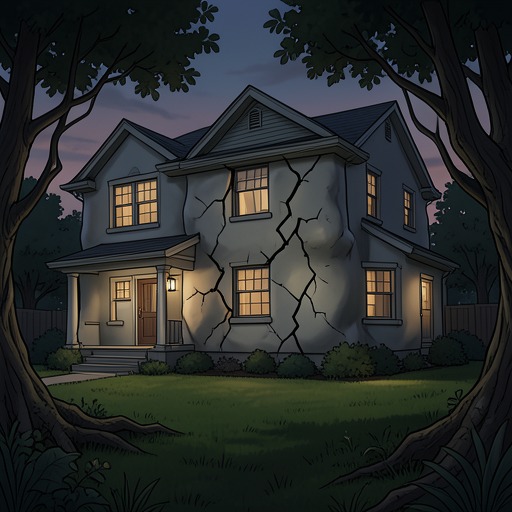
House of LeavesThe Five and a Half Minute Hallway is the first and most recognizable manifestation of the impossible architecture in The Navidson Record. Initially introduced through a five-and-a-half-minute film that appears to prove a doorway can lead nowhere, it develops into a dark passage whose length, position, and relation to the house continually contradict ordinary spatial knowledge. Its decisive significance lies in this double function: it is both a physical anomaly within the Navidson house and a test of the documentary’s claim to reality, forcing characters and viewers to confront a space that can be recorded without becoming intelligible.
Origin as a Filmic Anomaly
The hallway first surfaced nearly seven years before The Navidson Record, in a short called “The Five and a Half Minute Hallway.” On the surface, the piece seemed barely more than an optical illusion, a five-and-a-half-minute exercise within the reach of an NYU film-school graduate. Its disturbing force came from the accompanying claim that the footage was true. The short therefore established the hallway not simply as an image but as a disputed object: viewers had to decide whether they were watching artifice or evidence.
The film is constructed as one continuous shot. Will Navidson, who never appears on camera, first focuses on a doorway on the north wall of the living room. He then climbs through a window east of the doorway, crosses outside, redirects the camera from the flower bed toward the white clapboard exterior, and crawls back through a second window west of the doorway. The route circles the doorway completely. The exterior view offers no ten-foot projection, only rose bushes, a muddy dart gun, and the open summer air. The circuit seems to establish that the doorway can lead only into insulation or siding.
That apparent proof collapses when Navidson’s hand enters the frame and opens the door. Behind it lies a narrow black hallway at least ten feet long. He repeats the circumambulation, checking the exterior once more and finding no corresponding extension, but disbelief does not prevent him from returning to the impossible passage. As the camera approaches the threshold, Karen Green warns, “Don’t you dare go in there again, Navy,” and Tom Navidson adds, “Yeah, not such a hot idea.” Navidson stops short of entering, places a hand inside, withdraws it, and examines it as though sight might disclose a tactile difference. His final answer to Billy Reston’s inquiry is blunt: “It’s freezing in there.”
Circulation and Documentary Authenticity
The first short was never officially distributed. It did not enter film festivals or commercial film circles; VHS copies passed from hand to hand, each successive dub degrading the image. The hallway therefore circulated as a fragile, incomplete object, detached from reliable information about the owners of the house or the person who made the recording. Its scarcity intensified both curiosity and cultural speculation, while the poor copies made the question of evidence inseparable from the limitations of the medium.
The hallway’s later appearance in The Navidson Record differs from the bootleg version. The released film supplies a wider selection of shots and gives the sequence more thorough and fluid coverage. It also reveals a startling change in scale: the hallway that appeared well over sixty feet deep when Chad Navidson and Daisy Navidson entered it is now less than ten feet long. The revised footage does not clarify the earlier image; it makes the discrepancy part of the hallway’s identity. Context adds the Navidsons and their friends, whose personalities seem to crowd the space, but the added human presence does not make the corridor more explainable.
The hallway’s power also depends on the starkness of the production. Apart from framing, editing, and occasional subtitles, the footage leaves little room for the usual signs of cinematic manufacture: there is no make-up, expensive soundtrack, or elaborate crane work. Verifiable figures such as Will Navidson, Holloway Roberts, and Billy Reston lend the material an evidentiary surface, while the stripped-down production makes the impossible appear more, rather than less, credible. The passage consequently occupies an unstable position between cinematic symbol and documentary fact.
Spatial Behavior Inside the House
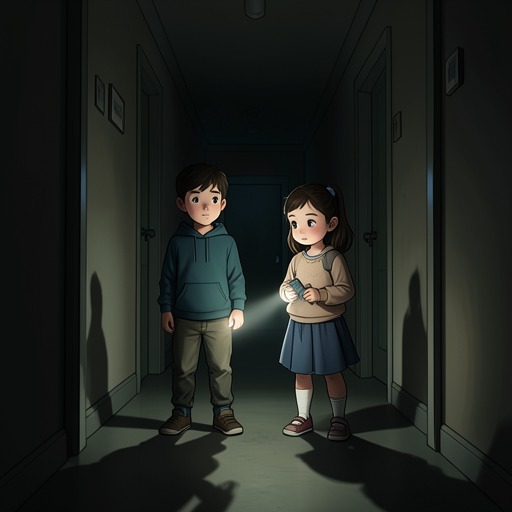
The hallway does not remain a fixed feature of one room. During the family’s ordinary life in the house, Chad and Daisy’s cries begin echoing from distances that no room could contain. Their voices return with separate answers, revealing that the sound is traveling through a dark, doorless hallway that has appeared in the west wall of the living room. Will Navidson enters without hesitation and returns carrying one child in each arm; both children still hold homemade candles and appear far less disturbed than Karen Green.
The episode establishes the hallway as a threshold whose danger is not shared equally. Karen freezes at the entrance, unable to push into the darkness, and is drenched in sweat once the children are safe. This is the first visible sign of her crippling claustrophobia. The children want to return, but Will Navidson agrees to make the new addition temporarily off limits, converting the passage from a mysterious curiosity into a prohibited part of the family home.
The corridor also participates in the house’s wider collapse of direction and proportion. Karen later obtains a compass after consulting a Feng Shui master, only to discover that the instrument refuses to settle inside the house; a replacement compass behaves in the same way. The hallway thus belongs to a structure that defeats ordinary reference points as thoroughly as it defeats architectural measurement. The Infinite Corridor, the Anteroom, the Great Hall, and the Spiral Staircase exist for everyone, yet their size and layout can change; other areas never repeat the same pattern twice. The hallway is the earliest compact expression of this unstable spatial order.
Threshold, Depth, and the Labyrinth
The hallway’s apparent smallness conceals its function as an entrance into an architecture of indefinite depth. Elsewhere, Will Navidson reaches an entrance that rises above his head and opens into blackness where his flashlight finds a floor but no walls and, for the first time, no ceiling. The sequence makes clear that the living-room passage is not an isolated trick but an opening onto a house whose dimensions exceed the visible building. The doorway is therefore less a portal with a known destination than a rupture in the distinction between interior and exterior.
That rupture repeatedly turns movement into risk. Will Navidson eventually begins down the Spiral Staircase, while Billy Reston refuses to let him proceed alone. Although the descent has been estimated at thirteen miles, Will reaches the bottom in less than five minutes and finds himself no more than one hundred feet below, suggesting that even vertical distance is subject to the house’s distortions. Later, when a floor gives way and furniture slides toward the void, Billy Reston’s escape depends on Will swinging from a door lever and jumping across a gap to reach him. The hallway’s initial coldness thus expands into a system in which thresholds, floors, doors, and stairs all become unstable instruments of survival.
No one ever sees the labyrinth in its entirety. Comprehension must be derived from within, even though entering it destroys the detached viewpoint that might have made a complete survey possible. The same structure governs The Navidson Record itself: its edits, shifts in perspective, and interruptions lead viewers toward a center that continually recedes. The hallway is consequently both a location and a model of the film’s discourse, promising access while preventing total knowledge.
Persistence Beyond the Film
The hallway remains meaningful precisely because it offers no settled explanation. It is not given the neat answer associated with a passage to another dimension or another world. Instead, it remains incontrovertibly present and virtually inviolate to interpretation, a thing that has effects without yielding a final definition. Its refusal of closure sustains the tension between the literal insistence of Will Navidson and the intellectual interpretations that treat the film as a warning, allegory, or theoretical object.
The passage also survives outside its original images. In a later bar, a song unexpectedly includes the lyric, “I live at the end of a Five and a Half Minute Hallway.” The phrase’s recurrence turns the hallway into a cultural fragment, detached from the house yet still carrying its peculiar geography. The same phrase can therefore function as title, location, memory, and incursion: a piece of recorded impossibility that continues to surface in other media and reassert the corridor’s existence without explaining it.
Its final force comes from the contrast between its modest physical presentation and its immense consequences. A doorway, a few windows, a strip of wall, a camera, and a hand are enough to undo the geometry of a house. Later recordings add equipment, measurements, monitors, drives, transmitters, ropes, flares, compasses, and microscopes, but technical accumulation never restores control. Even the most steady images made by Will Navidson cannot stabilize the space. The Five and a Half Minute Hallway remains the place where seeing becomes unreliable, measurement becomes impossible, and the home reveals itself as a labyrinth whose boundaries are continuously being rewritten.