The Great Hall
House of LeavesThe Great Hall is the largest and most overwhelming chamber discovered inside the house on Ash Tree Lane, and its appearance marks a decisive escalation in The Navidson Record. What begins as a discrepancy between building plans and lived dimensions becomes an architecture whose interior scale cannot be reconciled with the exterior structure. The Great Hall is not merely a large room: it is an environment that turns measurement into conjecture, exploration into exposure, and the idea of a stable home into an encounter with immeasurable darkness.
Discovery and Dimensions
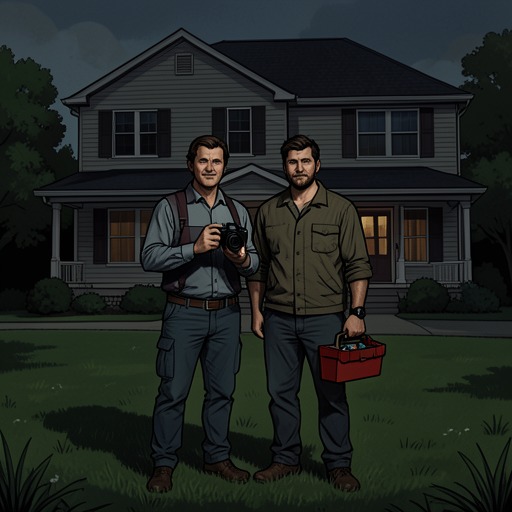
The Great Hall is first identified during Exploration #2, when Holloway Roberts, Jed Leeder, and Kirby “Wax” Hook move beyond the Anteroom. Navidson remains outside, listening to their progress over the radio. The explorers report a ceiling at least five hundred feet high and a span that may approach a mile. Those figures make the chamber effectively impossible to illuminate or survey as an ordinary interior, especially because they cannot be reconciled with the dimensions of the house above.
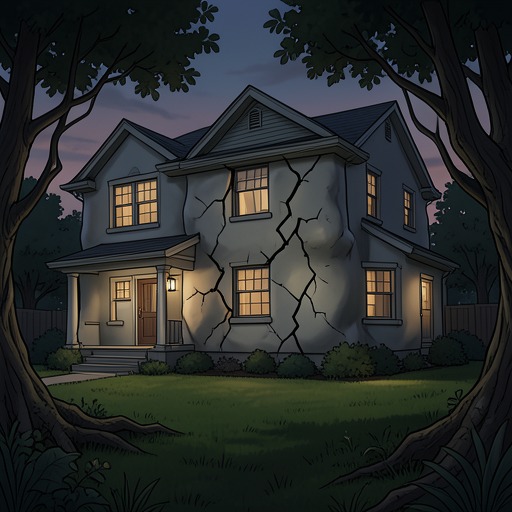
The Great Hall therefore extends the anomaly first detected when Will Navidson compares the house plans with his own measurements. The exterior distance between the far ends of the master and children’s bedrooms is 32 feet 9 3/4 inches, a measurement corroborated by the plans, yet the corresponding internal space is impossible once the rooms and walls are calculated together. The Great Hall gives that contradiction an immense physical form: the house’s interior no longer merely exceeds its exterior by inches, but opens into a chamber approaching a mile across.
Exploration and the Spiral Staircase
The explorers cross the Great Hall in darkness, marking their route with ample fishing line because their flares can illuminate only fragments of the surrounding walls. The chamber contains the Spiral Staircase, positioned at its center, with a diameter of more than two hundred feet and a descent that appears to spiral into nothing. Holloway radios this discovery while Navidson listens with increasing frustration. The report that the Great Hall is already enormous unsettles him; the staircase makes the space still more difficult to possess intellectually or physically.
Jed Leeder later describes the staircase as enormous and recalls that the team dropped several flares without hearing them reach the bottom. In a place otherwise so empty, cold, and still that a pin should be audible, the darkness simply swallows the lights. Kirby “Wax” Hook characterizes the depth as almost dreamlike. The description places the Great Hall at the boundary between measurable exploration and unreality: instruments and signals continue to operate, but the space refuses to return the evidence that would make its dimensions intelligible.
During a later descent, Will Navidson estimates that the Spiral Staircase extends thirteen miles downward. Yet Tom Navidson and Billy Reston hear him call out only a few minutes after he begins, and find him standing at a bottom no more than one hundred feet below them. The discrepancy turns vertical distance into the same unstable quantity as horizontal distance. Inside the Great Hall, time, depth, and location cannot be trusted to correspond with one another.
Scale, Orientation, and Physical Threat
The Great Hall is difficult to navigate because its size is joined to the house’s broader refusal of fixed direction. Karen Green discovers that even a compass cannot settle on a single direction inside the house. She replaces one compass with another, testing the second in a store before bringing it home, but the new instrument is equally useless. North, south, east, and west therefore cease to provide a reliable framework for locating the Great Hall or relating it to the rooms of the house.
The architecture also changes in ways that defeat stable mapping. The Great Hall, the Anteroom, the Infinite Corridor, and the Spiral Staircase exist for everyone who encounters them, yet their size and layout can shift. Other areas do not appear to reproduce the same pattern twice. The Great Hall is consequently both a recurring location and an unstable one: its identity persists, while its proportions and relation to adjoining spaces remain subject to alteration.
Its danger is not limited to the fear produced by darkness. The disorientation generated by the shifting dimensions has physiological effects, including nausea. During one escape, furniture slides across a floor and disappears over an edge, while Billy Reston nearly vanishes with it and survives only by catching a door lever. When Reston later calls for help, his hands damaged from the descent and his grip failing, Navidson must swing from the door and jump across a gap to reach him. The Great Hall converts ordinary objects, thresholds, and acts of movement into precarious instruments of survival.
A Labyrinth Without an Outside View
No one ever sees the entire labyrinth that includes the Great Hall. The distinction between those who participate inside and those who observe from outside therefore breaks down, because even the observers cannot assemble a complete view of the space. Understanding must be produced from within, through partial journeys, radio reports, photographs, measurements, and recollections that never resolve into a total plan.
This structure also governs the form of The Navidson Record itself. Like the Great Hall, the film moves from one fragment to another, promising discovery while repeatedly opening onto further ambiguity. Edits, changes of position, and incomplete images prevent the audience from standing at a secure exterior vantage point. The Great Hall is thus both a setting and a model for the work’s method: it captures the viewer even while allowing the viewer to wander.
The location’s relation to the rest of the house makes that method especially unsettling. A doorless hallway appears suddenly in the west wall when Chad Navidson and Daisy Navidson call from impossible distances, and Will Navidson enters to retrieve them while Karen freezes at the threshold. Later, when Karen returns to the house, the bookshelves are flush with the walls, the closet has disappeared, and the familiar doorway opens onto a shallow closet rather than the infernal corridor. The Great Hall belongs to an architecture in which rooms can be present, absent, or replaced without warning.
Symbolic and Narrative Significance
The Great Hall gives architectural form to the fear of a world that cannot be measured from the outside. It is grand in the strongest sense: its scale produces dread because it exceeds human control, yet its vastness also carries an austere visual and imaginative attraction. Flares licking an ashen wall, Tom Navidson surrounded by failing lights, and the Spiral Staircase descending beyond audible reach make the chamber an image of terror and sublimity at once.
Its darkness also links the house to older images of irreversible descent. The later evocation of Irkalla describes a house from which no entrant returns, a road with no coming back, where people sit in darkness, eat dust and clay, and see no light. The Great Hall does not simply reproduce that underworld image, but it supplies the spatial condition that makes such an association possible: an interior larger than the world that contains it, organized around a descent whose endpoint cannot be heard, seen, or confidently located.
At the same time, the Great Hall exposes the limits of interpretation. Measurements reveal contradictions without explaining them; compasses fail to restore orientation; film records surfaces without producing a complete view; and exploration generates testimony that conflicts with ordinary distance and time. The chamber’s decisive significance lies in this refusal of mastery. It is the point at which the house becomes a labyrinth, the labyrinth becomes a crisis of perception, and the domestic interior becomes an abyss that can be entered but never wholly comprehended.