The Growl
House of LeavesThe Growl is the signature sound of the Navidson house’s unstable interior: a distant, low rumble that may signal a moving creature, a rearranging structure, or the limits of human interpretation. Its decisive significance lies in its refusal to settle into any single explanation. Heard by Will Navidson, Holloway Roberts, Jed Leeder, and Kirby “Wax” Hook, it repeatedly converts an architectural anomaly into an encounter with something that seems to possess location, intention, and patience, even when the evidence never establishes that such an entity exists.
First Appearances and Acoustic Uncertainty
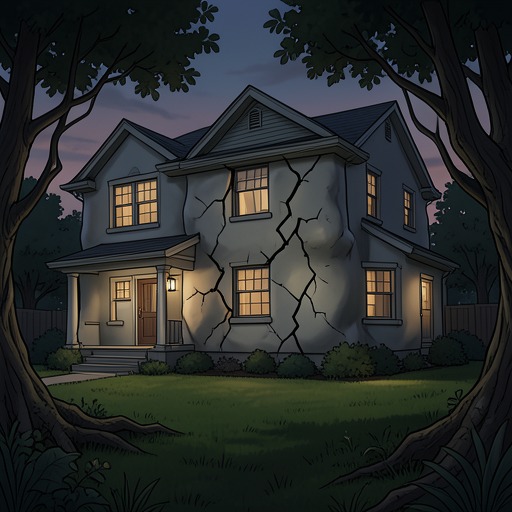
The sound emerges within a house whose dimensions already contradict its plans. After measuring the building with a 25’ Stanley Power Lock, Will Navidson finds that the internal measurements produce an impossible result. The contradiction prepares the ground for The Growl: the house cannot be understood as a stable container, and its sounds cannot be assigned confidently to stable distances or rooms.
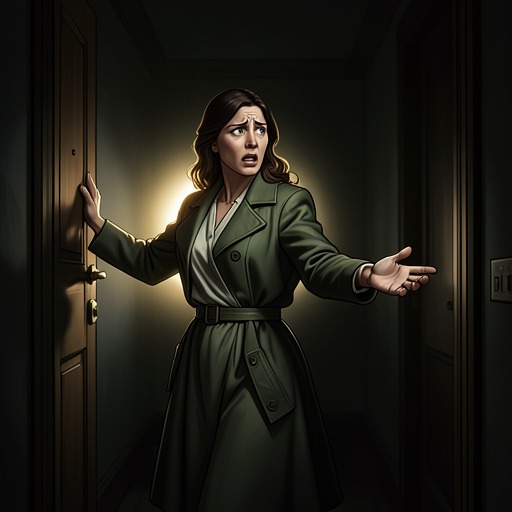
During Will Navidson’s first nocturnal entry into the new passage, the architecture expands as he moves. A hallway that appears to end opens onto another corridor, then onto a space so large that his flashlight cannot reveal its limit. When a faint growl returns, it is not simply heard; it reorganizes his behavior. He turns back, retraces his route, and discovers that the penny he left as a marker has moved from a distant point to the threshold before him. The doorway itself has changed into the arch he had been seeking. The sound therefore accompanies a collapse of ordinary orientation, making it impossible to decide whether the danger lies in a creature, in the corridors, or in the failure of spatial measurement itself.
The same uncertainty governs the children’s earlier encounter with the house’s impossible acoustics. Chad Navidson and Daisy Navidson call from a space that should not exist, and their voices return as separate answers, even though no room in the house should permit echoes of such length. The dark hallway appearing in the living-room wall is first registered through sound before it is fully confronted visually. The Growl belongs to this same acoustic regime: it makes absence active, turning what cannot be seen into something that appears to approach.
Recurrence in the Explorations
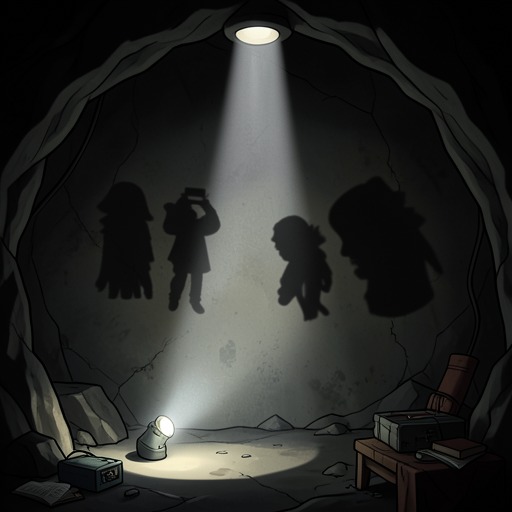
Holloway Roberts, Jed Leeder, and Kirby “Wax” Hook hear The Growl during their first exploration of the enormous void. Their stronger flashlights reveal a ceiling at least two hundred feet high and an opposing wall at least fifteen hundred feet away, but the dimensions do not make the place more legible. When Holloway runs out of fishing line and hears the sound Will Navidson has warned them about, he chooses to retreat rather than continue without a clearer plan. On the way back, the men witness the walls shifting, although the changes do not sever their line, and the markers help them return to the living room.
The second exploration tests whether repeated use can tame the phenomenon. Holloway brings four spools of fishing line, flares, and neon markers; Kirby “Wax” Hook operates a 35mm camera, while Jed Leeder collects samples from the walls. The expedition lasts more than eight hours, yet The Growl is heard only once, and the resulting alterations are comparatively slight. The first hallway seems narrower, the ceiling somewhat lower, and certain rooms appear larger, but the route largely remains intact. This recurrence suggests a disturbing conditional rule: continued passage may deter the sound or preserve the path, without explaining what causes either effect.
The house also defeats ordinary instruments for determining position. Karen Green consults a Feng Shui expert, buys a compass, replaces it when it fails to settle, and discovers that the second compass is equally useless inside the house. The Growl consequently operates within a wider breakdown of orientation. It is not merely a noise heard in a confusing building; it is one of the signs that direction, distance, enclosure, and access no longer possess dependable meanings.
Holloway Roberts and the Turn Toward the Beast
Holloway Roberts gives the sound its most forceful interpretation. In a recorded message, he identifies himself as a bearded, broad-shouldered man from Menomonie, Wisconsin, with a bachelor’s degree from the University of Massachusetts, then reports that something is following and stalking him. He insists that it has been waiting for something and emphasizes that he is not alone. His account joins The Growl to a persecutory presence before the narrative can establish whether the speaker is describing an actual creature or translating disorientation into the language of pursuit.
After the explorers find torn markers and missing water, Holloway treats The Growl as an utterance from a definite being rather than as a quality of the space. He loads a Weatherby 300 magnum with five 180 grain Nosler Partition rounds and chambers a sixth round, visibly energized by the prospect of having something concrete to hunt. He then follows doorways and corners with the rifle aimed ahead, while Jed’s flashlight reveals only more ashen walls and more corners. The sound appears to move across the distance like a line where rooms and passages might finally give way to a horizon, yet Holloway cannot get closer to its source.
Jed Leeder and Kirby “Wax” Hook recognize the contradiction. Although the three men travel farther from the staircase, they do not approach The Growl. They urge Holloway to turn back, but he first delays them and then insults them as cowards and worse. The argument demonstrates how the sound converts an expedition into a test of masculine courage: Holloway’s need to identify and pursue an enemy conflicts with his companions’ practical reading of the space. The less locatable the sound becomes, the more passionately Holloway insists that it must belong to something huntable.
Sound, Creature, and Possible Physics
Will Navidson later describes The Growl as beginning like the rustle of wind in trees high on a mountain. It starts in the distance as a gentle rumble, grows louder as it descends, surrounds the listeners, sweeps over them, and then recedes until it seems a mile or two away. This account gives the sound a directional arc without giving it a stable source. It behaves like movement, but its apparent movement may be produced by the architecture’s changing arrangement rather than by an organism crossing the space.
The accompanying commentary interprets the sound through the image of architecture as frozen music. If the house’s form can become unfrozen, The Growl becomes the audible release of a structure no longer fixed in place. In that reading, the rumble is both beautiful and terrifying: an immense harmony of time and change that human beings experience as the threatening sound of walls shifting around them. The sound’s aesthetic force depends on this doubleness. It is not only an alarm but also the sign that the building has acquired a dynamic life beyond ordinary construction.
After The Growl is recorded inside the room where Holloway Roberts dies, the ambiguity becomes more severe. The tape loses sight of the action as blackness consumes the illuminated wall, yet the sound remains. The account asks whether an actual creature made it or whether it was produced by another reconfiguration of the space, comparable to a natural process whose force is undeniable but whose mechanism remains obscure. Neither possibility is confirmed. The recording preserves the acoustic event while withholding the visual evidence needed to identify its source.
Silence and the Meaning of the Sound
At the end of Will Navidson’s descent, silence becomes as important as The Growl’s earlier eruptions. The sound no longer disturbs his position as he falls through the darkness. Deprived of any reliable sensation except his own consciousness, he says that he knows he is falling and expects to strike a bottom, then recognizes that he may be dead before he can know whether impact occurs. He concludes that there may be no bottom, only his end. Against this silence, The Growl appears less like a conventional monster’s voice than like an intermittent boundary marker for human fear: when it sounds, the unknown seems to have agency; when it disappears, the unknown becomes absolute.
The film’s form reproduces this uncertainty. Its viewers never see the labyrinth in its entirety, just as no participant can grasp the house from outside. Understanding must be derived from within, from fragments of footage, measurements, markers, echoes, and recollections. The Growl is the most persistent of these fragments because it seems to promise a center—a source that could be pursued and confronted—while repeatedly defeating every attempt to locate it.
The sound therefore sustains the house’s central tension between explanation and dread. It may be an animal, a manifestation of impossible physics, or the acoustic effect of architecture continually remaking itself. Its narrative function does not depend on resolving that choice. By making the unseen audible, The Growl gives form to an otherwise formless threat; by refusing to reveal whether that form is real, it keeps the house suspended between haunted structure and unknowable world.