The Quarter-Inch Anomaly in the Navidson House
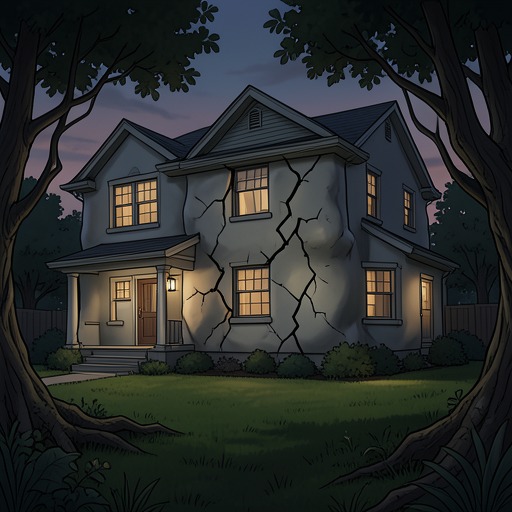
House of LeavesThe Quarter-Inch Anomaly in the Navidson House is the decisive threshold at which the house’s uncanny alterations become measurable. A strange interior addition first appears as a small black closet, but Will Navidson’s successive measurements establish that the structure contains one quarter-inch more space inside than exists along its exterior width. The discrepancy cannot be dismissed as a visual effect or a mistake in the plans: it survives drilling, fishing line, repeated calculations, and six separate attempts to eliminate it. The anomaly therefore converts an impossible architectural impression into a physical fact that the mind and body cannot comfortably accept.
Discovery of the Impossible Room
The event begins upstairs in the master bedroom, where Will and Karen Green find a plain white door with a glass knob. It opens not into the children’s room, as the arrangement of the house would suggest, but into a cramped space resembling a walk-in closet. The room is no more than five feet wide and at most four feet long. Unlike an ordinary closet, it contains no outlets, sockets, switches, shelves, hanging rod, or decorative molding. Its walls are smooth and almost pure black, softened only by a slight grey quality in the surface; an identical second door opens from the opposite end into the children’s bedroom.
The apparent addition immediately destabilizes the family’s confidence in its own memory. Will asks whether they somehow overlooked the room, an explanation that sounds absurd but becomes psychologically plausible when confronted with such an implausible reality. Karen searches out photographs that clearly show a bedroom wall without a door, establishing that the passage was not merely ignored during an earlier inspection. The possibility that an intruder could have entered the house and built the addition in four days is even less credible. Alicia Rosenbaum, the real estate agent who sold the house, can offer no explanation when Karen asks who might be responsible; the police inspect the closet, file a report, and can do little more than joke about a “crazy carpenter.”
Measurement and Verification
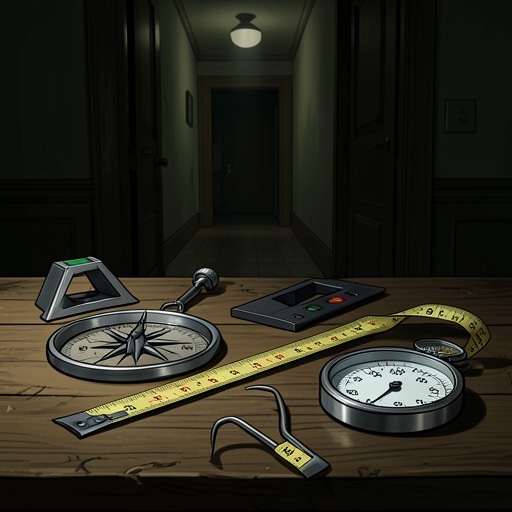
With ordinary explanations exhausted, Will returns to the building plans and takes out a 25’ Stanley Power Lock. He compares the dimensions printed on the cold blue pages with measurements taken directly from the house, moving repeatedly between the plan and the building while hoping that the result is only bad mathematics. From outside, he climbs a ladder to the second story and uses a 100’ Empire fiberglass tape with a hand crank to measure from the far end of the master bedroom to the far end of the children’s bedroom. That exterior distance totals 32’ 9 3/4”, a figure corroborated by the plans within an inch.
The interior measurement produces the impossibility. Will adds the length of the new space to the lengths of both bedrooms and accounts for the width of the walls. The total is 32’ 10” exactly. The interior width of the house thus exceeds the width measured from outside by 1/4”. The result is not a rough estimate or a suggestive visual impression; the additional space is precisely one quarter-inch.
Will assumes that he has miscalculated and drills through the outer walls to determine their width directly. With Karen’s help, he fastens fishing line to the edge of one exterior wall, runs it through a drilled opening, stretches it across the master bedroom, the new space, and the children’s bedroom, and passes it through a second hole in the opposite wall. He checks that the line is straight, level, and taut before marking it. The interior span remains 32’ 10” exactly. When he takes the same line outside and stretches it from one side of the house to the other, it is a quarter-inch too long. The discrepancy has survived every attempt to locate it in faulty plans, inaccurate tools, crooked walls, or careless procedure.
Domestic Consequences
The anomaly is intellectually legible only at a distance. A person can study an impossible diagram, puzzle over an Escher print, and close the book. The house removes that protective distance by placing the contradiction inside an inhabited domestic structure. Its impossible geometry is not a decorative conceit but a condition through which Will and Karen must continue to sleep, eat, raise their children, and move from room to room.
Karen refuses the knowledge rather than accepting its implications. She tells Will, “I don’t care,” and orders him to stop drilling holes in her walls. Her refusal contrasts with Will’s increasingly compulsive investigation: he repeats the measurement six consecutive times in six consecutive segments, yet cannot destroy or explain the tiny surviving sliver of space. The division between them becomes visible in their behavior. Karen grows quieter, Will’s mood darkens, and Chad Navidson and Daisy Navidson respond to the altered emotional atmosphere by hiding elsewhere in the house. The quarter-inch is physically minute but socially expansive, entering the family’s routines and changing the emotional weather of the home.
The consequences do not arrive as an instantaneous cinematic shock. The narrative emphasizes reality’s slower insistence: like a poison whose effects take years to emerge, the impossible can remain present while ordinary life continues around it. The next morning still contains orange juice, The New York Times, NPR, a dispute over sugared cereal, the dishwasher, the toaster, and Will’s coffee. Yet even the coffee becomes a miniature image of the house’s altered physics: the liquid rises above the rim in a bulging arc that refuses to spill before finally sliding over the edge and staining the newspaper. The domestic scene preserves its familiar objects while making their behavior newly unstable.
Expansion into Spatial Disorder
The quarter-inch discrepancy is the first precise sign of a larger spatial system. Later, Chad and Daisy Navidson’s cries echo through distances that cannot exist within the known dimensions of the house. Their voices answer one another across a dark, doorless hallway that has appeared in the west wall, and Will enters after them while Karen freezes at the threshold. The children’s calls reveal that the house can exceed not only its measured width but also the ordinary limits of acoustic distance and access.
The house subsequently defies ordinary orientation. Karen consults a Feng Shui master, obtains a compass, replaces it after concluding that it is defective, and discovers that the second compass also refuses to settle on any direction inside the house. The problem is therefore not simply inaccurate measurement; the structure resists stable systems of direction, reference, and navigation. Its recurring spaces include the Infinite Corridor, the Anteroom, the Great Hall, and the Spiral Staircase, although their sizes and layouts can change. Other areas fail even to repeat a consistent pattern.
The event’s spatial logic becomes more extreme during later explorations. Billy Reston’s ascent through the stair shaft accelerates even after Will releases the rope, while a dropped quarter appears after at least fifty minutes of falling, suggesting an impossible depth. During Exploration #5, Will reaches a small structure at the edge of an abyss, where a staircase lies horizontally through a wall; after he sleeps, the exit disappears and the staircase shifts above him. Later, a window and its room vanish, leaving Will on an ash-black slab surrounded by darkness. These episodes do not explain the original quarter-inch; they enlarge it into a recurring challenge to scale, direction, continuity, and dimensional stability.
Narrative and Thematic Significance
The anomaly changes the status of the house from unsettling home to active epistemological problem. Its rooms exist for everyone, yet their size and arrangement may change, while no observer ever sees the labyrinth in its entirety. Understanding must therefore be derived from within the system that defeats comprehension. The same structure governs the presentation of The Navidson Record, whose cuts, sequences, and digressions lead viewers through a maze that promises a center while repeatedly replacing one possible solution with another.
The quarter-inch also exposes the limits of measurement as a guarantee of truth. Will uses plans, tape measures, drilled walls, fishing line, and repeated checks, and every method confirms the same contradiction. Karen’s resistance does not refute the result; it demonstrates the emotional cost of accepting it. The anomaly is both a number and an invasion: too small to see directly, too exact to dismiss, and large enough to destroy the assumption that a home is bounded, protective, and familiar.
Its importance lies in this disproportion. A quarter-inch is almost nothing in ordinary construction, yet here it marks the difference between an explainable house and an impossible one. Once that sliver of excess survives verification, the family’s interior world can no longer be secured by exterior walls, architectural plans, magnetic directions, or the reassuring continuity of everyday routines. The anomaly is the house’s first incontrovertible declaration that its inside and outside do not belong to the same geometry.