The Spiral Staircase
House of LeavesThe Spiral Staircase is one of the defining structures within the impossible interior of the Navidson house. First encountered as a staircase descending from the center of a vast space, it repeatedly converts apparently measurable architecture into an unstable experience: its diameter expands, its depth becomes incalculable, and its relation to time and distance breaks down. For the explorers, it is both a route farther into the house and a threshold beyond ordinary spatial knowledge.
Discovery and Physical Form
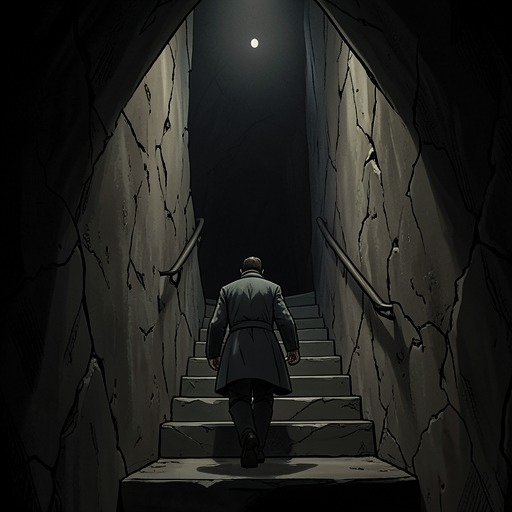
The staircase is found in the center of an immense chamber whose ceiling rises at least five hundred feet and whose span may approach a mile. Holloway reports that the stairway is more than two hundred feet in diameter and spirals downward into nothing. The image is architectural but also abyssal: the staircase possesses a recognizable form while denying the ordinary function of a staircase, since its apparent destination remains invisible and its descent cannot be completed by sight.
The structure is not simply large; it is mutable. During Exploration #3, Jed observes that its diameter has increased from roughly two hundred feet to well over five hundred feet. The staircase therefore cannot be treated as a fixed object on a stable plan. It belongs to the larger spatial system in which the Infinite Corridor, the Anteroom, and the Great Hall exist for everyone, while their dimensions and even their layouts may change. Other regions of the house appear never to reproduce the same arrangement twice, making the staircase a persistent form within an unstable architecture.
Exploration and the Collapse of Distance
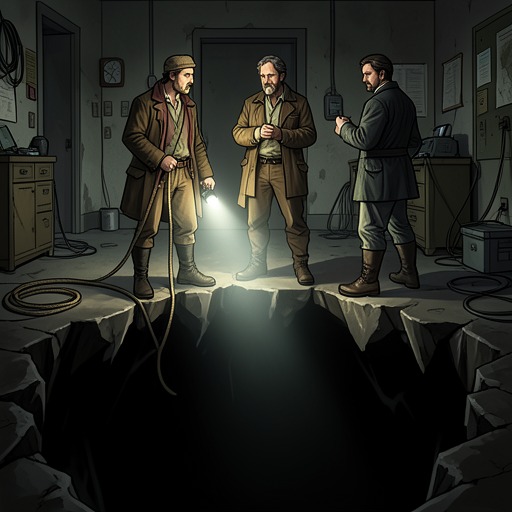
Exploration #3 establishes the staircase as a test of endurance rather than a conventional survey. Holloway, Jed, and Kirby “Wax” Hook take forty-five minutes merely to reach it, then spend seven hours walking downward. When they finally stop, a dropped flare neither illuminates nor audibly reaches a bottom. Their return requires more than eleven additional hours, making the expedition nearly twenty hours long in total.
The experience reverses the expectations created by measurement. A staircase should make vertical distance legible through steps, landings, and a visible relation between upper and lower levels. Here, the descent produces only duration, fatigue, and the recurring evidence of an unreachable depth. Jed returns with vertigo after having to retreat from the edge and sit down. Wax claims not to have felt fear, yet comes back more exhausted than the others. Holloway is more restrained, but concludes that the experience cannot be captured by either a Hi 8 camera or a 35mm camera: the place exceeds the representational tools brought to it.
The Staircase as a Threshold
The Spiral Staircase separates the domestic world from an interior that no longer obeys domestic categories. The house has already violated ordinary geometry when children’s voices echo through distances far beyond the known dimensions of its rooms. It then becomes a passage into a space where direction, scale, and orientation lose their reliability. Karen’s compass cannot settle on a direction inside the house, while the staircase offers movement without dependable arrival.
Its threshold quality is also visible in the different positions taken by those who approach it. During a later descent, Navidson estimates that the stairway extends thirteen miles downward. Yet within less than five minutes, Tom Navidson and Billy Reston hear him shout and discover him standing at the bottom, no more than one hundred feet below. Navidson suspects that they have reached the wrong staircase, but neon trail markers reveal remnants of Holloway’s earlier route. The scene makes the staircase’s central paradox concrete: a distance imagined as thirteen miles collapses into one hundred feet, while the markers preserve a continuity that the space itself seems to deny.
Descent, Rescue, and Reversal
The staircase becomes the route through which Navidson chooses action over caution. When he has already begun descending, Reston protests that he should not be allowed to continue alone and follows him, despite his disability and his joking complaint that the house has no handicap ramps. Tom remains above at first, but the apparent shortness of the later descent destabilizes the assumptions established by Holloway’s expedition. Reston reaches the last step less than twenty minutes after beginning his own descent, suggesting that the staircase’s distances do not merely challenge the explorers’ stamina; they change according to circumstances that remain unavailable to them.
At another point, the staircase turns against the logic of ascent and rescue. As it grows darker, the faintly lit circle above becomes smaller and smaller. The explanation for Reston’s movement upward is then reversed: Navidson is no longer holding the rope, and yet something is pulling Reston toward the top. The visible geometry of the stairway cannot settle whether Navidson is sinking or whether the staircase is rising. The passage thus converts a rescue into a spatial enigma, making even the direction of motion uncertain.
Representation and Narrative Significance
The Spiral Staircase is inseparable from the documentary’s struggle to represent the house. Navidson’s own camera is usually remarkably steady, with precise framing and a refined visual sensibility; compared with Holloway Roberts’ unstable footage and the less practiced tapes made by Karen Green and Tom Navidson, his images appear capable of shaping terrifying material into coherent form. Yet Holloway’s claim that the staircase cannot be photographed introduces a limit that Navidson’s technical mastery cannot overcome.
That limit governs the staircase’s place in the film’s structure. No participant sees the labyrinth in its entirety, so knowledge of it must always be derived from within. The film reproduces this condition by presenting partial views, radio transmissions, discontinuous footage, measurements, markers, and exhausted testimony rather than a complete map. The staircase is therefore not only a location inside the house but also a model of the documentary itself: both invite investigation while withholding a stable center.
Its ultimate significance lies in the pressure it places on human categories. Measurement promises control, recording promises evidence, and a staircase promises a legible relation between levels. The Spiral Staircase frustrates all three promises. Its expanding diameter, immeasurable depth, contradictory distances, and uncertain direction turn architecture into an encounter with the unknowable, while its effects on vertigo, exhaustion, and fear show that the house’s spatial impossibility is experienced physically as well as intellectually.