Virginia
House of LeavesVirginia serves as both the immediate landscape of the Navidson family’s home and a historical depth behind the events recorded in The Navidson Record. It first appears as a place of rural quiet, associated with sunlight, gardens, family life, and the hope of settling down; it later becomes the setting against which an impossible house, memories of war, and the ethics of looking at suffering acquire their force.
Rural Setting and Domestic Promise
Virginia is introduced through the countryside surrounding the Navidson house. Will Navidson’s documentary presents pristine views of the rural landscape, including purple hills at the edge of night, before turning to the practical work of inhabiting the house. The family unrolls pale blue oriental rugs, arranges furniture, unpacks crates, replaces light bulbs, and hangs pictures, including one of Navidson’s prizewinning photographs. The setting therefore begins as an experiment in ordinary domestic life: a small, old-style heritage house becomes a possible refuge where the family can establish routines and personal attachments.
Navidson explicitly imagines the Virginia house as a quiet outpost rather than a theater of catastrophe. He describes wanting to document how he and Karen Green move into the country with their children and learn to inhabit the place, with gardening, toothpaste, lemonade on the porch, and sunsets replacing gunfire, famine, and flies. The filmed image initially supports that intention. Navidson appears relaxed and sincere as he drinks lemonade on the porch and watches the morning light turn the first minutes of the day golden. Virginia thus embodies the domestic ideal before the house’s spatial violation makes that ideal unstable.
The House and the Return of the Uncanny
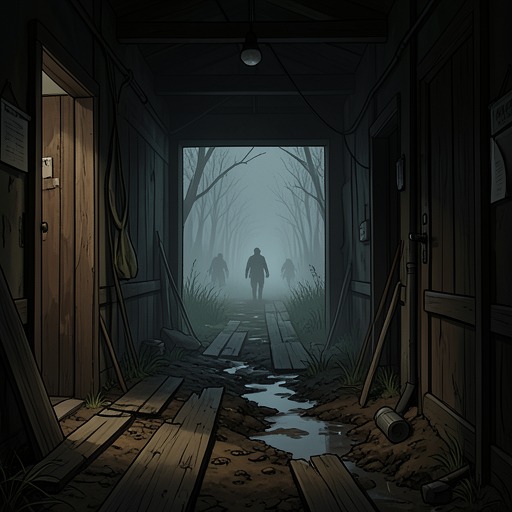
The apparent stability of the Virginia setting is broken when the Navidson family returns from Seattle after being away for four days. Something in the house has changed, although there is no fire, robbery, or ordinary vandalism. The intrusion is spatial and difficult to identify. Will Navidson reacts with something close to amusement, Karen Green covers her face as if preparing to pray, and Chad Navidson and Daisy Navidson run through the altered space while playing and laughing, unaware of its deeper implications.
Virginia’s ordinary domestic scenery makes the alteration more disturbing. The horror does not arrive in an obviously ruined or remote environment; it appears inside a home that had been carefully furnished and made familiar. The contrast between the settled countryside and the impossible interior gives the location its uncanny force: the supposedly secure landscape contains a house whose dimensions can no longer be reconciled with the world outside it.
Investigation and Documentary Geography
Virginia also functions as a practical base for attempts to understand the anomaly. After a day and a half of failed measurements, Will Navidson and Tom Navidson seek outside help. Tom contacts Lowell and postpones his construction obligations, while Navidson calls an old friend who teaches engineering at the University of Virginia. Early the following morning, the two brothers leave for Charlottesville. Their departure turns the local setting into a point of connection between domestic mystery and institutional expertise, even though the available explanations cannot resolve the contradiction between the house’s exterior and interior measurements.
The location is further defined through the technologies brought into the living room to study it. Billy Reston appears among an extensive array of equipment, including monitors, video decks, a VHS machine, computers, Zip drives, a color printer, radio transmitters and receivers, electrical and video cable, film cameras, flashlights, flares, rope, fishing line, batteries, tools, compasses, and a broken megaphone. Shelves hold sample jars, graphs, books, and an old microscope. Virginia’s house consequently becomes a laboratory assembled inside a family residence, where local space is examined through increasingly elaborate recording systems.
The documentary’s media history reinforces this transformation. The first circulating account of the house, The Five and a Half Minute Hallway, passes privately through deteriorating VHS copies rather than festivals or commercial distribution. Later, Exploration #4 suggests that the hallway footage belongs to a larger and discontinuous record. The Virginia house is therefore encountered not as a stable location directly available to the audience, but through copied, edited, technically imperfect evidence. Navidson’s own camera remains unusually steady and aesthetically controlled, in contrast with Holloway Roberts’ nearly unwatchable footage and the less experienced recordings made by Karen and Tom.
Colonial Memory Beneath the Landscape
The Virginia setting also carries a colonial history that the documentary does not fully investigate. When Karen’s friend Audrie McCullogh discusses local hauntings, she identifies Jamestown Colony as the only especially distinguished element in the area’s past. The film does not pause over that history because Karen is more concerned with the house and Navidson’s whereabouts, yet the reference places the residence within a landscape marked by older forms of violence, deprivation, and disappearance.
The history of Jamestown Colony begins with the London Company depositing 105 colonists on a marshy peninsula on May 2, 1607. Pestilence, starvation, and repeated massacres threatened the settlement; the winter of 1609–1610 nearly destroyed it before supplies arrived. The colony later survived through John Rolfe’s tobacco industry, the marriage of Pocahontas, and its period as Virginia’s capital, but Nathaniel Bacon’s conflict with Sir William Berkeley left the village in flames. After the capital moved to Williamsburg, the settlement decayed, and by the time excavations began in 1934, the marsh had obscured or consumed much of what remained.
This buried history does not provide a direct explanation for the house’s impossible architecture. Its importance is structural rather than causal. The present-day Virginia home appears new enough to invite domestic optimism, but the land around it is also a place where settlements have endured catastrophe, been abandoned, and been partly erased. The colonial past makes the landscape feel less like empty countryside than a surface layered over previous failures of habitation.
Virginia, Photography, and the Ethics of Seeing
Virginia is also the point from which Navidson’s personal and professional history is assembled. Karen Green’s account moves through his childhood, his grandmother’s funeral, college graduation, and Tom’s departure for Vietnam before opening into the larger history preserved in his photographs. Family portraits give way to images of tank drivers in Cambodia, peasants carrying empty canisters of nerve gas, children selling soda near body bags, crowds in Thailand, a murdered man in Israel, and the dead in Angola.
Navidson’s photographs consistently place people at the center. Among the thousands of images he took, there is no frame without a person; he does not photograph scenery for its own sake. Soldiers, lepers, medics, newlyweds in Rome, and a family of tailors swimming near Rio matter to him because the world matters through the people living in it. Virginia’s quiet landscape therefore stands in sharp contrast to the human disasters that shaped his visual practice, and the house eventually forces him to confront a subject that cannot be mediated by placing another person between himself and danger.
The Delial photograph concentrates this ethical problem. Delial is shown near the center of the frame while a vulture waits behind her to the left, slightly out of focus, and the right side of the image remains physically empty. Critics argue that the empty space is not truly empty because it represents Navidson’s presence and influence; the composition makes the viewer a participant rather than a detached spectator. The image’s power comes not only from illness, hunger, and approaching death, but from the arrangement that implicates the person looking.
Navidson later recognizes that returning to Ash Tree Lane means removing the human intermediary that had always stood between him and mortality. He had never photographed scenery, and he had never photographed the threat of death without placing someone else between himself and it. The Virginia house changes that practice: its unpopulated darkness threatens no one else’s existence but his own. In this sense, the local setting becomes the place where a photographer accustomed to witnessing other people’s suffering is compelled to make himself the subject at risk.
The Documentary’s Final Virginia Darkness
The final stages of Navidson’s record sever Virginia’s domestic brightness from any dependable visual horizon. After his fall, the film offers a still image of a window, flares dropping and hovering in the void, and images of Navidson reading and burning a book. Much of the sequence consists of audio recordings made as he begins to die from exposure, while nearly six minutes of screen time remains black. The darkness is not simply an absence of scenery; it is the documentary’s final refusal to provide a visible geography that could restore the house to ordinary Virginia space.
Navidson’s recorded condition is reduced to immediate physical facts: he has no food or water, his film remains but the flash is dead, he is cold, and his feet hurt. He then reports that the slab beneath him has disappeared and that he is floating or falling without knowing which. Sound becomes more reliable than image, especially after technical specialists clean up the tapes. His voice seems unnervingly close even when the screen shows nothing, while silence predominates whenever he does not speak.
Virginia consequently ends as a location that cannot be separated from the problem of representation. It begins as a pastoral setting for family life, contains a house that violates measurable space, evokes a colonial history of settlement and erasure, and culminates in a record whose image-track becomes almost entirely black. The location’s decisive significance lies in that progression: what appears to be a stable home landscape becomes the threshold through which domestic memory, historical violence, photographic responsibility, and the limits of documentary evidence converge.