Will Navidson
House of LeavesWill Navidson is the central photographer, filmmaker, and investigator of The Navidson Record. His decisive significance lies in the collision between his professional mastery of witnessing and the house’s refusal to remain a stable object of knowledge: the man who has spent his life placing other people between himself and death eventually enters a space where his own existence is the only stake.
Identity and Initial Aim
Will Navidson is identified as a prize-winning photojournalist who won the Pulitzer for his photograph of a dying girl in Sudan. His public reputation initially makes the strange footage seem like an extension of documentary authority, yet the record’s early circulation leaves his identity uncertain. For two years, viewers know the tapes without knowing who made them; photographers in the news community eventually recognize Navidson, but the discovery produces speculation rather than confirmation because he offers no press statement, no corroborating account, and no public location for the house.
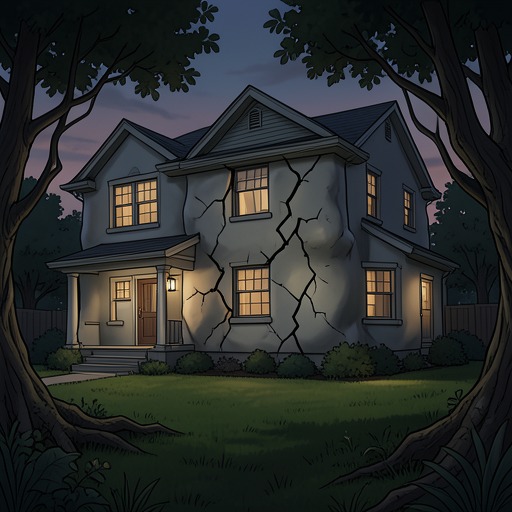
The project begins with an intentionally modest purpose. Navidson says that he wants to document how he and Karen Green buy a small country house, move in with their children, and begin to inhabit it. He contrasts this domestic subject with the gunfire, famine, and flies associated with his previous work, imagining instead toothpaste, gardening, lemonade on the porch, and the gradual process of putting down roots. The film initially follows that intention almost literally, presenting Navidson on the porch of a small, old-style heritage house as he watches the daylight turn golden.
This domestic ambition is important because it is not presented as a concealed plan for horror. Navidson appears lean, attractive, pleasant, and determined to explore a quieter life. His brother Tom Navidson describes the project’s family context indirectly through the long estrangement between the twins: Will is successful while Tom is not, and resentment has persisted since childhood, despite the brothers having once looked after each other. The ordinary home movie therefore carries both a stated wish for stability and an unstated history of family tension.
From Home Movie to Impossible House
The first known fragment is The Five and a Half Minute Hallway, a five-and-a-half-minute optical illusion that would scarcely exceed the abilities of a film-school graduate were it not accompanied by the claim that everything shown is true. In one continuous shot, Navidson circles a doorway in the living room by climbing out through an eastern window, moving across the exterior, and crawling back through a western window. The circuit appears to prove that the doorway can lead only to insulation or siding; the surrounding viewers laugh when Navidson bumps his head on a sill, although Karen Green, Tom Navidson, and Billy Reston remain off camera.
The apparent proof collapses when Navidson’s hand opens the door and reveals a narrow black hallway at least ten feet long. He repeats the circumambulation, pointing the camera toward the place where the passage should extend, but finds only the backyard, rose bushes, a muddy dart gun, and translucent summer air. Karen Green warns him not to enter, and Tom Navidson agrees that it is not a good idea. Navidson stops at the threshold, inserts his hand, withdraws it, and inspects it as though sight might reveal a sensation. His conclusion is matter-of-fact but foundational: the hallway is freezing.
The short spreads without official distribution. VHS copies pass from hand to hand, each dub deteriorating further, while the owners and author remain largely unknown. A second fragment, Exploration #4, appears less than a year later and is more urgently sought. Its eight minutes are discontinuous, jarring, and hurriedly edited, encouraging viewers to infer that the fragment belongs to a much larger work. In its opening, Navidson appears tired, depressed, and pale, speaks of wanting to burn the house down, and says that he cannot think clearly enough to do it.
The footage converts Navidson’s original domestic record into an unstable public mystery. Holloway Roberts identifies himself as lost, without food, low on water, and pursued by something that has stalked him for days without attacking. The fragment ends in deliberate incompleteness, and the eventual release of The Navidson Record reveals that the early shorts were only partial remains of a larger ordeal. Questions about how a person could be lost inside a house, whether the tapes were artifice or reality, and what Navidson was doing with such material persist because the film withholds the reassuring framework that ordinary documentary usually supplies.
The Photographer’s Method and Equipment
Navidson’s camera work distinguishes him sharply from the other participants. In footage he personally shoots, the camera rarely shakes, trembles, jerks, or suffers from poor framing. Even under terrifying conditions, his images remain steady and aesthetically controlled. Holloway Roberts’s tape, by contrast, is tilted, unfocused, poorly lit, and ultimately overwhelmed by danger; Karen Green’s and Tom Navidson’s footage is technically inexperienced and useful chiefly for its content. Navidson’s advantage is not merely courage but the ability to face an incomprehensible subject and shape it into an image.
His working environment expands into a makeshift technological command center. Billy Reston enters the living room past three monitors, two three-quarter-inch decks, a VHS machine, a Quadra Mae, two Zip drives, an Epson color printer, an old PC, at least six radio transmitters and receivers, heavy spools of electrical and video cable, a 16mm Arriflex, a 16mm Bolex, a Minolta Super 8, flashlights, flares, rope, fishing line ranging from braided Dacron to forty-pound multistrand steel, spare batteries, tools, compasses disturbed by the house’s strange polarities, and a broken megaphone. Shelves hold sample jars, graphs, books, and an old microscope. The accumulation suggests an investigator trying to answer an architectural impossibility through every available recording and measuring system.
The contrast between devices becomes part of Navidson’s epistemological problem. VHS degradation, multiple cameras, radio equipment, still photographs, and later audio recordings do not produce one coherent truth; they produce competing traces with different degrees of clarity, delay, and vulnerability. At the climax, the documentary cannot synthesize Navidson’s fall. It offers a still photograph of a window, flares dropping and hovering in the void, photographs of Navidson reading and burning a book, and audio impressions as exposure begins to kill him. Nearly six minutes of screen time remain black. The absence of image is not a failure that Navidson simply overcomes with technical skill; it is the point at which his methods confront a subject that cannot be made visible.
Even in darkness, his recorded voice remains unnervingly near. Audio specialists clean the tapes and monitor the transfers, and listeners can hear Navidson’s words taper without echo as though his dying were occurring too close for the screen to mediate. Silence predominates except when he speaks, and not even the growl interrupts that place. His craft thus reaches an inverse of photographic mastery: the final record is most intimate precisely where it can show almost nothing.
Relationships, Memory, and Ethical Conflict
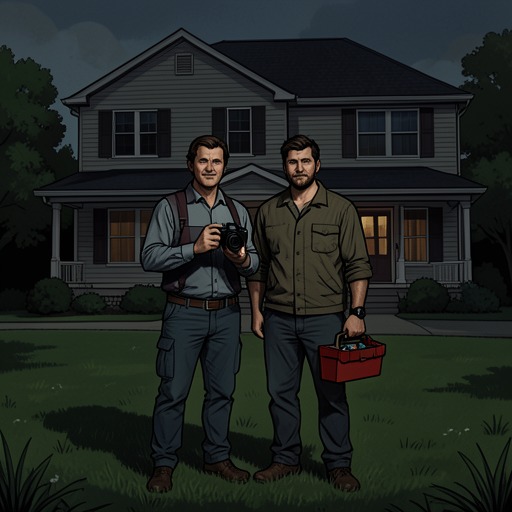
The family project places Navidson within a network of strained and sustaining relationships. Karen Green represents the domestic future he says he wants, while Daisy Navidson and Chad Navidson make the house a place of family continuity rather than merely an experimental site. Tom Navidson, his fraternal twin, returns after more than eight years of minimal communication when Will asks for tools. Tom is an affable, overweight giant whose humor wins the children immediately, but his arrival also reopens the resentment produced by the brothers’ unequal success. The home that Navidson hopes will become a cozy outpost therefore gathers both affection and unresolved history.
Karen Green later assembles a private history from Navidson’s photographs. The sequence moves from the sunlit backyard to a high-school prom, a grandmother’s funeral, Tom shielding his eyes at a barbecue, Navidson diving into a swimming hole, college graduation, and Will embracing Tom before his departure for Vietnam. Family portraits then give way to images of Cambodia, nerve-gas canisters, children near body bags, crowds in Thailand, a murdered man in Israel, and the dead in Angola. The private and geopolitical histories are not separate archives: the family images establish the person who enters the world of violence, while the war photographs reveal the burden he brings back into the home.
Navidson never photographs scenery. Across thousands of images, every frame contains a person, whether soldier, leper, medic, newlywed, or an isolated family swimming near Rio. People matter to him because the world matters through human presence, and his photographic practice repeatedly places a person between the camera and death. His attention to terrible circumstances is therefore also an attempt to oppose mortality by witnessing lives that remain capable of endurance or triumph.
The Delial photograph exposes the ethical cost of that practice. Navidson names the dying Sudanese girl in the image Delial and later confesses to Karen that he cannot stop thinking about the fame and gore attached to the photograph. He wonders why he kept her identity secret, describing that secrecy as a possible penance, while insisting that the photograph alone is not what now torments him. The confession makes clear that the image is both an act of attention and an object through which professional recognition, guilt, and memory have become inseparable.
The photograph’s composition places Delial near the center, bone in her fingers, insects at her lips, while a vulture waits on the left, slightly out of focus, preparing to fly. The empty right side is not truly empty: critics interpret it as the invisible position of Navidson himself, whose presence and influence confront the predator across the frame. The arrangement forces the viewer into participation rather than allowing an impartial, safely seated gaze. Navidson’s achievement is consequently inseparable from a troubling question about whether seeing suffering can resist death or instead make suffering available for aesthetic and public consumption.
Change, Descent, and Ending
Returning to the house removes the intermediary that had always structured Navidson’s photography. He had never photographed scenery, and he had never presented the threat of death without placing someone else between himself and it. The house is different: it has no population, no other participant whose existence can stand between the photographer and danger. Its dark architecture turns the professional observer into the exposed subject.
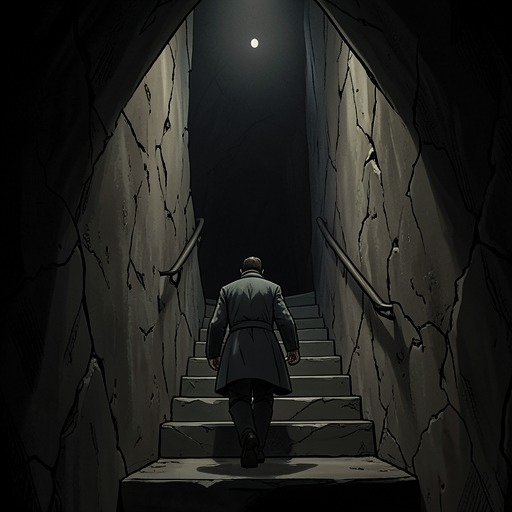
The change is visible in the movement from controlled curiosity to physical depletion. Navidson’s earlier project seeks to record people settling into a home; the later recordings document a man who has no food, no water, dead flash equipment, and painful feet. He reports that the slab beneath him has vanished and that he is floating, falling, or unable to determine which. The documentary gives no stable visual account of the descent, so his experience reaches the audience through fragments, uncertainty, and the long black interval that replaces conventional cinematic explanation.
Navidson’s ending does not restore the literal, reassuring world he originally hoped to preserve. He remains committed to taking the documentary literally and warns viewers not to stop or slow down if they ever pass the house. That insistence conflicts with the many intellectual interpretations that treat The Navidson Record as a warning, a theoretical object, or an allegory. Yet his warning is itself part of the record’s unresolved authority: it asks to be believed as fact while the film’s fragments, gaps, and mediated forms continually expose the difficulty of believing anything seen through it.
Narrative Role and Significance
Will Navidson embodies the tension between documentary evidence and the limits of representation. His identity as a celebrated photojournalist establishes an unusually high standard of visual competence, but that competence cannot master the house. The steadiness of his hand makes the eventual darkness more consequential, because the disappearance of the image occurs not through carelessness but at the edge of his greatest powers.
His trajectory also joins domestic longing to historical violence. The wish for lemonade, gardening, and family roots does not erase the wars, famine, and deaths that shaped his vision; it brings them into a house that initially seems to promise refuge. The impossible hallway then literalizes the instability beneath that promise. Home becomes a subject to be recorded, a structure to be measured, a memory to be repaired, and finally a darkness that records the observer in return.
Navidson’s significance is therefore not reducible to either heroic exploration or fraudulent performance. The record preserves his stated intention, his technical discipline, his family attachments, his professional history, his guilt over Delial, and his final inability to make the abyss visible. He begins by wanting to understand how people inhabit a place and ends by becoming the person whose own exposure defines the place’s meaning. The camera does not simply document his descent; its success, failure, and silence make that descent legible as the crisis of witnessing itself.