Will Navidson–Ash Tree Lane house relationship
House of LeavesThe Will Navidson–Ash Tree Lane house relationship is the central antagonism between Will Navidson’s desire to secure a home and the house’s refusal to remain a stable, knowable object. What begins as an attempt to establish a protected family space becomes a contest over possession, perception, and survival: Navidson tries to photograph, measure, and master the house, while the house expands into darkness, reorganizes itself around whoever enters, and ultimately forces him to confront the limits of representation and his own attraction to annihilation.
The House as an Intended Outpost
Will Navidson presents the Virginia house as a modest refuge from transience. Sitting on the porch with a glass of lemonade, he explains that he wants to watch people move into a place, settle in, put down roots, interact, and understand one another; personally, he wants to create a “cozy little outpost” for himself and his family. The word is more revealing than the rest of his laconic statement. An outpost is a protected base positioned against hostile forces outside it, an unexpectedly militarized description of a small countryside home. Navidson’s professional identity makes that aspiration inseparable from photography. Images can give fleeting moments an appearance of permanence, but the house exposes the insufficiency of that strategy. His attempt to make a domestic world durable therefore carries an implicit fear: abandoning photography would mean submitting to loss. The house is meant to become a fixed point against the instability of the world, yet it is precisely the supposedly fixed home that refuses to hold its shape.
Expansion and the Failure of Mastery
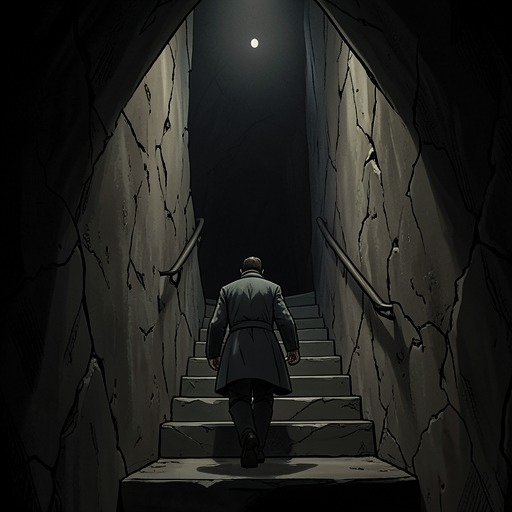
The relationship changes when the interior exceeds ordinary architecture. As Navidson advances through a passage, the flashlight and camera move past small rooms, alcoves, and closet-like spaces without finding a terminating point. Perspective promises a punctuation mark, but the corridor continues to generate more corners and walls. At last he reaches an entrance larger than the others, opening into blackness where the light finds a floor but no walls and, for the first time, no ceiling. Only then does the scale of the house become apparent. Navidson’s camera remains remarkably steady even under these conditions. Compared with Holloway Roberts’s unstable, poorly lit footage and the inexperienced recordings made by Karen Green and Tom Navidson, his images possess both technical control and a refined aesthetic intelligence. His advantage is not merely courage in the face of danger; it is the capacity to face the subject and shape it into an image. Yet that strength also sharpens the conflict. The house is not simply difficult to record. It is a subject that continually exceeds the framing intended to contain it.
Perception, Interior Knowledge, and Possession
The house cannot be understood from an external survey because no one sees its labyrinth in its entirety. Knowledge of its intricacies must be derived from within, making participation and observation inseparable. The same structure governs The Navidson Record: viewers move from one fragment of footage to another, expecting an edit to reveal a center or a complete explanation, only to encounter another sequence and another direction. The film, like the house, permits wandering while also capturing those who wander. This instability challenges the ordinary idea that architecture exists independently of the person who perceives it. The house seems to blur the distinction between an objectively existing space and a space produced, or at least altered, by human experience. Each person who enters encounters a vision that is almost, but pointedly not completely, the same as anyone else’s. Navidson therefore cannot secure the house through ownership or documentation alone: its reality is bound to the experience it generates, and that experience is never fully shareable. The possessive dimension of the relationship is made explicit in discussions of title and authority. At a 1994 symposium in Reykjavik, Jennifer Kellog and Isabelle Antwerk used Navidson as an example of a person governed by the need to possess. Although he and Karen Green own the house together and both names appear on the mortgage, Navidson repeatedly speaks as though he alone is its proprietor. During an argument with Billy Reston about further explorations, he insists, “Let’s not forget that’s my house.” The assertion sounds like ordinary ownership, but within the narrative it becomes a provocation: the more emphatically Navidson claims the house, the less responsive it becomes to human ownership.
Projection, Grief, and the Drive Toward Danger
The house’s darkness acquires meaning for Navidson because it becomes available for projection. The Bister-Frieden-Josephson Criteria describes the place as full of “unheimliche vorklanger” and therefore capable of serving as a form of personal propitiation. The house’s blankness is not interpreted as a neutral absence; it becomes a surface onto which Navidson’s grief, anger, remorse, and self-accusation can be cast. The death of Tom Navidson intensifies this process, causing the emotional tangle within Will to flare up so powerfully that it obscures the very condition that made the house compelling in the first place: its “utter and perfect blankness.” The same analysis argues that Navidson relies on these projections to deny an increasingly powerful and motivating Thanatos. He does not merely hope to discover an answer in the dark. He seeks a confrontation with a place where survival appears impossible, a lesson expressed through silence: life can continue only at the margin of the house. His investigations consequently become both an effort to understand the building and a movement toward the possibility of his own destruction. The antagonism is internal as well as architectural, since the house gives form to a desire that Navidson cannot safely acknowledge outside it.
Photography, Mortality, and the Final Opposition
Mortality has opposed Navidson throughout his photographic work. His interest in people caught in terrible circumstances places him in direct conflict with death, but his method has usually interposed another person between the camera and the threat. Returning to Ash Tree Lane removes that intermediary. The house is unlike anything he has previously encountered: it has no population, no participants, and no one else whose existence can bear the danger in his place. For the first time, the subject threatens only him. That change makes the house the most exact test of Navidson’s photographic vocation. Photography promises to preserve moments and stabilize a world, while the house offers an environment that cannot be stabilized, completed, or possessed. His steady hand can record the otherness of the place, but recording does not neutralize it. The house turns his greatest professional virtue into an instrument of continued exposure, compelling him to look more closely at what the image cannot master.
Animals and the Limits of the Home
The house’s effect is also registered by the animals connected to the family. When Hillary appears again at the end of The Navidson Record, a couple of years have passed and the former puppy has become watchful. He remains playful with familiar people, but strangers who approach hear a growl rising from deep in his throat, warning them away. The change suggests that the house has left an enduring mark on the domestic world even after the immediate events have receded. Mallory, by contrast, disappears completely, and no explanation is supplied. His vanishing remains a mystery, but the narrative emphasizes that the house played only a small part in the histories of both animals. That qualification creates a disturbing contrast: the building may not account for everything that happens, yet its presence reorganizes the meaning of ordinary domestic incidents. In one episode, Mallory and Hillary chase one another into the hallway and vanish into its darkness before barking is heard outside and Karen Green accuses Navidson of letting them out. The moment turns play into a breach between the familiar home and the impossible space within it. The relationship’s deepest irony is therefore that Navidson seeks a secure family outpost but encounters a house that destabilizes every category on which such security depends. It cannot be reduced to property, measured as ordinary architecture, or contained by a camera. It absorbs grief and desire, changes according to the experience of those who enter, and confronts Navidson with a blankness more threatening than any visible monster. His opposition to the house is consequently not a simple battle in which one side can finally prevail. It is a struggle between the human need to give space permanence and the house’s insistence that permanence, mastery, and survival remain provisional.