Will Navidson–Karen Green Relationship
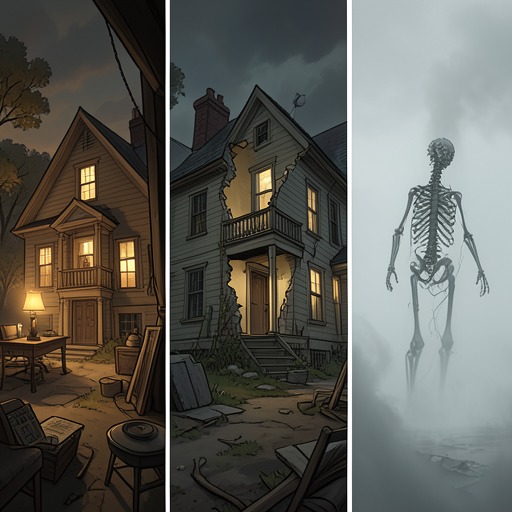
House of LeavesWill Navidson–Karen Green Relationship is the emotional engine of The Navidson Record. After nearly eleven years of departures caused by Will Navidson’s professional assignments abroad, Karen Green demands a choice between his working habits and their family. Unable to give up either, Will turns reconciliation itself into a documentary project, bringing the conflict into the home and eventually into the impossible darkness of the house on Ash Tree Lane. Their relationship moves through estrangement, fear, mutual protection, betrayal, renewed recognition, and finally a physically dangerous act of love that allows both partners to survive.
Identity and Background
Will Navidson and Karen Green are longtime companions and the parents of Chad Navidson and Daisy Navidson. They have been content not to marry, but the arrangement has not protected them from the consequences of separation. Will’s assignments abroad produce repeated departures and brief returns, gradually alienating him from Karen and creating what the narrative calls untold personal difficulties. Karen ultimately makes the stakes explicit: Will must abandon his professional pattern or lose his family.
The couple’s move to Virginia is therefore not simply a pastoral relocation. Will presents the move as a return to domestic life, but the deeper impetus is the failure of the relationship. He cannot make the demanded choice, so he compromises by documenting reconciliation. The cameras become both an attempt to preserve family life and a continuation of the professional behavior that has damaged it. Even before the house becomes visibly impossible, the project is already structured by the contradiction between Karen’s need for presence and Will’s need to observe, record, and pursue.
Their domestic intimacy initially appears intact. Karen watches over the children while they make candles from egg cartons, plaster of Paris, wicks, and crystal wax, yet she repeatedly looks toward the window, turning at passing trucks and even in silence. When Will’s car enters the driveway, relief sends her running from the room before she returns to instruct Daisy to wait for her. The scene makes reunion palpable while also showing how much anticipation, vigilance, and suppressed anxiety surround it.
Estrangement and the House
The house on Ash Tree Lane transforms existing relational tensions into a shared crisis. Karen’s fear is not an abstract dislike of the unfamiliar. She has severe claustrophobia: elevators, poorly lit basements, and blackouts can provoke extreme anxiety, and she has previously taken part in a pharmacotherapy study for the condition. Later accounts by her estranged older sister Linda allege that Karen suffered sexual abuse in adolescence, including being forced into a well, though Karen refuses to confirm or deny the story and the record cannot establish whether it is true. The narrative consequently leaves the origin of her fear uncertain while making its bodily force unmistakable.
The couple’s own testimony shows how the house damages both sexual and emotional intimacy. Karen recalls that, after the move, they had sex throughout the house, including the kitchen, shower, and garage; after the closet appears, she cannot bear to be touched because the place terrifies her. Will describes the same reversal from his perspective, saying that Karen once welcomed physical contact anywhere and now nearly cries when he kisses her, with the change beginning after their return from Seattle.
Their division is also a dispute over danger and responsibility. Karen does not want Will to enter the house’s dark space because she loves him and believes something terrible is there. Will, meanwhile, says that entering is the only thing he wants to do, yet he agrees to stay away because he loves her; his restraint becomes a source of torment because he feels that Karen’s fears and anxieties have eclipsed his own desires. Neither position is reducible to selfishness. Karen is trying to prevent the loss of the family, while Will is trying to understand the threat and cannot accept that retreat will resolve it.
The children sharpen this conflict. When Karen tells Tom Navidson that Will has spent a lifetime wandering into danger and can let someone else take over, she points to Chad and Daisy as the people who would be destroyed by his death. She says that she wants to grow old with Will. Her protective refusal is therefore also a commitment to a future that Will’s curiosity repeatedly places at risk.
Separation, Betrayal, and Recognition
Karen’s resistance becomes decisive after Will returns from the darkness. She refuses to let his appearance alter her plans and announces that she intends to leave for New York City that night, before he can recount his escape or explain that he found Holloway Roberts’s equipment. Her response shows that physical survival has not repaired the relationship: Will’s return does not automatically restore trust, authority, or domestic belonging.
The relationship is further complicated by Karen’s alleged affair with Fowler, an actor living in New York. The affair is barely present in The Navidson Record except through objects that preserve evidence of it, and later details emerge only after the film begins to succeed, leaving aspects of the account uncertain. Audrie McCullogh claims that Karen was always the one who opposed marriage, wanted freedom, and then became distressed when Will was away; she connects the relationship with Fowler to that contradiction. The affair thus mirrors the larger structure of the partnership: separation is both desired as freedom and experienced as abandonment.
Will’s work eventually gives Karen a new way to see him. While editing a short film containing more than a hundred cuts, she studies images of people confronting fate and defeat. She recognizes in Will’s photographs and expressions his tenderness toward her and the children, as well as his guarded obsession with human perseverance. The work does not erase the harm caused by his documentary impulse, but it enables Karen to distinguish Will from the fears and projections through which she has been viewing him. In seeing the purpose behind his images, she begins to see both him and herself more clearly.
This recognition also carries an ethical burden. Karen includes Will’s Pulitzer Prize-winning photograph of a starving Sudanese child watched by a vulture, an image from his personal collection that he placed among the first objects in the car when the family fled. The photograph links Will’s professional vision to the relationship’s deepest question: whether witnessing suffering is an act of care, an act of distance, or both. Karen’s editing does not simply praise his courage; it confronts the cost and meaning of his compulsion to look.
Final Descent and Ending
After Will disappears down the Spiral Staircase, Karen is left between two thresholds, one opening into the house and one leading away from it. She eventually leaves Ash Tree Lane and, in some respects, leaves Virginia and Will as well. Yet the fear follows her: in New York City she refuses subways and avoids elevators. Physical escape therefore fails to produce psychological freedom.
Her final decision reverses that pattern. Karen stands at the threshold for several minutes, shining her flashlight into the darkness and calling for Will. When she enters, she makes no announcement and takes no deep breath; she simply steps forward and disappears behind the black curtain. The hollow then vanishes, replaced by the ordinary wall, while the children’s drawings are gone. The action is both literal rescue and relational declaration: Karen enters the space that has governed her life in order to reach the person whose pursuit of it has wounded their family.
The narrative identifies her love for Will as the primary catalyst. Whatever the truth of the alleged well, the abuse, or the hidden shadows of her childhood, the desire to embrace Will overcomes the force of those memories. Her courage does not deny fear; it places fear within a larger commitment. The relationship’s repair therefore depends neither on Will’s conquest of the house nor on Karen’s simple submission to his world, but on Karen’s newly chosen act of crossing into it.
Both Karen and Will survive and exchange conjugal vows in Vermont. The ending is formally happy but materially scarred. Will’s ravaged face, patch over his left eye, missing hand, and crutch make the physical price visible, while the unseen emotional trauma remains equally decisive. The couple may leave the house and Virginia, but they cannot leave its memory. Their marriage is consequently not a return to the uncomplicated domestic future imagined at the beginning; it is a commitment made after damage, in full knowledge that survival has not restored what was lost.
Narrative and Thematic Significance
The relationship gives the impossible architecture a human scale. The house externalizes the couple’s incompatible needs: Will seeks danger, knowledge, and the image that can contain experience, while Karen seeks safety, continuity, and a family life not organized around absence. Their conflict is not added to the supernatural plot from outside; it determines the emotional meaning of every descent, refusal, recording, and return.
The relationship also develops through a recurring pursuit-and-withdrawal pattern. Will’s departures and investigations intensify Karen’s fear of abandonment, while Karen’s refusals and threatened departures intensify Will’s need to pursue what she cannot tolerate. The cycle reaches its most destructive form when the house converts emotional distance into literal thresholds and corridors. Yet the ending suggests a movement from mutual misrecognition toward integration: Karen can acknowledge both Will’s capacity to harm the family and the tenderness contained in his work, while Will’s survival depends on the love he had repeatedly endangered.
The final marriage does not cancel the history of estrangement, the disputed trauma, the affair, or the bodily injuries. Its significance lies precisely in that refusal of easy restoration. Love becomes rescue not because it makes the darkness unreal, but because it gives Karen a reason to enter it and gives the surviving couple a future that includes, rather than erases, the memory of what nearly destroyed them.