Zampanò's apartment
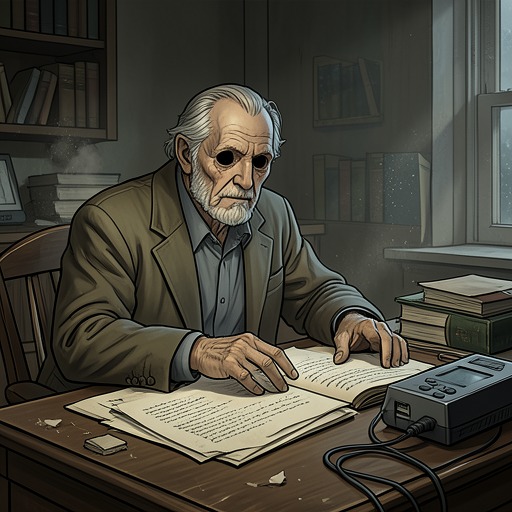
House of LeavesZampanò's apartment is at once a real, decaying dwelling and the narrative threshold through which Johnny Truant enters the world of The Navidson Record. Situated in a building on Franklin, its first-floor rooms look onto a broad, overgrown courtyard; after Zampanò's death, the apartment becomes an abandoned space whose discarded contents are about to be removed when Lude brings Johnny there in the middle of the night. The location's decisive importance lies in this conjunction of domestic neglect and textual discovery: a place associated first with an old man's solitary death becomes the site from which an immense, disorienting archive begins to exert power over Johnny's life.
Setting and Residents
Zampanò's apartment belongs to a building whose courtyard is described as wild and heavily overgrown with knee-high weeds. More than eighty stray cats populated the space during Zampanò's lifetime, and they repeatedly rubbed against his legs as he walked its perimeter every morning and evening. Although he largely kept to himself, this routine made him a visible presence in the building: neighbors could recognize his absence because he normally appeared at the same times and followed the same circuit, sometimes stopping on a sun-beaten bench before continuing.
Zampanò's isolation is emphasized through the building's social contrasts. He had no family, no close friends, and hardly any money, and his death leaves no intimate household to claim or protect his possessions. Lude later treats that solitude as a warning about his own possible future, imagining an existence without a wife, children, or even a single friend. The apartment therefore functions not merely as a residence but as the material proof of a life reduced to routine, enclosure, and the limited companionship of animals.
Discovery of the Death
Zampanò's death is first registered as an absence from the courtyard. After returning very late and suffering from a severe hangover, Lude notices that the old man's familiar rounds have not begun. A single mother in the building, who leaves for work at six each morning, has also noticed that Zampanò is missing. When dusk arrives without his appearance, she and Lude alert Flaze, the building manager.
Flaze is physically formidable and normally confrontational with vandals and intruders, but the possibility of entering Zampanò's apartment unnerves him. He hesitates, claims not to be able to find the keys, and begins muttering about contacting the building's owner. Lude's impatience finally prompts him to offer to handle the matter himself; almost immediately, Flaze finds the keys and hands them over. Flaze later admits that he had never seen a dead body before, while also insisting that everyone already knew what they would find. The apartment is thus approached as a sealed confirmation of death rather than as an uncertain site of investigation.
Abandonment and Johnny's Arrival
The day after the discovery, the landlord posts a notice of abandonment. A week later, after deciding that the apartment's contents are worth less than three hundred dollars, he calls a charity to remove them. This administrative judgment strips the apartment of conventional value: its furniture and belongings are treated as disposable remnants, destined for gloves, handtrucks, and removal crews rather than preservation or inheritance.
Johnny enters precisely at this moment of impending erasure. Lude telephones him at three in the morning, waking him from a sleep that has already become a recurring problem, and Johnny goes to the building on Franklin because Lude is a sufficiently trusted friend to make him answer the call. Lude waits outside the gate with an excited, ominous expression. Johnny later recognizes the approach as a sequence of warnings: the keys rattle like bone chimes, the gate hinges shriek, and the damp corridor seems less like the entrance to an occupied building than to an ancient crypt. The ordinary hallway and the last door on the left acquire the atmosphere of a boundary between the living and the dead.
The apartment's significance is therefore produced by timing as much as by architecture. Johnny arrives before the charity workers can empty the rooms, when the contents are officially worthless but still available to be encountered. A space abandoned by its landlord becomes, for Johnny, the point of access to a manuscript whose consequences far exceed the building's monetary evaluation.
From Domestic Interior to Impossible Space
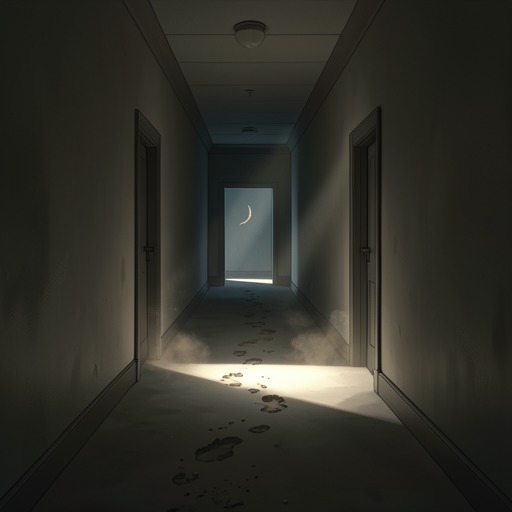
The apartment is not itself identified with the later spatial anomalies of the Navidson house, but it becomes the place from which Johnny's engagement with those anomalies begins. The manuscript he finds there directs attention toward a different dwelling, where Will Navidson measures the house against its plans and discovers that the interior dimensions are impossible. In that later house, a hallway appears where no such space should exist, and the cries of Chad Navidson and Daisy Navidson echo through distances no room can contain. The contrast is crucial: Zampanò's apartment is materially cramped, neglected, and socially empty, while the house described in the manuscript expands beyond measurement, orientation, and stable representation.
The connection between the two locations is mediated by documents and acts of reading. The Navidson house cannot be comprehended from an external, complete viewpoint; understanding must be derived from within the labyrinth. The same principle retrospectively colors Zampanò's apartment. What appears to be a minor, abandoned room becomes legible only through the chain of entry, removal, discovery, and interpretation that follows. Its importance is not visible in its walls alone. It emerges from what the apartment contains, from who enters before the contents disappear, and from the narrative that is constructed out of those remains.
Narrative Significance
Zampanò's apartment establishes the book's recurring transformation of domestic space into a site of epistemological and existential danger. The apartment begins as a first-floor dwelling overlooking weeds and stray cats, passes through the fact of an unattended death, and becomes a threshold where a discarded manuscript survives long enough to be found. Its spatial modesty intensifies rather than diminishes its importance: the most consequential doorway initially looks unremarkable.
The location also links mortality to the production of narrative. Zampanò's solitary death leaves behind no family structure capable of giving his life a public continuation, yet his apartment preserves the material trace from which an enormous textual world is transmitted to Johnny. The landlord's valuation of the contents at less than three hundred dollars stands in sharp opposition to the manuscript's eventual psychological and narrative force. In that reversal, the apartment becomes a compact model of the book's larger logic: what appears abandoned, marginal, or worthless may contain an architecture that destabilizes every supposedly reliable measure of value, direction, and reality.