
The Ecology of Fungi
How to Change Your MindFrom mushrooms’ ecological roles to speculative ideas about communication and intelligence, Pollan’s investigation enlarges the book’s account of nature.
increasing Bearing strength in each event
 decreasing
Bearing strength in each eventdecreasingFungi as Overlooked Life
A Neglected Kingdom
Essential work
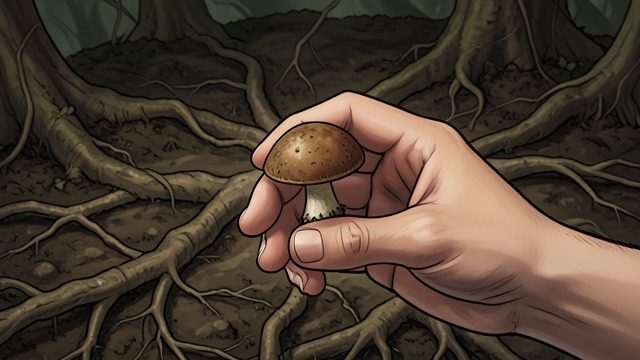
Fungi recycle organic matter and help form soil, yet people often regard them with suspicion. Paul Stamets presents this neglect as a cultural prejudice against a crucial kingdom.
A change in scale
Learning about fungi shifts Pollan’s attention from visible mushrooms to the extensive organisms and relationships beneath the ground.
Repairing Damaged Places
Fungi at Work
A demonstration
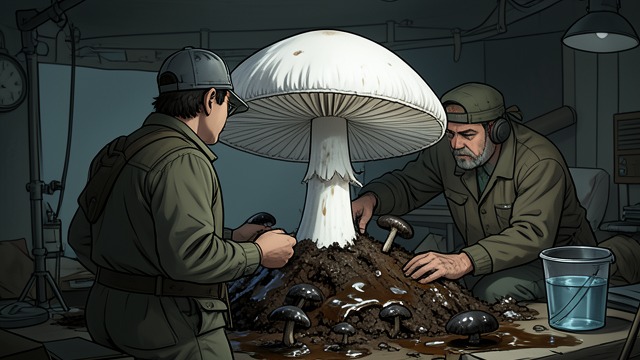
Stamets describes using oyster mushrooms on petroleum-contaminated waste. The visible growth makes fungal decomposition feel like practical ecological alchemy.
Promise and proof
The experiment supports interest in mycoremediation, while the book distinguishes Stamets’s demonstrable work from broader claims that require further evidence.
Networks Beneath Trees
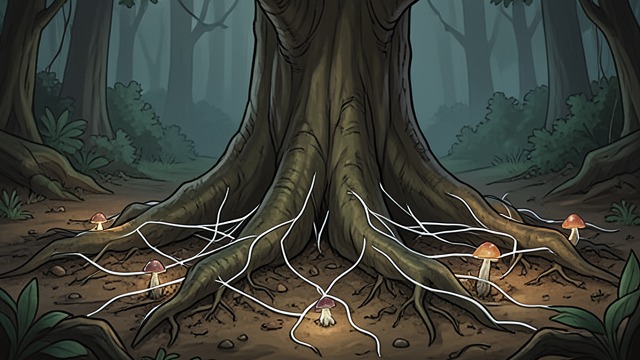
The Wood-Wide Web
Hidden connections
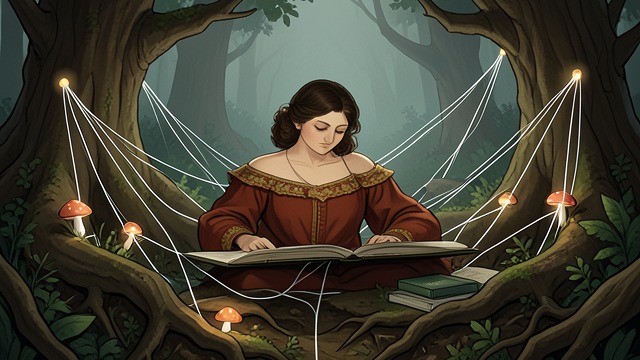
Research indicates that fungal networks can connect tree roots and facilitate exchanges. Stamets’s image of an underground internet gains support as a useful ecological metaphor.
Beyond isolated organisms
The network suggests that forest life depends on relationships not visible from the surface. It complicates the idea of nature as a collection of separate objects.
A Mushroom’s Evolutionary Puzzle
Why Produce Psilocybin?
A chemical without an obvious defense role
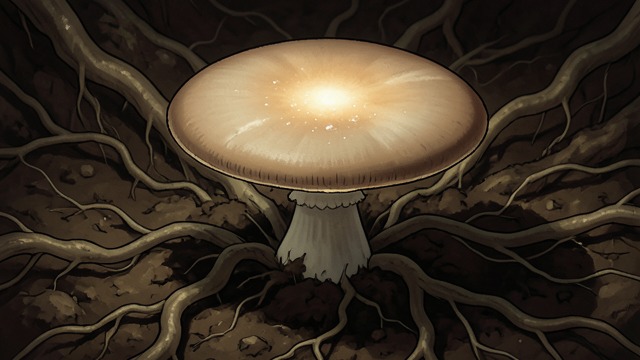
Michael Beug notes that psilocybin is concentrated in fruiting bodies rather than the protected mycelium. This weakens the simplest account of the compound as a defensive toxin.
A dispersal hypothesis
Beug proposes that stronger mushrooms may have attracted animals that spread their spores. The explanation remains a hypothesis, but it turns attention toward animals as agents in fungal evolution.
Nature as a Possible Teacher
Beyond Human Centrality
Agency in other lives
Pollan considers whether plants and fungi possess forms of agency and subjectivity appropriate to their own lives. Scientific ecology supports interdependence more clearly than it establishes consciousness.
An altered perspective
Psychedelic experiences make these relationships feel immediate. Pollan treats that feeling as a reason to reconsider human exceptionalism, not as conclusive proof that nature sends messages.
During Pollan’s early mycology inquiry
After the 1989 Exxon Valdez spill
During Pollan’s study of forest research
During the Columbia River foray
During the closing reflections on ecology
