“Seeking the Magic Mushroom”
How to Change Your Mind“Seeking the Magic Mushroom” was R. Gordon Wasson’s 1957 account of a mushroom ceremony in Mexico, published in Life at a moment when psychedelic drugs had not yet acquired the political stigma that would later shape their reception. Its significance lies both in the reach of its vivid first-person report, which helped make magic mushrooms a subject of mass public interest, and in the tension between that report’s universal religious interpretation and the local purposes of the practice it described.
Publication and Form
Life made the article possible on unusually favorable terms. It offered Wasson $8,500 and gave him final approval over the editing, headlines, and captions. The magazine also specified that his account include a description of his sensations and fantasies under the mushrooms. In 1957, Life had a circulation of 5.7 million, placing Wasson’s account before a readership far beyond the small circle of medical professionals then interested in psychedelics.
The article opened with a full-page color photograph of a Mazatec woman turning a mushroom over a smoky fire, then extended across at least fifteen pages. Its headline introduced the phrase magic mushrooms—not as counterculture slang coined by a psychedelic enthusiast, but as the work of a Time-Life headline writer. The contrast between the magazine’s national reach and the ceremony’s remote setting was part of the article’s force: a New York banker’s journey into the mountains of Oaxaca became a highly visible account of a practice that had long been concealed from outsiders.
A surviving copy preserves the publication’s material character as well as its cultural impact. In 1977, Paul Stamets hosted Wasson and Albert Hofmann, two of his heroes. Decades later, Stamets showed Michael Pollan an original copy dated May 13, 1957. The cover featured Bert Lahr in a morning suit and bowler hat, while its most prominent line advertised Wasson’s story. Stamets let Pollan take the issue to bed, turning the mass-market artifact into a tangible link to an earlier moment in psychedelic history.
The Quest Behind the Account
The article condensed a search that began well before Wasson’s Mexican journeys. In 1927, on their honeymoon in the Catskills, his Russian physician wife, Valentina, knelt before wild mushrooms she had found in the woods. Wasson, unfamiliar with them and alarmed by the prospect of eating them, refused. Their sharply different reactions prompted the couple to investigate why some cultures regarded mushrooms with fear and others with affection. They introduced the terms mycophobia and mycophilia and eventually proposed that a psychoactive mushroom might once have played a part in the beginnings of human religion.
That proposal became a thirty-year quest for what Wasson called the divine mushroom. Robert Graves sent him a pharmaceutical-journal clipping in 1952 that referred to a psychoactive mushroom used by Indigenous people in sixteenth-century Mesoamerica. The research behind the article, by Harvard ethnobotanist Richard Evans Schultes, redirected Wasson’s search from Asia to the Americas. Schultes had identified teonanácatl, the sacred mushroom of the Aztecs and their descendants, and his work pointed toward reports of mushroom use in the remote villages of southern Mexico.
Wasson made his first of ten trips to Mexico and Central America in 1953. In Huautla de Jiménez, where a missionary had told him healers used mushrooms, residents initially avoided speaking openly about the practice. The article’s account of a ceremony therefore emerged from a history of secrecy, not from an undiscovered custom waiting to be freely exhibited. That history included centuries of religious suppression after the Spanish conquest.
Ceremony and Interpretation
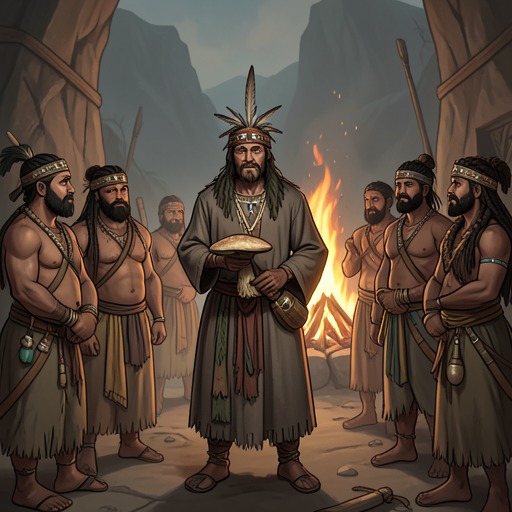
Wasson presented the experience in awestruck terms, describing the ceremony’s performers and the mushrooms’ effects as exceeding his expectations. He portrayed himself and the photographer accompanying him as the first white men in recorded history to eat the sacred mushrooms. The article’s narrative made the journey—an arduous approach to a distant Oaxacan town and a ceremony in a modest home—part of a larger argument about the origins of religious experience.
That argument was already central to Wasson’s thinking when he arrived. He treated his experience as support for the hypothesis that visions from psychoactive mushrooms might have inspired new ideas about worlds beyond ordinary perception, perhaps even the first conception of a god. The article consequently did more than report an encounter: it arranged the encounter as evidence for a theory about religion’s beginnings.
The framing left out an important distinction between Wasson’s interpretation and the ceremony’s contemporary function. By 1955, many Mazatecs were devout Catholics, and mushrooms were used for healing and divination, including attempts to locate missing people or important objects, rather than simply for worship. Wasson knew that context. To gain access to María Sabina’s ceremony, he told her he was worried about his son’s whereabouts and well-being. After returning to New York, he believed he had received accurate information about both. The episode shows how the article’s universal religious claim rested on a specific, carefully obtained healing encounter.
María Sabina later explained the difference directly: before Wasson, she said, people did not take mushrooms solely to find God; they took them to help the sick get well. Her account complicates the article’s presentation of her as a religious figure and the ceremony as a form of communion. The article preserved a powerful description of an Indigenous practice, but it also recast that practice through Wasson’s pre-existing theory, blurring its historical associations with its local use in the 1950s.
Reception and Consequences
The article’s audience quickly extended beyond Life’s readers. Wasson discussed his experience on the CBS program Person to Person, and other magazines published first-person accounts of mushroom journeys involving mushrooms he supplied. He also conducted ceremonies in his Manhattan apartment. An exhibition on magic mushrooms followed at the American Museum of Natural History in New York. The story thus moved through print, television, private gatherings, and a public museum, making a once-guarded practice newly conspicuous.
The report also helped set in motion further scientific attention. Soon after publication, Wasson arranged for Mexican mushroom specimens to be sent to Albert Hofmann in Switzerland. In 1958, Hofmann isolated and named psilocybin and psilocin and developed a synthetic form of psilocybin. He later returned to Huautla with Wasson and gave María Sabina psilocybin in pill form; she said the pills contained the spirit of the mushroom. The sequence connected Wasson’s public account to the chemical identification and laboratory study of the compounds.
For María Sabina and Huautla, the new attention brought serious costs. Visitors, including celebrities, eventually made their way to the village and to her home. Wasson later accepted responsibility for unleashing commercial exploitation on Huautla. The village became a destination first for beatniks and then for hippies, while sacred mushrooms once kept secret were sold openly in the streets. Neighbors blamed María Sabina; her home was burned, and she was briefly jailed. Near the end of her life, she regretted having shared the mushrooms with Wasson and, through him, with the world.
The article therefore occupies two histories at once. It made a hidden practice legible to a mass audience and helped catalyze scientific investigation, but its success also transformed the conditions under which that practice could remain private and locally meaningful. Its lasting importance depends on holding those consequences together: the revelation Wasson celebrated was also an exposure whose burdens fell most heavily on the community that had allowed him to witness it.