Ego dissolution
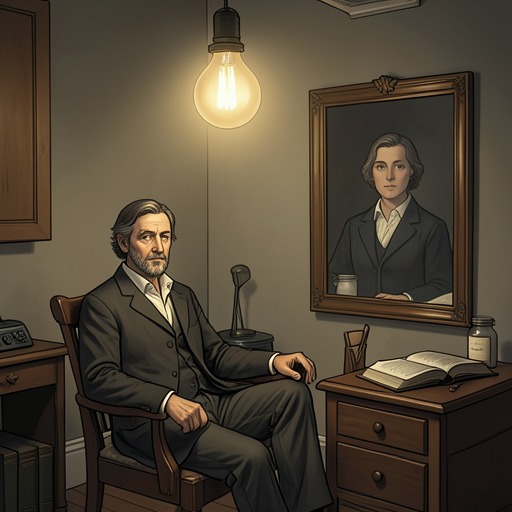
How to Change Your MindEgo dissolution is the temporary loss or loosening of the ordinary sense of being a separate, continuous self. In the book, it is more than one effect among many: it is offered as a central psychological process through which psychedelic experiences can unsettle habitual self-conceptions, alter the felt boundary between self and world, and open new ways of relating to fear, other people, and mortality. The account holds two explanations in view without forcing a choice between them: this altered perspective may feel spiritual or revelatory, while remaining plausibly a product of the brain.
Definition and experience
Ego dissolution names an experience in which the familiar self—the subject that remembers its past, anticipates its future, and interprets the world from a seemingly stable center—temporarily loses its authority or coherence. Michael Pollan’s psilocybin experience gives the concept a concrete form. Returning to a computer-generated landscape after taking a higher dose, he watched the self that had navigated it begin to come apart. His identity appeared as small scraps of paper scattered into the wind; then it seemed dispersed across the landscape like a thin coat of paint. What had ordinarily felt like the perceiving subject became, in the experience, an object spread through the scene.
The striking feature was not simply the disappearance of the familiar self, but the presence of awareness that could observe that disappearance. This awareness seemed distinct from the usual embodied point of view: it was unbounded by the body, neutral in its interpretation, and undisturbed by what would otherwise have seemed a personal catastrophe. The usual ego, with its fears, desires, resentments, and worries, was absent, but awareness had not vanished with it. Pollan describes the remaining emotional tone as calm and contentment. The episode therefore challenged the assumption that a person must either remain identified with the everyday ego or cease to experience altogether.
The experience did not establish that awareness exists independently of the brain. Pollan considered whether it resembled Aldous Huxley’s idea of Mind at Large, a universal consciousness beyond any one brain, but concluded that a brain-generated explanation seemed at least as plausible and more parsimonious. The importance of the episode, in his account, did not depend on proving a metaphysical claim. It demonstrated that the usual self could fall away without total annihilation, and that another, less defended perspective could briefly take its place.
Brain, self, and non-duality
Research discussed in the book connects reports of ego dissolution with activity in the default mode network, a brain system associated with self-reflection and mind wandering. In Robin Carhart-Harris’s first psilocybin brain-imaging experiment, the largest reductions in default mode network activity were associated with volunteers’ reports of losing their sense of self. Participants described experiences in which they existed only as an idea or could no longer distinguish where they ended and their surroundings began. The reported intensity of self-loss tended to increase as blood flow and oxygen consumption in the network declined more sharply.
Judson Brewer, whose functional magnetic resonance imaging research examined experienced meditators, noticed that their scans resembled Carhart-Harris’s results. The transcendence of self reported by expert meditators was also associated with quieting of the default mode network. The comparison does not make psychedelic experience and meditation identical; it suggests that distinct practices may reach a related change in the ordinary organization of self-experience. The book also considers breathing exercises, sensory deprivation, fasting, prayer, awe, extreme sports, and near-death experiences as possible routes to similar changes, while treating the brain activity involved in those states as an open question.
When the distinction between subject and object weakens, the resulting experience may feel like a merger with a larger whole. The book connects this non-duality with the mystical experience: transcendence, sacredness, unity, infinitude, and bliss may arise when the boundaries that make a separate self feel fixed temporarily recede. It also offers a possible account of why insights in such states can feel objectively true. If a person’s ordinary sense of subjectivity has temporarily disappeared, an insight may not be experienced as one person’s interpretation, but as something revealed. That feeling of certainty is part of the experience, not proof that every interpretation made during it is objectively correct.
Therapeutic meaning and connection
The book treats ego dissolution as a possible psychological driver of several effects associated with psychedelic experiences, including mystical experience, awe, new meaning, and a sense of facing death. In this account, the ego’s ordinary role is not simply harmful: a coherent individual identity supports a life shaped by memory and future aims. But a strong sense of separation can also intensify self-focused thought and make it harder to remain open to other people or the wider world. Temporarily interrupting that pattern may allow new emotional and interpretive possibilities to emerge.
Jeffrey Guss describes psilocybin’s effects as egolytic: the drug may silence or muffle the ego, understood in his psychoanalytic account as a mental construct that helps maintain boundaries between conscious and unconscious processes and between self and other. When those boundaries fade, rigid patterns of thought may loosen and new meanings may become easier to perceive with less fear. The proposed therapeutic value lies not in erasing a person’s identity permanently, but in making its usual defenses and habits less absolute for a time.
This framework is especially relevant to the book’s account of cancer patients’ existential distress. A terminal diagnosis can narrow a person’s attention toward questions of fate, meaning, and personal extinction. The resulting rumination and isolation resemble the self-absorbed patterns associated with a hyperactive default mode network. In the interviews discussed in the book, patients described feeling separated from loved ones and from the broader world. Psilocybin sessions could initially make the weakening of the self feel threatening; when participants were able to surrender to the experience, that passage was often followed by acceptance, powerful emotion, and a renewed sense of connection.
Katherine MacLean characterizes a high-dose psychedelic experience as a kind of death practice: participants may feel that they are losing what they know to be real, including the ego and body. The comparison helps explain why some cancer patients reported reduced fear of death. A psychedelic session may offer a temporary encounter with the felt loss of the self, followed by the discovery that awareness or meaning can continue in another form within the experience. The book does not present that feeling as evidence for a literal afterlife; rather, it shows how the experience can change a patient’s relationship to death and to the meanings attached to it.
The interviews from the NYU trial add a relational dimension. Participants described movement from separateness toward interconnectedness, feelings of connection to loved ones, and emotions such as joy, bliss, and love. The book interprets this shift as a possible consequence of the ego’s reduced control over the boundary between self and other. In the account of Patrick Mettes, that opening could be experienced as love extending beyond specific relationships to encompass everyone and everything. The proposed gain is not merely a more pleasant state: a wider sense of connection can change what feels important and how a person understands a life threatened by illness.
Limits, practice, and significance
Ego dissolution is temporary, and the book does not treat a powerful session as a permanent personality change. After his experience, Pollan’s ordinary ego returned quickly. Mary suggested that a person brings a different self to each journey, so a relatively peaceful session does not guarantee that later experiences will be the same. The episode’s possible value lay instead in providing a lived example of another way to react—or not react. Meditation, Mary proposed, could help cultivate that possibility after the drug’s immediate effects had passed.
Pollan connects the experience with a form of selflessness that loosens habitual demands for certainty and expands the circle of attention beyond the individual self. The shift from a first-person singular perspective toward a wider sense of belonging is not something a chemical can sustain for more than a few hours, but those hours can show how such a perspective might feel and offer a basis for practice. In this interpretation, interconnectedness is not merely an abstract proposition: during the experience, it can become directly felt.
The book’s broader claim is that the loss of self may bring a gain in meaning. When the ego’s boundaries weaken, previously distant memories, impressions, and interpretations may become newly available; experiences that once seemed irrelevant can acquire personal significance. The underlying biology remains incompletely understood. Research offers clues, including the association between reduced default mode network activity and increased connectivity across brain regions, but it does not yet explain precisely how altered brain activity becomes a felt transformation in meaning.
This account finally changes the terms of the argument about spirituality. Rather than treating spirituality chiefly as the opposite of materialism, the book proposes that egotism may be its more useful contrast. On this view, a spiritual shift need not establish access to a supernatural realm: it can consist in loosening the bounded conception of the self and its interests, with a more openhearted sense of connection taking its place. Ego dissolution matters, then, both as an experience of self-loss and as a temporary demonstration that the self is not the only possible ground from which to encounter reality.