Evergreen State College mycology campus
How to Change Your MindEvergreen State College mycology campus became an unlikely center of American mushroom research: an experimental college in Olympia where Paul Stamets and his collaborators investigated Psilocybe at a time when the genus was poorly understood and often passed over. Its importance lay not simply in where Stamets studied, but in the methods, discoveries, and research networks that took shape there and helped redirect attention toward the Pacific Northwest.
An Experimental Setting for Mycology
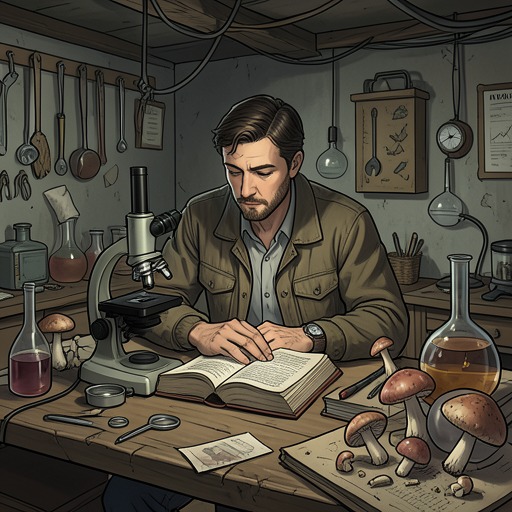
In the mid-1970s, Evergreen State College was a new kind of institution where students could design independent courses of study. Stamets had left Kenyon College after one year; it was at Evergreen State College mycology campus that he found a setting for sustained mycological work. Michael Beug, a young professor trained in environmental chemistry rather than mycology, took Stamets and two other intensely interested students, Jeremy Bigwood and Jonathan Ott, under his wing. The four built their expertise together, working with an electron microscope and a DEA license Beug had obtained.
Their choice of subject set them apart. Psilocybin mushrooms had been illegal since 1970 and were chiefly known in countercultural circles as a more natural alternative to LSD. Little was established about their habitats, distribution, life cycles, or potency. The prevailing picture located them in southern Mexico, while much of the Psilocybin in circulation in the United States came from Latin America or from domestic cultivation using spores of Latin American species, especially cubensis. Against that narrow picture, the Evergreen group began studying the mushrooms around them.
Research and a Shift in Focus
The group identified and published three new Psilocybin species, developed methods for indoor cultivation, and devised techniques for measuring Psilocin and Psilocybin levels in mushrooms. Their findings did more than add species to a catalog: they moved the center of attention among people studying Psilocybe from southern Mexico toward the Pacific Northwest. Stamets and his colleagues repeatedly found and published new local species, making the region a place of active discovery rather than merely a source of specimens.
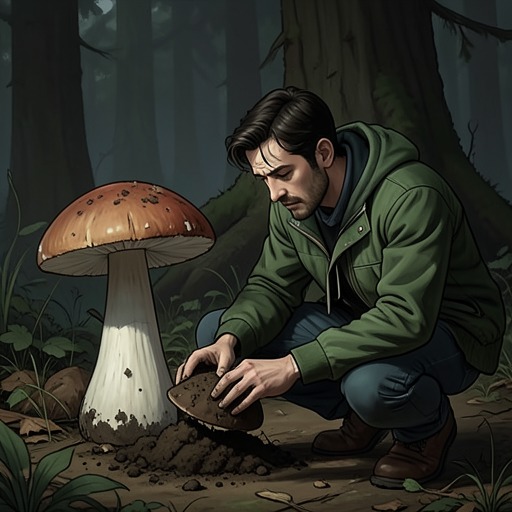
The work also had a visible, informal presence beyond research publications. Stamets recalled people across the Pacific Northwest tracing odd patterns through lawns and farm fields, bent over in what he called the psilocybin stoop. In 1978, at twenty-three, he published his first book, Psilocybe Mushrooms and Their Allies. The title’s idea of allies reflected his growing sense that humans were not only studying these fungi but also helping spread them.
A Regional Meeting Ground
From 1976, Stamets and his Evergreen colleagues organized a series of mushroom conferences that brought together credentialed researchers and amateur enthusiasts. Evergreen State College mycology campus served as the Pacific Northwest’s de facto intellectual hub and research-and-development center, while the conferences made the broader network visible in person. Their character exceeded that of conventional academic meetings: at the 1999 gathering, attendees arrived in a vividly painted school bus called Farther, driven by Ken Kesey. Among those present were Andrew Weil, Alexander “Sasha” Shulgin, and mycologist Gary Lincoff. The proceedings mixed serious scholarship with a more exuberant psychedelic culture; Jonathan Ott, for example, lectured on the history of entheogens.
The surviving record of that last conference is itself revealing. Les Blank filmed it, but the raw footage was never edited. When the narrator visited Stamets years later, Stamets brought out the VHS tapes, preserving a gathering whose combination of research, community, and spectacle resists a simple institutional label.
Influence Beyond the Campus
Evergreen’s significance extended through people and practices rather than a single formal program. Beug’s later discussion of Psilocybin drew on his experience as Stamets’s professor and collaborator: he questioned whether the compound served as a mushroom defense, noting that his tests found only minute quantities in the mycelium but sometimes more than two percent by dry weight in the fruiting bodies. The exchange shows the scientific questions emerging from the group’s work, while also marking the limits of what its discoveries could explain.
The college’s history also belongs to a larger transfer of psychedelic knowledge between formal research and less visible practice. Later accounts describe underground guides whose professional lineages reached back to several earlier researchers and therapists, including Al Hubbard, and note that university researchers consulted underground guides about practices such as music in guided Psilocybin sessions. This was not a direct institutional succession from Evergreen, but it echoes the college’s defining pattern: knowledge moving through personal collaboration, practical training, and networks that crossed the boundaries between credentialed science and informal expertise. Evergreen State College mycology campus thus mattered as both a place of concrete mycological advances and a regional node in a culture of research that continued to circulate beyond the university.