Flesh of the gods
How to Change Your Mind“Flesh of the gods” is both a name for psychoactive mushrooms and a phrase around which competing accounts of spiritual experience gather. In the book, it connects Indigenous healing and divination, colonial efforts to suppress mushroom practices, and modern arguments about whether a chemically mediated experience can also disclose a reality beyond matter. Its force lies partly in that unresolved tension: the mushroom is at once a natural organism, a sacramental means of access, and an object whose meaning changes with the people describing it.
Name, mushroom, and practice
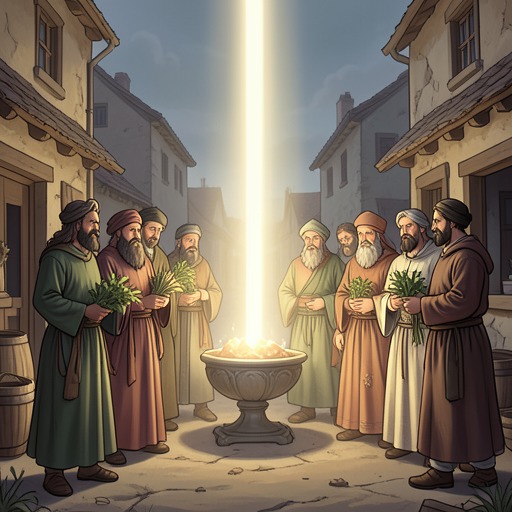
The phrase is associated with the Mazatec name for psychoactive mushrooms used in southern Mexico. The book places that practice in a history extending to before the Spanish conquest, while noting that its sacramental use was kept from Westerners for centuries after conquest. In the sixteenth century, the missionary Bernardino de Sahagún recorded an Aztec observance in which participants ate mushrooms before dawn and later spoke with one another about the visions they had experienced. His account presents a communal practice with varied responses, rather than a single standardized religious experience.
By the twentieth century, the contemporary purposes of mushroom ceremonies could not simply be equated with the historical sacrament. In 1955, R. Gordon Wasson approached María Sabina in Huautla de Jiménez after pursuing the possibility that an ancient mushroom cult survived in the region. The book emphasizes that many Mazatecs had become devout Catholics and that, by then, mushrooms were used for healing and divination, including seeking information about missing people or objects. The expression therefore carries a history of sacramental use, but it does not by itself describe every later ceremony or practitioner’s purpose.
A sacrament under pressure
Spanish authorities understood mushroom use as a challenge to Christian authority. A priest accompanying the conquest described the mushrooms as the flesh of the devil, a hostile inversion of the Christian sacrament. The book draws attention to the sharp contest embedded in these descriptions: both traditions used the language of divine flesh, but the mushroom was understood to offer direct access to visions, without the priest and liturgy that mediated access to the divine in the Christian rite.
That difference helps explain why the colonial campaign reached beyond disagreement over doctrine. Authorities sought to suppress mushroom cults, interrogated Indigenous people about their practice, and destroyed mushroom-shaped stone sculptures associated with religious ceremonies. In 1620, the Roman Catholic Church condemned the use of plants for divination as opposed to the faith. The phrase thus records more than a religious analogy: it marks a struggle over who could authorize contact with the sacred, and whether that contact could occur through a plant without institutional mediation.
Wasson’s interpretation and its limits
Wasson treated his experience with María Sabina as support for his theory that psychoactive fungi lay near the origins of religious experience. But the book distinguishes his interpretation from the contemporary meaning of the ceremony. Wasson entered with a theory already in mind and presented the encounter as a form of Holy Communion; to gain access, he said he wanted information about his son’s well-being and whereabouts. That request was consistent with the healing and divinatory purposes the book attributes to Mazatec mushroom use, but Wasson’s later account recast the ceremony as a search for God.
María Sabina’s reported distinction is central to this correction: before Wasson, she said, people did not take mushrooms simply to find God; they took them to help the sick get well. The phrase can therefore become misleading when treated as a complete explanation of Indigenous practice. It preserves a profound sacramental association, yet it can also flatten a practical, locally situated tradition into a universal story about mystical revelation. The book keeps those meanings in view at once, refusing to treat Wasson’s influential interpretation as identical to the practice he encountered.
Nature, chemistry, and spiritual meaning
The expression also frames a modern paradox. Psilocybin is a chemical compound found in a mushroom, and contemporary researchers use a synthetic version rather than whole mushrooms. In the laboratory, the compound arrives as a small white pill, and clinical surroundings can distance the experience from the fungus and from the cultural histories attached to it. A mushroom medallion given to research volunteers offers a small counterimage: it makes the organism visible again beside the molecule studied in the lab.
The book sets two readings of this material fact against each other. Because psilocybin can alter consciousness and occasion a profound mystical experience, its effects can be taken as evidence for a material explanation of spirituality: a chemical changes the mind, so religious experience might be understood as a product of the brain. Yet many people who undergo such experiences do not conclude that reality is only material. They report a sense of a Beyond, while still accepting that the experience has a natural, molecular basis. The same evidence can thus seem to disenchant the world or to reveal its enchantment: if the molecules mediating transcendence move through human brains and the natural world of plants and fungi, nature may be understood not as mute matter but as a setting in which spiritual meaning is immanent.
“Flesh of the gods” holds these interpretations together without resolving them. It recalls the Indigenous sacrament and the colonial attempt to suppress it; it also names the point where a mushroom’s chemistry becomes entangled with questions of divine access, cultural authority, and the status of nature. The phrase is powerful precisely because neither a strictly material account nor a spiritual one exhausts what the book describes: a natural substance can be studied as chemistry and experienced as a passage to the sacred, even as those accounts remain in tension.