Huautla de Jiménez, Mexico
How to Change Your MindHuautla de Jiménez, Mexico, is a mountain village in Oaxaca where R. Gordon Wasson encountered Mazatec mushroom ceremonies in 1955 and whose name soon reached an international audience. The encounter made the town a pivotal site in the modern Western history of psychedelics, but the publicity that followed also transformed a guarded local practice into a commercial attraction, with painful consequences for María Sabina and her neighbors.
A remote center of mushroom knowledge
In 1953, after Richard Evans Schultes redirected the Wassons’ search from Asia toward reports from the Americas, Wasson began the first of ten journeys to Mexico and Central America. Several took him to Huautla, deep in the mountains of Oaxaca, where a missionary informant had said local healers used mushrooms. At first, residents were reluctant to discuss the practice: some denied knowing of it, said it had ended, or placed it in another village. That reticence reflected a long history of secrecy. After the Spanish conquest, sacramental mushroom use had been driven underground, and colonial authorities had sought to suppress Indigenous practices involving psychoactive plants and fungi.
The history that drew Wasson to Huautla was not simply an unbroken survival of an ancient religion. By the mid-twentieth century, many Mazatecs were Catholics, and mushrooms were used for healing and divination, including efforts to find missing people or objects. The village therefore held a living practice whose contemporary purposes did not necessarily match the religious interpretation outsiders brought to it.
Wasson’s ceremony in 1955
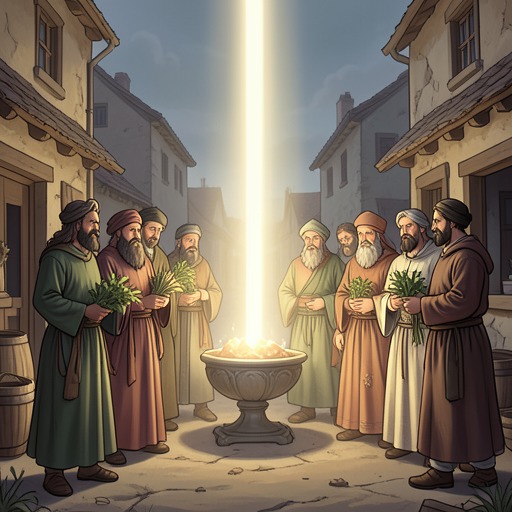
On the night of June 29–30, 1955, during his third visit to Huautla, Wasson took part in a ceremony led by María Sabina, a sixty-one-year-old Mazatec healer respected in the village. She agreed to let Wasson and his photographer observe and participate, although no outsider had previously joined such a ceremony. It took place after dark in the basement of a local official’s home, before a simple altar bearing Christian images. Wasson concealed Sabina’s identity in his account, calling her Eva Mendez.
After preparing the mushrooms and passing them through incense smoke, Sabina gave Wasson six pairs, which she called the little children. For him, participating marked the culmination of six years of pursuit. His account of the experience strengthened his conviction that psychoactive mushrooms had played a profound role in the origins of religious ideas. The village thus became central not only as the setting of a ceremony, but as the place through which Wasson framed a broad theory about humanity and religion.
Local practice and outside interpretation
Wasson presented Sabina and the ceremony in terms that emphasized religious communion and the search for God. Yet he had approached her with a practical request: he said he was worried about his son and wanted to know where he was and whether he was well. He later believed the information he received was accurate. The discrepancy matters to the history of Huautla because Wasson’s account elevated the ceremony’s significance for an outside readership while fitting a complex local practice to a theory he already held.
Sabina’s own later explanation stressed that people had taken the mushrooms to help the sick get well, not simply to seek God. Wasson’s presentation therefore carried two legacies at once: it brought attention to Mazatec knowledge and a ceremony that had been kept from outsiders, while also translating that practice into a religious story that did not fully describe its contemporary local use.
Publicity and its costs
Wasson’s account in Life magazine, his appearance on the CBS program Person to Person, and subsequent magazine stories brought the mushrooms to a mass audience. He also supplied mushrooms for ceremonies in his Manhattan apartment. Soon, thousands of visitors were making their way to Huautla and to Sabina’s door; among those drawn there eventually were Bob Dylan, John Lennon, and Mick Jagger. What had been a closely guarded practice became openly commercial, and Huautla shifted first into a destination for beatniks and then a hippie mecca.
The influx did not bring its benefits evenly. Sabina’s neighbors blamed her for the changes affecting their village. Her home was burned down, and she was briefly jailed. Wasson later acknowledged his part in bringing exploitative attention to Huautla, while Sabina, nearing the end of her life, regretted having shared the mushrooms with him and, through him, the wider world. The town’s place in psychedelic history is consequently inseparable from this reversal: international recognition preserved and publicized the story of a local tradition, but the attention also disrupted the community and altered the conditions under which that tradition could be practiced.