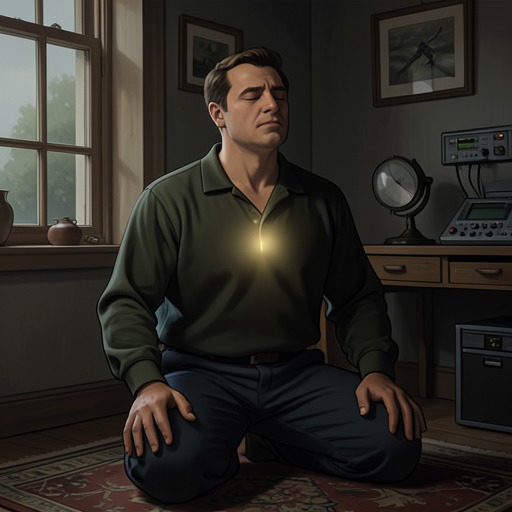
Ian Rouiller
How to Change Your MindIan Rouiller’s account shows both the promise and the limits of Psilocybin treatment for depression: a guided session gave him access to painful memories and emotions he had long avoided, brought months of relief, and left insights that persisted after the depression returned. His experience is not presented as a permanent cure. Instead, it traces a change in how he could meet his distress, followed by the gradual fading of the session’s immediate effects.
Identity and Background
Rouiller was a thirty-nine-year-old music journalist taking part in a study at Imperial College London. He and his older sister had been abused by their father during childhood. As adults, the siblings brought charges against him, resulting in their father spending several years in jail. That outcome did not end Rouiller’s depression, which had accompanied him for most of his life.
He remembered the onset of the depression as a distinct childhood moment: he was ten, in the family room of the Fighting Cocks pub in St Albans, when the cloud first seemed to descend. The account establishes an early beginning without claiming that this single remembered moment explains the whole course of his illness. The later prosecution of his father likewise did not settle the emotional burden. A decisive change in the circumstances of the family had occurred, but Rouiller’s depression remained.
Antidepressants had helped for a time. In Rouiller’s view, however, their effect was more like covering a wound than healing it. That distinction is central to his account: medication had offered some relief, but he felt it had not brought him into direct contact with the pain beneath the symptoms.
The Psilocybin Session
During the guided Psilocybin session, Rouiller’s guide had advised him to go into and through frightening material that arose. The instruction gave him a way to respond when thoughts of his father appeared. Ordinarily, he pushed those thoughts away; this time, he turned toward them and faced the image that emerged.
The image was not a straightforward replay of a family scene. Rouiller saw a military horse standing on its hind legs, dressed in a military outfit and helmet, and holding a gun. He initially found the figure frightening and wanted to set the image aside. Instead, he continued to look at it. Its absurdity then struck him, and he began to laugh. The moment marks the turn in his account: what had been a difficult trip changed as he stayed with the image rather than retreating from it.
After that shift, Rouiller experienced a wider range of emotion. Thoughts of Syrian refugees in Calais brought him to tears, and he came to feel that difficult emotions were no less valid than pleasant ones. He described resistance to emotion as something that could amplify it; allowing different feelings to be present opened instead into a sense of contentment. The experience also brought an encompassing feeling that people, including himself, should be approached with love. The importance of the session, as he recounts it, lies not in the disappearance of painful feeling but in his newfound willingness to let it be felt.
Relief and Its Return
Rouiller experienced several months of relief from depression and a changed perspective on his life. In a six-month follow-up with Rosalind Watts, he compared the shift to zooming out, as if viewing a landscape through Google Earth. For several weeks after the session, he felt connected to himself, other living things, and the universe. These effects were substantial, but they did not remain at their initial intensity.
By the one-year follow-up, the brightness of the weeks immediately after the trial had gradually faded, and his depression had returned. He nevertheless regarded the insights as lasting: what had first felt immediate and vivid now seemed more like ideas, but he did not believe those ideas had been lost. He was doing better than before and had been able to hold down a job, even as the depression continued. His account therefore holds two outcomes together—the return of symptoms and a durable change in what he understood about emotion and his own experience.
Rouiller wished he could have another Psilocybin session at Imperial College London, but that was not then an option. Instead, he sometimes meditated while listening to the playlist used during his session, which helped him reconnect with the state he had experienced. Music thus became a practical link to the treatment after the session itself was over, though the account does not suggest that it recreated the original experience or permanently relieved his depression.
Significance and Limits
Rouiller’s story is one example within the Imperial College London depression study, not proof that the treatment had the same effect on every participant. The broader account notes that more than half of the study’s volunteers eventually saw their depression return. That pattern places his months of relief in a larger tension: the experience could offer a valuable interruption to depression without functioning as a one-time, lasting remedy.
His trajectory also gives concrete form to a distinction made by Watts: depression can narrow emotional life, while the session may enable access to feelings that have been blunted or kept at a distance. Rouiller’s encounter with the horse image, followed by his response to the suffering of refugees, moves from one particular fear to a wider acceptance of emotional experience. This is not a claim that the childhood abuse or depression was resolved. Rather, his account emphasizes a new capacity to face painful material and to regard negative emotion as part of life instead of something that must be excluded.
The ending remains deliberately mixed. Rouiller’s depression returned, and he wanted further treatment; at the same time, he retained insights from the trial, continued to use meditation and the session playlist, and reported doing better than before. His experience contributes to the book’s examination of psychedelic treatment as a possible reset whose effects may need to be revisited, while resisting the simpler story of either a cure or a failure.