Nature's immanent spirituality and the agency of living beings
How to Change Your MindNature's immanent spirituality and the agency of living beings is the possibility that the natural world is not spiritually mute or merely passive, but participates in forms of subjectivity and relation that ordinary human perception tends to overlook. The book develops this idea through a deliberate paradox: a mushroom’s chemical action can be described materially, yet the experience it occasions may persuade people that reality exceeds a material account. Rather than resolve the contradiction by choosing either supernatural belief or reductionism, the narrative asks whether nature itself can be understood as both material and meaning-bearing.
The Paradox of Chemistry and Transcendence
Psilocybin makes the question especially sharp because its effects can be connected to a chemical compound acting in the brain. It is closely related to serotonin and can cross the blood-brain barrier; from this perspective, a psychedelic experience seems to support a materialist explanation of religious feeling. If a molecule can alter consciousness and produce experiences interpreted as spiritual, then gods and transcendence might appear to be products of human neurochemistry. The mechanism seems to explain away the meaning.
Yet the experiences described in the book do not usually feel, to those who undergo them, like evidence that meaning is merely an illusion. Even people with secular outlooks may return convinced that there is a Beyond, though they need not reject the natural basis of what happened. The same event can therefore point in opposite directions: the chemical offers an account of how a spiritual experience occurs, while the experience itself can seem to disclose a reality that exceeds the chemical account. This is the central paradox, not a puzzle the narrative claims to have solved.
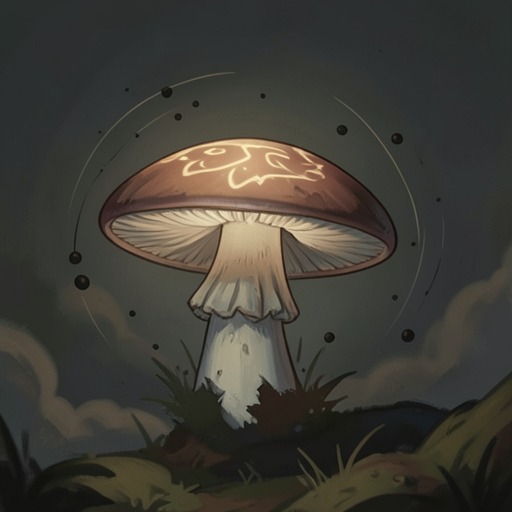
The mushroom’s own biology adds another question. The fungus produces the hallucinogen chiefly in its fruiting body, the part most likely to be eaten, which makes a simple explanation of psilocybin as a poison meant to deter predators less straightforward. The narrator wonders whether the compound might instead alter the behavior of animals that consume it, but presents this as an open question. The uncertainty matters: an apparent invitation to interpret the mushroom as a communicator is not itself evidence that the mushroom has such an intention.
A Mycologist’s Vision of Communication
Paul Stamets gives the idea of natural communication its most expansive expression. He proposes that plants and fungi may have intelligence and may use biochemical signals to enlist human help in caring for the environment. In his account, human beings matter not because they stand outside nature, but because their consciousness and language might make them capable of hearing such signals and acting on them. He imagines psilocybin as a message from Earth and sees humans as participants in a larger evolutionary process.
Stamets’s account is presented with admiration and reserve. The narrator recognizes its poetic and ecological appeal, but also its distance from established scientific explanation; the suggestion that neurochemistry is nature’s language is not treated as a demonstrated theory. Stamets describes the mushrooms as having taught him the interconnectedness of life and a sense of himself as part of a stream of molecules moving through nature. The narrator finds in this a resemblance to the volunteers whose psychedelic experiences diminished their sense of being separate individuals. In Stamets’s version, that enlarged identification makes him nature’s servant; it also supports his hope that fungal knowledge might help address ecological problems without waiting for ordinary evolutionary change.
This perspective shifts the question from whether nature can literally speak to whether human beings have mistaken their own limited mode of attention for the whole of reality. The book lets Stamets’s vision remain precarious, balanced between imaginative insight and speculation. Its significance is not that it proves fungi possess human-like intentions, but that it presses against the assumption that only human minds can be sources of meaning or agency.
The Garden and the Perception of Other Lives
The narrator’s own psilocybin experience gives this question an intimate, specific form. After eating a small brown mushroom found with Stamets at the edge of a parking lot in a Pacific coastal state park, the narrator later looked through the leaves of a climbing hydrangea in a New England garden. In the late-afternoon light, the leaves seemed to offer a plant’s-eye view of the world; at the same time, the narrator felt that they were looking back with curiosity and benevolence. The experience made the subjectivity of a plant feel immediate rather than theoretical.
The sense of attention extended beyond the hydrangea. A swamp maple across the meadow seemed newly alive, and the narrator felt that the division between matter and spirit had become difficult to maintain. This was not described as a complete mystical experience: the narrator retained the position of an observing self. But the usual boundary between the observer and the surrounding world had loosened, allowing plants, trees, birds, and even insects to appear as presences rather than background to human life. The transformation was emotional as well as perceptual, widening the narrator’s feelings toward family, Judith, and the other beings on the property.
The narrative does not present this perception as conclusive evidence of supernatural intervention. A material explanation remains available: psilocin’s effects on the brain may have altered perception, while emotion and thought became associated with the trees and leaves in view. The narrator considers projection as one possible account. But a natural explanation does not make the experience meaningless or require the natural world to be inert. In the narrator’s more cautious interpretation, the altered state invented nothing; it changed the emphasis, making the ordinary world’s complexity and other lives harder to ignore.
Immanence Without a Supernatural Beyond
The narrator’s interpretation moves away from the assumption that spiritual experience requires belief in a supernatural God or a separate realm. The garden can disclose wonder without ceasing to be a garden, and a neurochemical change can alter the filters through which it is perceived without making the resulting attention unreal. The experience suggests that what is called spirit might be immanent in nature: not an entity outside the world, but a name for the felt presence and subjectivity of beings within it.
The book connects this reading to Alexander von Humboldt’s account of reciprocal interaction between humans and nature, and to the idea associated with Ralph Waldo Emerson that nature reflects the colors of the spirit. It also draws on William James’s conception of other forms of consciousness as separated from ordinary awareness by a thin screen. These references help frame the experience as a change in access or perspective, rather than a definitive revelation about what exists beyond the natural world. The narrator remains uncertain, but becomes less willing to treat ordinary waking consciousness as the only valid measure of reality.
Huston Smith’s description of spiritual realization as an acute sense of the astonishing mystery of everything supports this non-dogmatic possibility. Wonder need not depend on a declared faith; it may arise when convention and ego cease to monopolize attention. In this account, the spiritual dimension is not necessarily elsewhere. It may be present in a garden, though ordinarily hidden in plain sight by the habits through which human beings privilege their own subjectivity.
Experience, Ritual, and the Limits of the Claim
The idea of nature as communicative also appears in the practices people build around psychedelic experience. A draft charter found by the narrator described the aim of making profound experiences more available, including states characterized as unitive or nondual. It mentioned meditation, breathwork, and fasting alongside psychoactive substances as possible means, and treated those substances as spiritual catalysts. The varied methods suggest that the experience is not attributed to chemistry alone: intention, preparation, guidance, and interpretation help shape what it becomes for participants.
The guide community’s ethical materials further show how such experiences are contained and interpreted. Its code emphasized informed consent, confidentiality, physical and psychological safety, and protection against manipulation, particularly because participants may be unusually open to suggestion. Its practical guidelines addressed preparation, drug interactions, intention, difficult experiences, and post-session integration. These protocols do not establish that nature is sending messages. They show instead that powerful experiences require a human framework of responsibility, and that the meaning assigned to them cannot be separated entirely from the conditions in which they occur.
That distinction remains visible in the narrator’s account of an ayahuasca ceremony led by a guide trained under Leo Zeff. A dozen strangers gathered in a yoga studio far from the jungle; traditional songs, prayers, bells, rattles, and scents created a ceremonial setting in which ayahuasca could be approached as a plant teacher. The ritual gave a shared form to the encounter, but did not settle what the plant’s apparent teaching meant. Across the book, nature’s agency is therefore neither dismissed as a chemical illusion nor established as a literal message from a conscious fungus. The enduring claim is more measured: human beings may experience themselves as participants in a living world whose other subjectivities are real, even when the nature of that reality remains open to interpretation.