Patrick Mettes's psilocybin session
How to Change Your MindPatrick Mettes’s psilocybin session was a full-day clinical trial experience that moved from careful preparation into visions of rebirth, cosmic unity, and death, before returning him to the immediate fact of his bond with Lisa Callaghan. The session’s significance lies not simply in its intensity, but in the way a structured therapeutic setting held an experience Patrick later struggled to put into words—and in the choice, at its most consequential moment, to remain in his life with Lisa.
Preparation and Setting
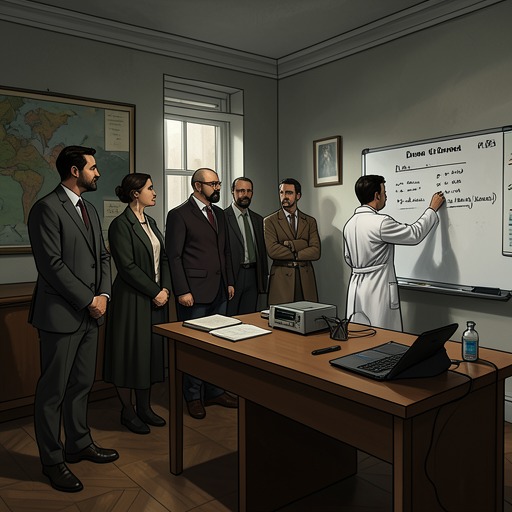
The session took place in January 2011 in a treatment room at the NYU dental school on First Avenue and Twenty-fourth Street. Lisa had an important work meeting that morning, so Patrick made the trip from their Brooklyn apartment by subway and arrived alone. The location itself reflected the trial’s uncertain institutional footing: both Bellevue and NYU’s cancer center wanted distance from research involving psychedelics, so the dental school housed the treatment room.
Patrick’s participation followed a defined clinical procedure rather than an improvised encounter. After three or four preparatory sessions of talking therapy, he was scheduled for two dosing days: one with an active placebo, a high dose of niacin that produces tingling, and one with a capsule containing twenty-five milligrams of psilocybin. For at least thirty minutes, neither Patrick nor the guides would know which capsule he had received. Each session was expected to occupy most of a day, with Patrick lying on a couch, wearing eyeshades and headphones, while two sitters remained available. Tony Bossis, his male guide, and Krystallia Kalliontzi, a female sitter, would speak little unless help was needed. The music playlist ranged from Brian Eno, Philip Glass, Pat Metheny, and Ravi Shankar to classical and New Age compositions.
Before the session, Bossis supplied flight instructions written by Bill Richards and urged Patrick to meet threatening material rather than turn away from it. His suggested phrase, “Trust and let go,” made surrender a practical instruction within the trial’s carefully prepared structure. Patrick was also asked to state an intention. He wanted to cope better with the anxiety and depression surrounding his cancer and to work on what he called his “regret in life.” He placed photographs of himself and Lisa on their wedding day, along with a photograph of their dog, Arlo, around the room.
The Journey
At 9:00 a.m., Bossis and Kalliontzi presented Patrick with a chalice containing the pill. At 9:30, he lay on the couch, put on the headphones and eyeshades, and became quiet. In the written account he worked on over the following weekend, he compared the beginning to a space-shuttle launch: “a physically violent and rather clunky liftoff which eventually gave way to the blissful serenity of weightlessness.” The image records a passage from apprehension into an experience he could later describe as expansive and peaceful.
One of his early encounters was with Ruth, his brother’s wife, who had died of cancer more than twenty years earlier, at forty-three. Patrick described her as a guide who was unsurprised by his arrival. Her translucent appearance, he wrote, made her recognizable. He associated this part of the journey with feminine presence; Michelle Obama also appeared. From that cluster of images came an understanding of maternal love as enduring despite a mother’s shortcomings. Patrick felt himself emerging from a womb and being born again, an experience he described as comforting.
The notes Bossis made during the session preserve a striking contrast between that inward account of a smooth rebirth and the visible effort of the moment. Patrick was crying and breathing heavily; he reached for Kalliontzi’s hand, drew up his knees, and pushed. Bossis recorded Patrick saying, “Birth and death is a lot of work.” The guides’ presence and his physical gestures formed part of the scene, even though Patrick’s later account gave it a different kind of coherence: a passage of renewal rather than a clinical sequence of observable actions.
Love, Cancer, and the Edge
After a pause, Patrick was reluctant to “go back in,” but eventually put his eyeshades and headphones on and lay down again. The experience then centered on love. He described it as the only consideration and purpose, emanating from a point of light and joining his sense of his body to the cosmos. Music became a simple, encompassing note, C, which he understood as the vibration of everything that existed and, together, as God. He called the joy beyond comparison with any earthly pleasure.
The insight also took the form of a critique of excess. Thinking about politics, food, music, architecture, and television news, Patrick felt that too many embellishments obscured what mattered. He concluded that love was the only thing that mattered and that making it his life’s cause was now his task. At 12:15, Bossis recorded him telling the guides that their work was done. The declaration suggests a moment of apparent completion; the journey continued, however, and turned back toward his illness.
Patrick next described touring his lungs and seeing two spots. In his account, the cancer seemed minor in the larger scheme of things, an imperfection of human life rather than the central work before him. That perspective did not erase the disease; it altered its place within the experience. Later, he approached a sharp, stainless-steel-like edge above what he understood as an infinite abyss. He was hesitant, but not frightened, and considered whether crossing it might mean leaving his body permanently. When he explained his choice to the guides, he said he was not ready to leave Lisa. The session thus brought the prospect of death into view without making departure its conclusion: his attachment to his wife gave his decision a particular human consequence.
Return and Significance
The journey ended rather suddenly at about 3:00 p.m. Patrick described the return from a state without time or space to ordinary awareness as quick and comparatively dull; he had a headache. When Lisa arrived, she recalled that he looked exhausted, yet was eager to tell her what he had experienced. He told her he had “touched the face of God.” The phrase gave Lisa a compact account of an experience that Patrick’s longer written narrative had already shown to resist ordinary description.
The account became part of a wider inquiry into psilocybin treatment for people with cancer, not proof that Patrick’s individual course of illness had changed. In the NYU and Johns Hopkins trials, about 80 percent of cancer patients showed clinically significant reductions in anxiety and depression, sustained for at least six months; across the trials, stronger mystical experiences were closely associated with greater symptom relief. The studies were small, with eighty subjects in all, and required larger-scale repetition. Patrick’s session nevertheless makes concrete what those results measure only in aggregate: an encounter in which illness, fear, love, and mortality were reinterpreted within a guided clinical setting. Its movement from intention, through an ordeal of birth and imagined death, to a decision grounded in his relationship with Lisa also underscores that the experience did not end when the dose wore off. Patrick labored through the weekend to write it down, turning an intense private event into a narrative that could be revisited and shared.