Psilocybin
How to Change Your MindPsilocybin is a mushroom-derived psychoactive compound that became a laboratory-made research substance and a catalyst for experiences many people describe as mystical or life-changing. Its significance in the book rests on a paradox: a chemical can provide a material explanation for altered consciousness while the experience it occasions persuades some participants that reality exceeds the material. The compound links natural history to laboratory science, formal experiments to private journeys, and biological action to disputes about what an experience means.
Natural Source and Laboratory Form
The book repeatedly restores a natural history that can recede behind the clinical setting. Psilocybin comes from a fungus; the compound and the mushroom associated with it entered scientific knowledge in the 1950s, while Mazatec people had used the mushrooms secretly for healing and divination since before the Spanish conquest. In that tradition the mushrooms were known as the flesh of the gods. The historical contrast is pointed: an experience treated in a modern clinic as the effect of a measured compound has roots in a living organism and in practices that joined healing with sacred interpretation.
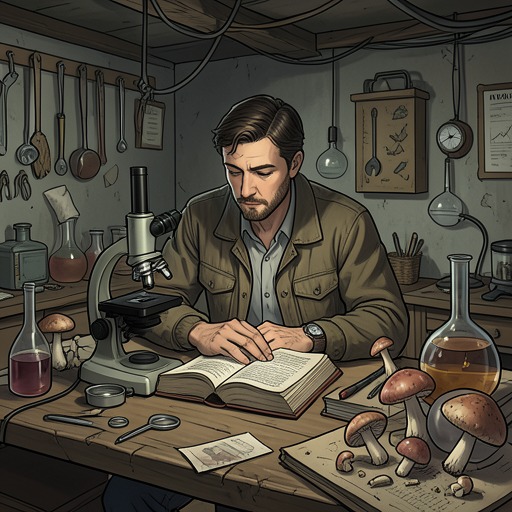
Modern psychedelic researchers work with synthetic psilocybin rather than mushrooms. Volunteers take a small white pill, not a handful of acrid-tasting fungi, and their sessions unfold in medical suites. This form makes the compound easier to study, but it also distances research from the mushroom’s cultural and ecological associations, including Native American shamanism, 1960s counterculture, and the natural world. The book notes how few reminders of mushrooms appear in the laboratory, despite their being the source of the chemical at the center of the research. A ceramic mushroom on a shelf and a medallion depicting Psilocybe cubensis stand out precisely because the clinical environment otherwise makes that origin easy to forget.
The underlying biology sharpens the mystery rather than settling it. Psilocybin is closely related to serotonin, a neurotransmitter, and can cross the blood-brain barrier. In the author’s account of one experience, the active compound psilocin is described as acting at 5-hydroxytryptamine 2-A receptors. These are material mechanisms by which a fungus-derived substance can alter a mammalian brain. But the book does not present a settled evolutionary explanation for why the mushroom produces the compound. The straightforward suggestion that it serves as a defense against animals is complicated by its concentration in the fruiting body—the part of the organism most likely to be eaten. Paul Stamets and Terence McKenna propose that neurochemistry may be a language through which nature communicates, but the narrator treats this as a poetic conception rather than a scientific answer. Michael Beug, a chemist and Stamets’s former professor, helps frame the question through the broader possibility that compounds affecting a predator’s behavior might function as defenses without simply killing it; the passage leaves the specific function of psilocybin unresolved.
Research and the Question of Evidence
At Harvard, Timothy Leary and Richard Alpert established the Harvard Psilocybin Project in a small office in the Department of Social Relations, with the tacit approval of department chair David McClelland. The university permitted them to give the new drugs to graduate students but not undergraduates. In the project’s first experiments, the researchers administered psilocybin to hundreds of people, including housewives, artists, musicians, academics, writers, psychologists, and graduate students, then asked them to complete questionnaires. Their preliminary report described experiences that were generally positive and sometimes life-changing.
The circumstances of those sessions mattered. They took place in comfortable living rooms, with music and candlelight, rather than in university buildings; the researchers often took the drug too. Leary and Alpert’s observations helped bring the terms Set and setting into psychedelic research literature. The project’s claims therefore concerned more than a molecule in isolation: its researchers attended to the surroundings and expectations accompanying the drug. Yet the book distinguishes the influence of the terminology from the origin of the underlying idea, crediting Al Hubbard with much of the conceptual groundwork.
The Concord Prison Experiment extended the claim that psilocybin might change personality into a high-stakes question about recidivism. Planned by Leary and graduate student Ralph Metzner, it involved thirty-two inmates in a maximum-security prison who received psilocybin in sessions attended by a member of Leary’s team. One team member took the drug with the prisoners, while another remained sober to observe and take notes. A comparison group received neither drugs nor special treatment; both groups were followed after release. Leary reported that ten months later 25 percent of the psilocybin recipients had returned to jail, compared with 80 percent of the control group. Decades later, Rick Doblin’s reconstruction of the outcomes found no statistically significant difference between the groups. The striking initial figures thus became an example of how a drug’s promise and a research design’s weaknesses can coexist, and why reports of transformative effects do not by themselves establish a treatment outcome.
The Good Friday Experiment offers a contrasting research context. Walter Pahnke’s study involved twenty divinity students and attempted a controlled, double-blind design using an active placebo, so neither investigators nor participants knew who had received psilocybin. The study was imperfect: Pahnke did not disclose that one participant had become distressed and required sedation. Its central conclusion nevertheless endured in the book’s account—that psilocybin could reliably occasion a mystical experience resembling, or perhaps identical to, those described in religious literature. The result later helped inspire renewed research, including a 2006 study at Johns Hopkins University. Together, these studies show the compound being investigated not only as a chemical agent but also as a means of eliciting experiences whose meaning and measurement are difficult to separate.
Journeys Beyond the Clinic
The book places personal mushroom journeys beside research sessions to show what changes when psilocybin is encountered as a mushroom rather than only as a standardized pill. Before one journey, Mary prepared an altar in a second-story loft and recited a long Native American prayer invoking the cardinal directions, elements, and animal, plant, and mineral realms. Among the objects on the altar were water, dark chocolate, an amethyst, a bronze Buddha, and a psilocybin medallion given by Roland Griffiths. The mushroom itself was unusually large, and Mary encouraged the narrator to examine and eat it rather than dissolve it into tea. He ate nearly all of it, amounting to about two grams; Mary planned to offer another two grams later, which would have brought the total to approximately the dose used in the NYU and Johns Hopkins trials. The account makes the substance’s form and setting inseparable: the same research compound is encountered here as a tangible piece of fungus within a deliberately ceremonial environment.
A later journey with Judith began differently. After finding Psilocybe azurescens with Stamets, the narrator followed Stamets’s advice to cook the mushrooms to reduce stomach upset. He crumbled two small mushrooms into each of two glasses, poured hot water over them, and he and Judith drank half a cup each, including the mushroom pieces. They set out along a dirt road near their former home while waiting for the effects. Within about twenty minutes Judith felt unwell and wanted to return. She described her mind and body as drifting apart and her mind as having flown out of her head and into the trees. As she grew urgent about getting home and feeling safe, the pair turned back. When a neighbor’s pickup approached shortly before they reached home, they ducked into the woods until it passed. The episode shows how the promise of a meaningful experience could be accompanied by fear, disorientation, and the immediate practical importance of being somewhere that felt safe.
The narrator later describes the transformation of the familiar natural world into something numinous: an altered openness toward his parents, Judith, and the plants, trees, birds, and insects around the property. Some of that openness persisted, and he understood the experience as wonder and immanence. Yet he also lays out a materialist account: psilocin’s action at receptors could have set off disordered mental events, allowing feelings or thoughts to become associated with what he saw. On that account, the sense of significance might be projection rather than evidence of a transcendent reality. The text does not resolve the two interpretations. Instead, it makes that unresolved choice part of the compound’s meaning: psilocybin can be understood as a chemical event in the brain and, by those who undergo it, as an encounter with something beyond a material account.
The Materialist and Spiritual Paradox
The book treats psilocybin’s effects as a challenge to any simple division between scientific explanation and spiritual experience. Because the experience is mediated by a chemical, it can support the conclusion that religious beliefs arise from material processes in the brain. Yet many people who undergo psychedelic experiences, including those described as secular, come away convinced that some kind of Beyond exists. They need not deny the natural basis of the experience; they interpret that basis differently. If molecules shared by brains and the natural world can mediate transcendence, then nature may be understood not as spiritually empty but as the place where spirit is immanent.
That reversal is the substance’s decisive narrative role. Psilocybin can seem to disenchant the world by locating an experience of the sacred in a molecule; the same experience can re-enchant it, making the molecule a passage into a sense of nature’s presence. The book holds both readings in view without declaring either proven. Its movement from a mushroom hidden by clinical routines, through experiments whose evidence varies in strength, to ceremonies and unsettling private encounters gives the compound more than one kind of agency in the narrative: it changes consciousness, but it also forces researchers and participants to ask what counts as an explanation of consciousness at all.