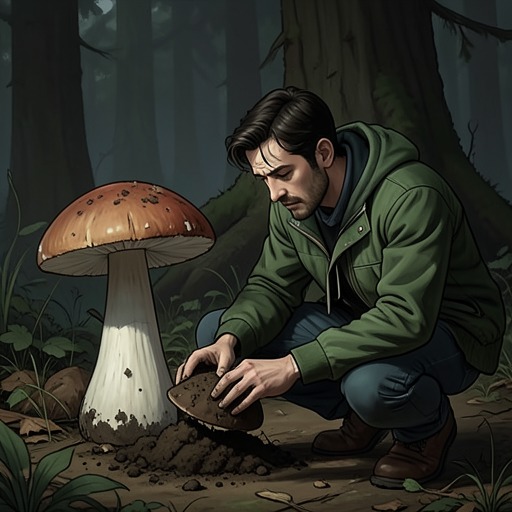
Psilocybin as a fungal messenger
How to Change Your MindPsilocybin as a fungal messenger is a proposal associated with Paul Stamets that frames the psychoactive compound in terms of communication rather than treating it only as a chemical with effects on human consciousness. The book identifies the proposal as part of Stamets’s mycological thinking, but the available account does not set out what message psilocybin might carry, to whom it might be addressed, or by what mechanism. The distinction matters: the idea is named, while its explanatory details remain unspecified.
The proposal and its limits
The phrase “fungal messenger” suggests a role for psilocybin within a larger account of fungi and their relations with other living things. It therefore invites questions that a purely human-centered description of the compound might leave aside: whether a fungal product participates in communication, what organisms could be involved, and how such a signal would operate. Those questions clarify the scope of the proposal, but the book evidence provided here does not answer them. It would go beyond that evidence to claim a particular recipient, adaptive purpose, or signaling pathway.
The idea is consequently best understood as a theoretical framing, not as an experimentally established mechanism in the material available here. In particular, evidence that a forest contains connected routes for moving resources cannot on its own establish that psilocybin carries information through those routes. The forest findings offer ecological context for thinking about connection and exchange; they do not demonstrate the messenger claim.
Forest networks as context
A concrete account of interconnected forest life comes from scientists at the University of British Columbia, who injected fir trees with radioactive carbon isotopes and tracked their movement through the forest community. Within days, the carbon had been routed from tree to tree. In a plot thirty meters square, every tree was connected to the network, and the oldest trees served as hubs, with some linked to as many as forty-seven others. The resulting diagram resembled a map of the Internet.
A paper by one of the researchers called this network the “wood-wide web,” described in the account as a tip of the hat to Stamets. The study gives a specific picture of forest connection: labeled isotopes moving among trees, hubs with many links, and a mapped pattern that invited comparison with digital networks. Its measured subject was the spread of carbon, however, not the movement of psilocybin or a message carried by it. Keeping those claims separate preserves the suggestive ecological setting without converting an analogy into proof.
Significance within Stamets’s mycology
The messenger proposal gives psilocybin a place within a broader mycological outlook, one in which fungi and their relations are worth considering beyond their immediate usefulness to people. Its significance in the account lies partly in that change of emphasis: the compound becomes a possible participant in biological relations, not simply an object of human consumption or study. The book’s juxtaposition of Stamets’s theory with the forest-network research makes the idea legible as an inquiry into connection, while leaving its mechanism open.
That openness is essential to an accurate account. The forest study supplies detailed evidence for carbon moving through a connected system; the messenger theory supplies a conceptual question about what psilocybin might do within fungal life. The two belong in conversation, but the evidence does not collapse them into one finding. Psilocybin as a fungal messenger therefore remains a distinctive proposal whose wider explanatory promise is apparent, even though its specific operation is not described here.