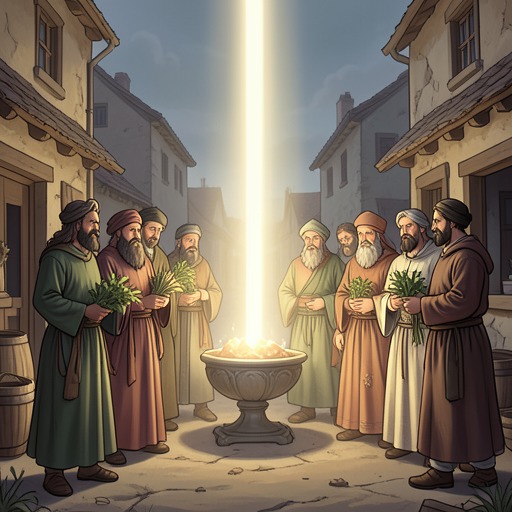
Roman Catholic Church
How to Change Your MindThe Roman Catholic Church is presented as an institutional opponent of Indigenous mushroom ceremonies in colonial Mexico, where the mushrooms offered a form of sacred access that did not depend on Christian clergy or liturgy. Its confrontation with those practices involved condemnation and suppression, but the history does not end with a simple opposition between Christianity and Indigenous religion: centuries later, Mazatec practitioners could be devout Catholics while using mushrooms for healing and divination, and an outsider’s account could obscure those local purposes by interpreting the ceremony through his own religious theory.
Sacramental Authority
The conflict was not merely over an unfamiliar plant or a set of unusual customs. The book identifies a challenge to religious authority: psychoactive mushrooms were understood as a sacrament capable of giving those who ate them direct access to visions of a divine realm. Christian Eucharistic practice, by contrast, depended on faith in the sacred meaning of bread and wine, within a rite mediated by a priest and the Church. In the book’s account, the mushroom sacrament’s power lay partly in the immediacy of the experience it promised. That contrast helps explain why Church authorities could regard Indigenous mushroom use as more than a rival ritual: it threatened the institution’s claim to mediate access to the sacred.
The Nahuatl name for the mushrooms, Flesh of the gods, sharpened the theological collision. To Spanish Christian ears, the phrase could sound like a competing account of divine communion, since the Eucharist also concerned the sacred flesh of God. The book uses this parallel to explain the intensity of the response without suggesting that the two traditions were identical. One was embedded in Catholic doctrine and Church ritual; the other involved a psychoactive sacrament associated with direct visions. The dispute was therefore also about who could define legitimate communion and the means by which people might encounter the divine.
Conquest and Suppression
After the Spanish conquest, the sacramental use of psychoactive mushrooms was driven underground. The book describes the resulting secrecy as lasting for four centuries, a duration that helps account for the reticence encountered by R. Gordon Wasson when he began asking about mushroom practices in southern Mexico. Some people denied that the mushrooms were used; others said the practice had ended or survived only in another village. The silence was not evidence that the tradition had never existed, but part of the historical consequence of its suppression.
The account includes several forms of that suppression. A priest brought to Mexico by Cortés to Christianize the Aztecs condemned the mushrooms as a vehicle for worship of a rival deity. Indigenous people were subjected to interrogation and compelled to confess their practices, while mushroom stones—some foot-tall sculptures carved from basalt and presumed to have served in ceremonies—were smashed. The Inquisition brought charges against Native Americans involving both peyote and psilocybin. These actions connected the attack on mushroom ceremonies to a broader effort to control plant-based divination and religious practice; the book frames that history as an early campaign against particular plants and fungi.
In 1620, the Roman Catholic Church formally declared the use of plants for divination to be superstition opposed to the purity and integrity of the Catholic faith. The decree placed an institutional judgment behind the practical repression described elsewhere in the account: such practices were not recognized as an alternative religious path, but classified as incompatible with the Church’s doctrine. The evidence here establishes that condemnation and its historical context, rather than a detailed account of how the decree was enforced in every place or period.
Local Practice and Outside Interpretation
The later history complicates any picture of an unbroken contest between Catholicism and mushroom use. By the time Wasson attended a ceremony in Huautla de Jiménez in 1955, many Mazatecs had become devout Catholics. According to the book, mushrooms were then used not principally for worship but for healing and divination, including efforts to locate missing people and important objects. Catholic faith and Indigenous practice could therefore inhabit the same community, even as outsiders might describe them as mutually exclusive.
Wasson approached the ceremony with a theory about psychoactive fungi and the origins of religious experience already firmly in mind. To gain access, he told María Sabina that he was concerned about his son’s whereabouts and well-being. The book says Wasson later believed that information he received during the ceremony was accurate, but it also stresses the gap between his interpretation and Sabina’s understanding of her work. He presented her as a religious figure and the ceremony as a kind of holy communion, while her practice served the sick and those seeking divinatory help. Her later explanation, as reported in the book, directly challenged the claim that people had traditionally taken the mushrooms simply to find God.
This distinction matters to the Church’s place in the account. The colonial conflict concerned an Indigenous sacrament that Christian authorities perceived as a threat to their spiritual authority; the twentieth-century encounter also involved a Western observer transforming a living, locally situated practice into evidence for a general theory of religion. The book thus keeps institutional suppression and later interpretive appropriation in view without treating them as the same act. In both cases, however, the meaning assigned by outsiders could displace the purposes and explanations held by practitioners.
Historical Significance
The Roman Catholic Church is the first institution in the book’s account to recognize fully the challenge that a psychedelic plant could pose to established authority. That observation gives the history significance beyond the particular ceremonies described: the struggle concerned who could authorize religious experience, distinguish legitimate devotion from superstition, and set the boundaries of acceptable practice. The Church’s response combined doctrinal classification with efforts to break the social and material continuity of Indigenous rites, including the destruction of mushroom stones.
Yet suppression did not erase the practice or determine its later meaning. The ceremony Wasson encountered had survived within a transformed religious landscape, and its purposes could not be reduced to his search for a universal encounter with God. The book’s treatment therefore holds two facts in tension: Church authorities saw the mushroom sacrament as a rival to Christian mediation, while later Mazatec practitioners could maintain Catholic commitments and turn to mushrooms for healing and divination. That tension makes the Church more than a backdrop to the rediscovery of sacred mushrooms. It is central to the history of why the practice became secret, how it was classified, and how its meaning continued to be contested.