Sandoz
How to Change Your MindSandoz was the pharmaceutical company whose synthesis, marketing, and unusually open distribution of LSD helped make the drug a worldwide research subject. From 1949 to 1966, it supplied LSD without charge to researchers and even therapists willing to report their observations, setting off a far-reaching first wave of psychedelic investigation. When controversy gathered around the drug, Sandoz reversed course and withdrew it from circulation; that decision helped end the very research effort its supply policy had enabled.
From laboratory compound to psychiatric drug
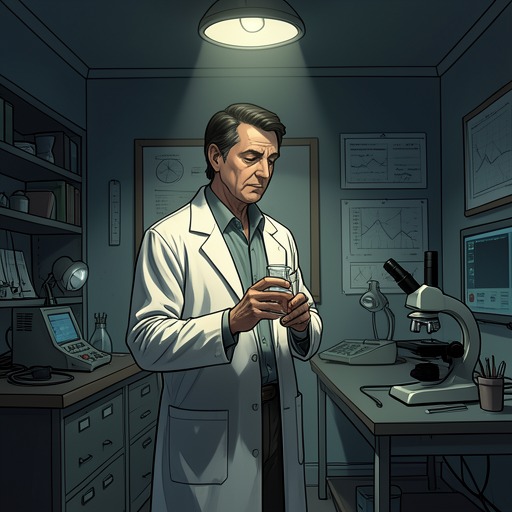
In 1938, Swiss chemist Albert Hofmann synthesized LSD-25 while working at Sandoz, as part of a search for a medicine to stimulate circulation. LSD was the twenty-fifth molecule he derived from alkaloids produced by ergot, a fungus that infects grain. When the compound showed no promise as a medicine, Hofmann set it aside. Five years later, a premonition led him to resynthesize it. After accidentally ingesting a small quantity, he discovered its powerful psychoactive effects. The episode transformed an unsuccessful candidate compound into a substance with implications that Sandoz could not readily place within existing medical categories.
Sandoz began marketing LSD as a psychiatric drug in 1947 under the brand name Delysid. Hofmann’s 1943 experience had left him unsure whether he had encountered madness or transcendence, but he recognized the compound’s potential importance to neurology and psychiatry. The drug presented an unusual commercial and scientific problem: its effects were dramatic, but what those effects meant, and what practical use they might have, remained uncertain. Rather than limit access to a narrow research program, Sandoz invited a broad field of investigators to find out.
An open-supply research policy
From 1949 onward, Sandoz offered to provide researchers with however much LSD they requested, free of charge. The company defined a researcher liberally: therapists could qualify if they promised to write up their clinical observations. In effect, Sandoz distributed the task of discovering LSD’s uses across a worldwide network of practitioners. The policy reflected the hope that someone might identify a commercial application for the compound, but its consequences extended well beyond a controlled, company-run investigation.
The supply helped make LSD available for experiments in different countries and within different psychiatric frameworks. Researchers could test its effects on patients, while many also tried it themselves. At the Saskatchewan Mental Hospital in Weyburn, Humphry Osmond and Abram Hoffer obtained LSD-25 from Sandoz as they investigated the drug within the psychotomimetic paradigm. Their work entered public discussion in 1953, when Maclean’s published Sidney Katz’s account of an LSD session at the hospital. Katz had been led to expect madness, and his report described frightening transformations alongside visions of beauty. His experience exemplified how a drug’s meaning could be shaped both by its effects and by the expectations surrounding an experiment.
Sandoz’s role also reached beyond LSD. Shortly after R. Gordon Wasson’s article about Mexican mushrooms appeared in Life, Wasson arranged for specimens to be sent to Albert Hofmann in Switzerland. In 1958, Hofmann isolated and named psilocybin and psilocin and developed synthetic psilocybin, the form used in later research. This work extended Sandoz’s place in psychedelic science from supplying an experimental drug to enabling the identification and synthesis of compounds found in the mushrooms.
Supply beyond formal institutions
Sandoz’s distribution network also depended on intermediaries whose activity crossed the boundaries between research, therapy, and advocacy. Al Hubbard used his connections in government and business to persuade Sandoz to give him a very large quantity of LSD. Accounts differed about the amount: one described a liter bottle, another forty-three cases, and another six thousand vials. Hubbard reportedly said he intended to use it to liberate human consciousness. He later became Sandoz’s exclusive distributor of LSD in Canada and secured an Investigational New Drug permit from the FDA to conduct clinical research in the United States.
Hubbard’s access helped carry LSD into settings outside conventional hospital research. Myron Stolaroff, an engineer at Ampex, traveled to Vancouver in March 1956 for a session with Hubbard. Sixty-six micrograms of Sandoz LSD preceded an experience in which Stolaroff reviewed, over several hours, the planet’s formation, the development of life, the emergence of humanity, and his own birth. He later described the session as a decisive opening and committed himself to the work. He shared his interest with friends and colleagues at Ampex; Hubbard then traveled to Menlo Park to guide members of the group and train them to guide others. The episode shows how the company’s supplies could circulate through personal networks as well as hospital and laboratory channels.
At Harvard, the drug’s growing public visibility became entangled with disputes over research oversight. After university officials required Timothy Leary to place his supply of Sandoz psilocybin pills under Health Services’ control, a student reporter’s account of a faculty controversy appeared on the front page of the Crimson. Leary and Richard Alpert later concluded that their work was too controversial for a university setting and announced that they would conduct research under the International Federation for Internal Freedom instead. The episode involved psilocybin rather than Sandoz’s LSD supply, but it reflected the larger problem facing psychedelic research: access to the compounds, institutional control, and public controversy had become difficult to separate.
Withdrawal and the end of the first wave
By 1966, controversy had become a liability Sandoz sought to escape. In April, the company withdrew LSD-25 from circulation, describing the compound in later accounts as Hofmann’s problem child. It turned over most of its remaining stocks to the U.S. government. At the time, seventy research programs were underway; many shut down after the supply was withdrawn. A policy that had given investigators broad access for more than fifteen years thus ended with an abrupt contraction of the research it had helped set in motion.
The withdrawal coincided with a national dispute over the distinction between legitimate medical investigation and illicit use. In May 1966, Timothy Leary and Sidney Cohen testified at Senate hearings on LSD, defending psychedelic research while attempting to distinguish it from the black market. Senator Robert F. Kennedy questioned why projects considered worthwhile six months earlier should no longer be allowed to continue, and warned of the loss to medicine if illicit use led to a ban on proper research. The hearings did not reverse Sandoz’s decision. By the end of the year, the first major project of psychedelic science had collapsed.
Sandoz’s importance therefore rests on a consequential reversal. Its free-supply policy made LSD available to a broad range of researchers and therapists, contributing to a period of investigation in psychiatry and to uses that traveled well beyond formal clinics. Its withdrawal, prompted by the controversy surrounding the drug, helped deprive those investigators of their material and close many active programs. Delysid had begun as a pharmaceutical offering whose purpose was unsettled; for seventeen years, Sandoz let a dispersed community test what it might mean. In 1966, the company withdrew the compound just as the question of its meaning had become a public and political conflict.