Set and setting
How to Change Your MindSet and setting is the principle that a psychedelic experience is shaped not only by the substance but also by the person’s mental state and expectations and by the surroundings and relationships in which the session takes place. It became a practical foundation of psychedelic therapy and a challenge to experimental methods that treat context as an extraneous variable. The history traced in the book distinguishes the early recognition of the principle by Al Hubbard from the later popularization of its terminology by Timothy Leary: the names came later than the therapeutic insight.
Meaning and Origins
Set refers to the inner conditions a person brings to a session: mindset, expectations, and, in therapeutic practice, the intention around which the experience is prepared. Setting refers to the outward circumstances, including the physical environment and the conduct of the people present. These factors can shape the character of a psychedelic experience, and the book emphasizes that their influence is unusually strong in this context. The principle therefore concerns not merely where a drug is taken, but how the person, surroundings, and session are organized together.
Al Hubbard recognized this importance before the terms became standard. In the treatment room, he regarded the white walls and fluorescent lights of the conventional hospital as poorly suited to a session. He brought in pictures, music, flowers, and diamonds instead. Paintings by Salvador Dalí and pictures of Jesus could help prime patients for a mystical revelation; a diamond’s facets offered something to focus on; and the surroundings could also help redirect a journey when it turned frightening. Hubbard’s practice treated the room as an active part of therapy rather than a neutral backdrop.
The objects were not decoration alone. In one Vancouver session, Hubbard gave an alcoholic patient a bouquet of roses and asked him first to hate the flowers, then to love them. The patient later recalled seeing the petals wither and fall, then return brighter, and understanding the episode as a lesson in how his own outlook shaped his relationships. The incident illustrates the principle in miniature: an object, a therapist’s direction, and the participant’s altered state became parts of a deliberately arranged experience. The book links Hubbard’s methods to a Westernized use of tools familiar from shamanic healing, where words, objects, and music can guide a person in a trance or under the influence of a powerful plant medicine.
From Treatment Practice to Research Finding
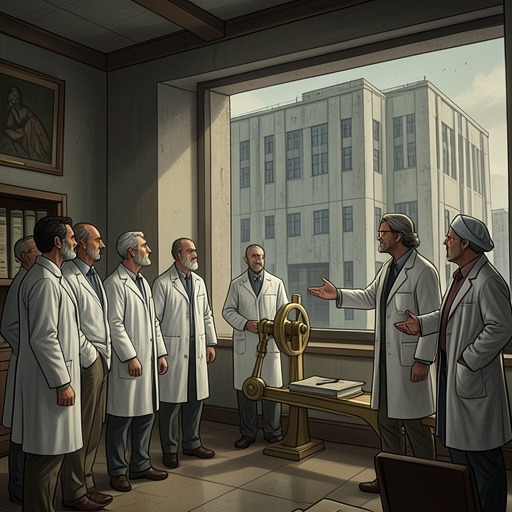
Hubbard’s approach developed alongside the work of Humphry Osmond and Abram Hoffer with alcoholics at Weyburn hospital. Their volunteers helped the researchers see that the experience did not always resemble the temporary psychosis their early model predicted. The surroundings and the therapist mattered, too: Osmond and Hoffer came to value an engaged, empathetic therapist, ideally one with personal experience of LSD. They suspected that some psychotic reactions might be partly an artifact of an impersonal clinical environment—the metaphorical white room and white-coated clinician—rather than an inevitable effect of the drug alone.
The contrast between Saskatchewan and Toronto made the importance of context especially visible. Saskatchewan’s results led the provincial government to make LSD therapy a standard treatment option for alcoholics. In the early 1960s, the Addiction Research Foundation in Toronto attempted a more tightly controlled replication. Its clinicians sought to separate the drug’s effect from other variables: participants were placed in neutral rooms, clinicians avoided engaging with them except to administer a lengthy questionnaire, and some volunteers were restrained or blindfolded. The results did not match the Saskatchewan outcomes, and several participants had terrifying experiences. The opposing interpretations each captured part of the problem: the treatment appeared less effective under those controls, while its supporters argued that removing the supportive features of the session had also removed conditions essential to the therapy.
The discrepancy exposed a difficulty rather than settling the question. If a therapist’s presence, the participant’s expectations, and the environment help shape what happens, then they cannot simply be ignored when evaluating the drug. Yet the more deliberately those factors are used, the harder it becomes to treat the session as a test of a chemical in isolation. Set and setting thus became both a therapeutic principle and a methodological problem.
Naming the Principle
The language became prominent later than the practice. The book credits Leary with introducing the terms set and setting in this context in the literature, drawing on fieldwork conducted during the Harvard Psilocybin Project. In its early experiments, Leary, Richard Alpert, and their colleagues gave psilocybin to hundreds of people, including artists, academics, writers, musicians, housewives, and graduate students, and collected accounts of their experiences. Sessions took place in comfortable living rooms with music and candlelight rather than university buildings; researchers often took the drug themselves. The setting was therefore part of the method, even as the researchers were developing ways to describe its importance.
Leary’s terminology helped make the principle portable, but the book does not credit him with originating the underlying insight. It identifies Hubbard as an earlier practitioner who understood how expectations and circumstances could influence a session and who used that understanding in treatment. The distinction matters: naming an idea can consolidate and circulate it, while the history of its practical use may begin elsewhere. Leary’s most enduring contribution to psychedelic science, in the account presented here, may have been the terms themselves, rather than the first recognition of the phenomenon they describe.
The Harvard work also demonstrated how easily a research environment could blur into an experiential one. Its living-room sessions looked more like parties than conventional experiments, and the researchers’ participation complicated the separation between observer and subject. The project’s observations helped articulate the role of context, but that same role made it difficult to isolate variables or to treat the experience as independent of the people producing and interpreting it.
Therapy, Suggestion, and Scientific Control
The principle has direct consequences for how psychedelic therapy is understood. It is not simply the administration of a drug; it involves preparing a participant, shaping the session, and responding to what arises. In the smoking-cessation work discussed in the book, the aim of breaking the habit is established in preparatory meetings and reinforced through the therapist’s involvement and later integration. Psilocybin does not automatically make a smoker quit: many people have taken it and continued smoking. The therapeutic intention and the way the experience is framed are part of the intervention.
That role for context complicates conventional drug trials. Participants and guides can often tell whether the substance is psilocybin or a placebo, making blinding difficult. Researchers must also contend with expectations, therapists’ conduct, and the setting, all of which can affect the outcome. These conditions muddy causal claims in experiments built around isolating a single variable. They also raise a deeper question for medicine: how should a treatment be evaluated when its apparent action may depend in part on the experience it occasions, rather than on a narrowly pharmacological effect alone?
Researchers have differed over how to describe that therapeutic dimension. Charles Grob has called psychedelic therapy a form of applied mysticism. Franz Vollenweider has objected that mysticism is not a medical concept and described it instead as an interesting shamanic concept. Other researchers, including Grob, have argued that rigorous scientific methods should be informed by successful applications of the shamanic paradigm. In that account, the therapist orchestrates factors beyond the drug itself, including set and setting, to make constructive use of the medicines’ suggestibility. The principle sits at a contested boundary: it makes the experience more deliberately therapeutic while making it harder to fit into models that depend on isolating a drug from its context.
A Container for the Experience
The principle also underlies the practical rules developed around psychedelic sessions. Guidelines for participants and guides address mental and physical preparation, drug interactions, intention, the stages of the experience, responses to frightening material, and post-session integration. Ethical codes emphasize consent, confidentiality, risk disclosure, and the guide’s responsibility for a participant’s well-being, including protection from manipulation and self-promotion. In this setting, careful preparation and professional boundaries are not secondary to the experience; they help shape the conditions in which it occurs.
The book frames these protocols as a cultural container for powerful and potentially misused medicines. Modern medicine offers one such container through controlled trials, clinicians, and diagnostic systems; underground guides offer another through inherited knowledge, agreements, rules, and rituals. Neither arrangement makes context disappear. Rather, each organizes it differently, attempting to contain and channel the force of the experience. Set and setting therefore names more than a room and a mood: it points to the relationships, expectations, safeguards, and therapeutic aims that help determine what a psychedelic session becomes.