Stuttering
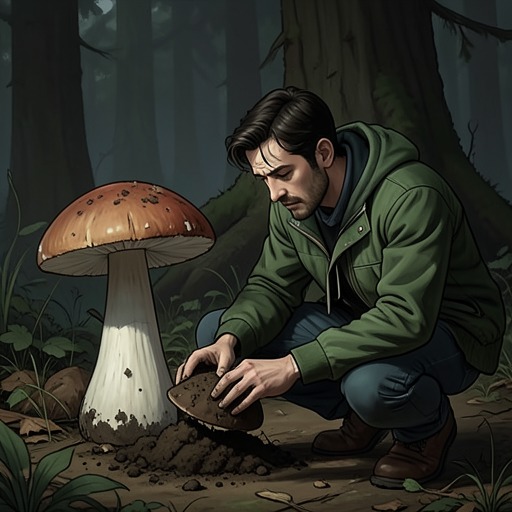
How to Change Your MindStuttering is presented in Paul Stamets’s account as a long-standing difficulty with concrete consequences for how he navigated social encounters. He remembers looking down at the ground because he feared that someone might try to speak to him. That habitual downward gaze also shaped his attention: he said it was one reason he became so good at finding mushrooms. His recollection therefore connects speech, social apprehension, and the beginnings of a practiced way of seeing the ground beneath him. The condition is not described as an isolated symptom; it enters the story as both a constraint on ordinary interaction and an unintended accompaniment to an emerging skill.
A Difficulty That Shaped Daily Life
Stamets says the stutter had troubled him for as long as he could remember and calls it a debilitating issue. Its effects appear in the simplest social possibility: being approached and spoken to. His account specifies that he was afraid people would try to talk to him, and that he responded by keeping his eyes lowered. This places the difficulty in the space between speech and anticipated contact, without supplying a diagnosis, a clinical history, or details about treatment before college.
The downward look carries a second consequence. Stamets connects it to his ability to find mushrooms, suggesting that a posture associated with avoidance also trained his attention toward the ground. The account does not say he deliberately turned a limitation into a method; rather, it identifies a practical result that became meaningful in retrospect. Looking down could mark his unease around other people while also bringing the forest floor into focus. That double function makes the stutter part of the circumstances from which his later interest in mushrooms emerged, not simply a problem mentioned apart from the rest of his life.
The Freshman-Year Experience
Near the end of his freshman year at Kenyon College, Stamets ate a whole bag of mushrooms on a spring afternoon while walking alone along a wooded ridgeline above campus. He estimated the amount at perhaps ten grams and thought it was a proper dose; the account contrasts this with four grams as already a lot. As the effects came on, he noticed a particularly beautiful oak and decided to climb it. The episode places his speech difficulty inside an intense and physically precarious experience, rather than in a controlled therapeutic setting.
High in the tree, he became dizzy and felt unable to climb down. He wrapped his arms around the trunk and held on as the tree swayed and a thunderstorm approached. The lightning and storm became the immediate frame for a thought about survival: while holding the tree, he asked himself what issues he would have if he lived. His answer turned directly to his stutter. He told himself that he was not stupid, but that stuttering was holding him back, and that he could not look women in the eyes. In this remembered crisis, the condition is named alongside a specific social inhibition, giving it a sharper personal meaning than the earlier description of a general fear of conversation.
The Repeated Resolve and Reported Change
Stamets says he made stopping the stutter his mantra and repeated the resolve over and over. The account emphasizes repetition, not a particular technique or a gradual program of practice. The storm eventually passed; he climbed down, walked back to his room, and went to sleep. He later described the experience as the most important of his life to that point, but the reported change becomes visible in an ordinary encounter the following morning.
Walking along the sidewalk, Stamets saw a girl he was attracted to and regarded as beyond his reach. She greeted him and asked how he was. He looked at her and answered that he was doing great. He reports that he did not stutter, and that he has hardly ever stuttered since. The smallness of the exchange matters to the account: after the storm, the tree, and the fear of being struck by lightning, the change is registered in a brief conversation on a campus sidewalk. His description presents a striking before-and-after, but it remains his account of what followed the experience; it does not establish a general treatment effect or explain the mechanism of the change.
Consequence and Narrative Significance
Stamets’s recollection makes the stutter a decisive part of the route by which mushrooms became central to his life. After describing the next-morning encounter, he says that this was when he realized he wanted to look into mushrooms. The sequence links his reported change in speech with a new direction of attention: the condition that had helped keep his gaze on the ground had also, in his telling, accompanied his developing ability to find fungi. The account thus gives the stutter a double place in his personal history—as an obstacle he says receded, and as part of the lived circumstances surrounding his growing interest.
The story is organized around a vivid contrast: before the experience, he anticipates conversation and looks down; afterward, he meets the gaze of someone he is attracted to and answers without stuttering. That contrast gives the episode its narrative force, but the evidence does not describe every aspect of his speech over time or claim that the condition vanished completely. Stamets says he has hardly ever stuttered since. Preserving that qualification keeps the reported change distinct from a claim of an absolute or universal cure, while recognizing how profoundly he understood the encounter to have altered his life.