The mycelial network as “Earth's natural Internet”
How to Change Your MindThe mycelial network as “Earth's natural Internet” names Paul Stamets’s vision of fungi as more than organisms living beneath the forest floor: they form a responsive network linking life across it. The image gathers his scientific observations and his conviction that nature is intelligent and communicative. As research has begun to support parts of that picture, the network has come to seem less like a fanciful metaphor and more like a way to describe ecological relationships that conventional, object-centered thinking can overlook.
Structure and Ecological Work
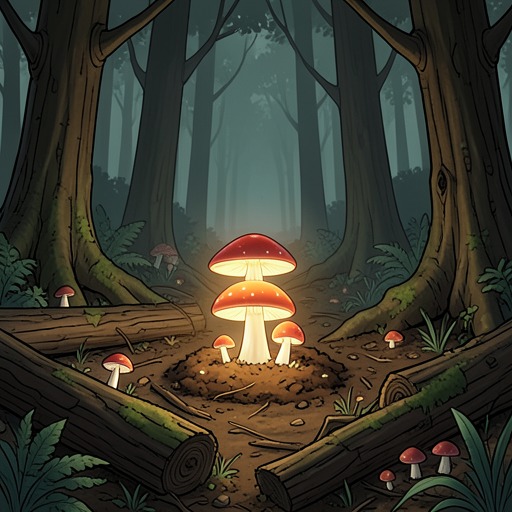
Stamets describes mycelia as a vast, cobweb-like web of fine filaments called hyphae, running through soil. Their work is both material and connective: they help form soils, support the health of plants and animals, and knit the forest together. The network is not a single, simple cable but a branching system whose complexity, redundancy, and capacity for self-repair give the Internet comparison its force. Stamets also points to scale: the book notes that a honey fungus in Oregon, extending 2.4 miles, is the largest organism on Earth.
In this account, the forest is not simply a collection of separate trees and other organisms. Mycelia link trees root to root, supplying nutrients while also conveying information about environmental threats. Trees can selectively send nutrients to other trees through these connections. The network therefore participates in the forest’s exchanges: its significance lies not only in what it transports but in the relationships it makes possible.
From Metaphor to Evidence
Stamets has described the mycelial web as a communications system that links species over great distances. He further argues that it is, in some sense, conscious: able to register its environment and respond to challenges. The book treats this claim with care. The narrator initially regarded the language as fanciful, but describes a growing body of research that made it harder to dismiss the underlying idea as metaphor alone.
Experiments with slime molds provide one concrete example. These organisms can navigate mazes toward food, sensing its location and growing in that direction. Research on forest mycelia offers another: the network connecting trees can carry nutrients and information about threats. Such findings do not establish every claim Stamets makes about fungal consciousness, but they give the network image observable functions—sensing, responding, connecting, and redistributing resources. They make the forest appear more sociable and interdependent than a view of nature as discrete objects would suggest.
Stamets’s Way of Seeing
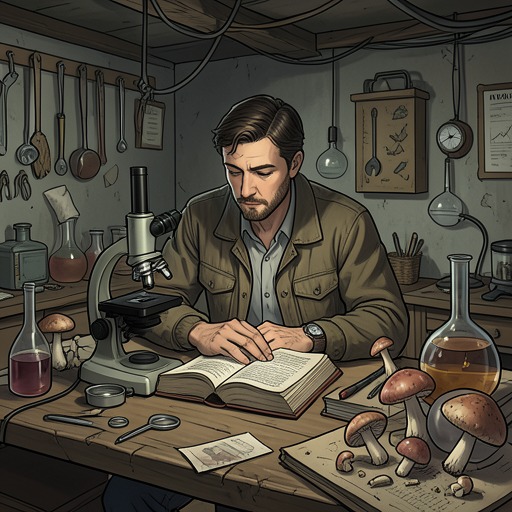
The network belongs to a larger pattern in Stamets’s thought. In Mycelium Running, he presents mycelia as a sentient membrane and as nature’s neurological network; he also describes mushrooms as carrying a message from nature. The book portrays his commitment to fungi as so complete that he seems, in the narrator’s comparison, almost like a spokesman for them, spreading their reach through his business, mail-order work, and enthusiasm. The image of the network thus describes both what fungi do and the world Stamets believes they reveal.
The narrator places Stamets in the tradition of Romantic science associated with Alexander von Humboldt. In this tradition, feeling, imagination, and the human senses are not obstacles to understanding nature; they are among the means by which its patterns become perceptible. Stamets is presented as self-taught, uncredentialed, and willing to cross disciplinary boundaries, an inventor and naturalist whose imagination helps him notice systems that others may miss. His network metaphors—the Earth’s Internet, nature’s neurological network, and the forest’s immune system—sound speculative, but the book argues that their durability makes them worth taking seriously.
This approach also changes the implied position of the observer. Rather than regard nature as a set of passive objects viewed from outside, the Romantic naturalists sought to understand relations among living subjects, including plants, animals, and microbes. Humboldt’s formulation that everything is interaction and reciprocal captures the outlook the book associates with Stamets. The mycelial network is therefore both a biological subject and an epistemic model: it encourages attention to connections that become visible when observation is joined to imaginative shifts in perspective.
A Recurring Pattern of Connection
The book’s history of psychedelic research offers a human-scale parallel to the network’s work, without claiming that research communities literally operate like fungi. Al Hubbard moves among research centers, carrying LSD, practical knowledge, and clinical experience between researchers in Canada and the United States. The narrative calls him a psychedelic honeybee: an intermediary connecting otherwise distant sites and helping practices travel. The comparison echoes the network’s emphasis on links and exchange, and shows how the book’s fungal imagery resonates beyond ecology.
That pattern recurs in the account of underground psychedelic guides. Their professional lineages often reach back to Timothy Leary, Stanislav Grof, Al Hubbard, or Leo Zeff. The relationship between underground practice and university research is not sealed: researchers sought underground guides’ knowledge of music for guided psilocybin sessions, and some guides helped train practitioners for university trials. When James Fadiman called an early-morning meeting for guides at a 2010 conference in San Jose, he expected only a handful; a hundred people arrived. These episodes give the book another example of knowledge moving through relationships and informal intermediaries rather than only through formal institutions.
Significance and Limits
The network image also helps illuminate why psychedelic therapy troubles conventional models of scientific testing. The book describes difficulties in blinding trials when participants and guides can recognize whether psilocybin was administered, and in separating a drug’s effects from the influence of expectation, therapists, and the surrounding environment. If an intervention works partly through an experience shaped by context, isolating a single variable may fail to capture how it works. This is not evidence that mycelial networks and psychedelic therapy are the same phenomenon; it is a conceptual resonance between a relational view of nature and a field in which effects cannot easily be understood apart from their conditions.
The same boundary problem appears in the debate over spirituality and medicine. Charles Grob calls psychedelic therapy a form of applied mysticism, while other researchers remain uneasy with language that sounds shamanic or nonmedical. The book presents the network metaphor as part of a broader challenge to habits of thought that prize isolated objects, single causes, and sharply separated domains. Its force rests on a careful distinction: research supports specific forms of fungal navigation, connection, and exchange, while Stamets’s claims about consciousness extend beyond what those findings alone establish. The network remains compelling precisely because it joins an empirical account of ecological interdependence to a more ambitious question about what nature can perceive and do.