Wasson’s Mazatec mushroom ceremony
How to Change Your MindWasson’s Mazatec mushroom ceremony was both the culmination of R. Gordon Wasson’s long search for sacred mushrooms and a consequential encounter shaped by unequal interpretation. On the night of June 29–30, 1955, he joined a velada led by María Sabina in Huautla de Jiménez. The experience furnished Wasson with a vivid account of visionary perception that would influence later psychedelic writing. Yet the ceremony’s importance cannot be separated from the gap between what Wasson hoped to discover and how Mazatec people used the mushrooms in their own lives.
The Search and Its Historical Setting
Wasson’s visit belonged to a larger change of direction. He and his wife had initially looked toward Asia for their divine mushroom, but Richard Evans Schultes directed their attention to the Americas, where reports suggested that mushroom practices might survive in remote southern Mexican villages. Wasson began traveling to Mexico and Central America in 1953; Huautla de Jiménez, in the mountains of Oaxaca, became a focus after a missionary told him that healers there used mushrooms. Residents often declined to discuss the practice with an outsider, sometimes saying it had ended or survived only elsewhere.
That reserve had a long history. After the Spanish conquest, sacramental mushroom use was driven underground, amid efforts by the Spanish to suppress Indigenous religious practices. Authorities treated the mushrooms as a challenge to the church’s religious authority; people were interrogated and tortured, and mushroom stones—carved basalt objects associated with ceremonies—were destroyed. The Roman Catholic Church later condemned the use of plants for divination. By Wasson’s time, the ceremony therefore took place within a history of concealment and pressure, not in an untouched religious past.
The Night of the Velada
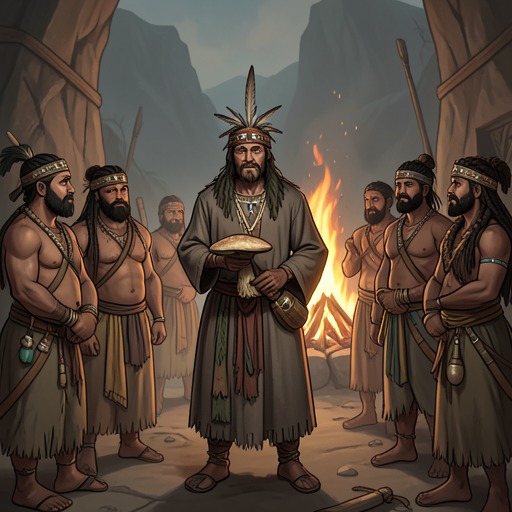
On his third trip to Huautla, Wasson persuaded Sabina, a sixty-one-year-old Mazatec curandera respected in the village, to let him and his photographer participate in a ceremony that no outsider had previously joined. The velada took place after dark in the basement of a local official’s home, before a simple altar adorned with Christian images. The setting itself held together religious worlds that Wasson’s later account would tend to distinguish: a Mazatec healing practice unfolded alongside familiar Christian symbols.
Before the ceremony, Sabina cleaned the mushrooms and passed them through incense smoke. She then gave Wasson a cup containing six pairs, which she called the little children. Wasson wrote that their taste was unpleasant, but that taking them felt like the culmination of six years of pursuit. His notebooks preserve the night’s clock-time with unusual precision: arrival at 8:15, ingestion at 10:40, and the snuffing of the last candle at 10:45. After that entry, the handwriting becomes disordered; some sentences appear upside down, and his descriptions break into fragments.
Visions and the Written Account
Wasson described visions that began with geometric and decorative patterns and developed into palaces, gardens, and a mythological beast drawing a chariot. He insisted that the images did not seem blurred or uncertain: they appeared to him more real than ordinary sight. In his account, the experience made everyday vision seem incomplete and disclosed underlying forms. That language helped give the episode significance beyond his private night: the report presents the visionary state as a different way of seeing, not merely as a sequence of unusual images.
Wasson also understood the experience as confirmation of his prior theory that psychoactive fungi lay near the roots of religious experience. He speculated that mushrooms might have exposed early humans to other worlds and even contributed to the idea of God. The book emphasizes, however, that he arrived with this hypothesis already firmly in mind. His interpretation is therefore part of the event’s history, but not a neutral account of what the ceremony meant to its practitioners.
Local Purpose and the Limits of Wasson’s Interpretation
Wasson presented Sabina as a religious figure and the velada as a form of holy communion. But by 1955 many Mazatecs were devout Catholics, and mushroom ceremonies commonly served healing and divination: people sought help for the sick or guidance in finding missing people and important objects. Wasson knew that local context. To secure Sabina’s participation, he told her he was concerned about his son’s whereabouts and well-being. He later believed that information he received during the ceremony proved accurate when he returned to New York.
The distinction matters. A practice could have sacramental histories without its contemporary use being reducible to worship or a search for God. Wasson’s account made the ceremony legible to a Western audience through the language of mystical revelation, while that framing risked recasting a complex healing tradition as evidence for his own theory. The episode thus records both an extraordinary encounter and an interpretive imbalance: Sabina guided the ceremony, but Wasson’s published meaning for it traveled far beyond the village.
Afterlife of the Encounter
Wasson’s writing helped establish a vocabulary for describing psychedelic visions as vivid, ordered, and more revealing than ordinary perception. The ceremony also became a bridge between a locally grounded practice and a much wider public interest in magic mushrooms. Its legacy is consequently double. It brought attention to an experience that had been concealed from Western outsiders for generations, while magnifying the power of the outsider’s account to define what that experience was said to mean. The ceremony remains significant not only for what Wasson saw, but for the unresolved difference between his search for divine origins and the healing and divinatory purposes he encountered.