Age of Aquarius
How to Flirt with A Naked WerewolfAge of Aquarius is the name Mo gives to the free-loving, consequence-free ideal embraced by her parents, Saffron Wenstein and Ash Wenstein. It is expressed not as an abstract account of an era but as a domestic ethic: a life organized against convention, including marriage, whose assumptions later stand in revealing contrast to Mo’s own family choices.
Origins and Meaning
Saffron, originally Lynn Duvall, met George Wenstein at a recycling seminar in Chicago in 1975. They remained together, but the closest they came to a wedding was a naming ceremony: Saffron renamed George Ash Wenstein, and he named her Saffron. Their arrangement gives the Age of Aquarius ideal a distinctly personal form. The refusal of conventional marriage is paired with a ceremony of their own, in which the power to name—and to define their relationship—belongs to them.
The narrative’s description of their outlook as free-loving and consequence-free is affectionate but not wholly uncritical. Saffron’s name, a spice said to cling to the skin, becomes an image of the lasting mark she leaves on people around her. The phrase thus evokes both the parents’ resistance to ordinary conventions and the durable influence their choices have on Mo.
Principles at Home
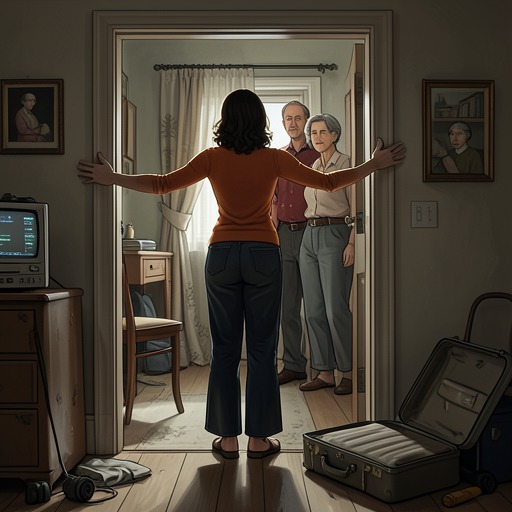
The parents’ ideals shaped the rules of family life. Their standards excluded religion, television, junk food, Western medicine, and pets; the restriction on pets came from Ash’s allergy, rather than an animal-rights principle. Their home was a barely refurbished old barn with literally no walls, serving as the central building of a self-sufficient, ecologically responsible commune for vegans who distrusted the government. Ash called the community Sunrises, later changing the name after people repeatedly left drugged-out teenagers at its gate, apparently mistaking it for a rehabilitation center.
Their principles could also become a source of pressure on Mo. When she told Saffron that the restaurant where she worked served meat, she anticipated her mother’s anger gong. Saffron had replaced it after discovering that Mo had worked at the Tast-E-Grill Drive-In for six months without telling her. Mo had also raised money for People for the Ethical Treatment of Animals as penance, yet, once she turned eighteen, she returned to the drive-in after school and during summers while attending college. Saffron responded by acting as if the work were not happening and striking the gong. The episode shows the gap between the parents’ declared ideals and Mo’s effort to make independent choices: the gong gives Saffron a ritual outlet for anger, while Mo’s return to the job makes clear that the disagreement has not resolved her practical needs or preferences.
Inheritance and Contrast
The Age of Aquarius ethos is a family inheritance, but the novel does not present it as a rule Mo simply repeats. Her parents’ life together supplies a precedent for rejecting convention, while their conflicts with her over work and food show that their principles can also constrain her. Mo’s adulthood develops within that tension: independence does not mean that she has escaped the emotional reach of her upbringing.
Her relationship with Cooper Graham offers a sharper contrast around commitment. Their shared home takes shape gradually and without a formal discussion: his T-shirts appear in her closet, his toothbrush sits beside hers, and he brings groceries to replace the food he consumes. Mo, who would normally panic at such blurred boundaries, wants him close. That domestic arrangement is intimate and mutual, but it is not the same as her parents’ rejection of marriage as a convention.
Partnership and Family
The contrast becomes explicit when Mo discovers that she is pregnant. Her reading on werewolf pregnancies gives her reason to expect a gestation of about six months, and the prospect makes her question whether she might have to raise the child alone. Cooper later explains that marking a partner means that a werewolf cannot mate with anyone else: in his words, wolves mate for life. Their bond therefore joins physical intimacy to an enduring rule of kinship.
As Mo’s pregnancy advances, Cooper asks her to marry him and raise their baby with him. Mo points out that her parents are not married, recalling the family example at the center of the Age of Aquarius ideal; Cooper nonetheless makes marriage part of the future he is asking her to share. The phrase’s significance lies in this generational contrast. Saffron and Ash made a life together without a wedding, while Mo and Cooper approach parenthood through a permanent mate bond and a marriage proposal. The narrative does not frame either choice as a simple repudiation of the other: Mo’s family history remains present even as she considers a different form of commitment.