Chocolate chess squares
How to Flirt with A Naked WerewolfChocolate chess squares are Mo’s signature Southern confection and a material emblem of her transformation in Grundy. What begins as compulsive baking becomes professional evidence, social currency, and a persuasive tool: the squares help Mo enter the Blue Glacier Saloon’s community, establish authority in its kitchen, reshape its menu, and turn a private talent into a public form of belonging.
Composition and Culinary Identity
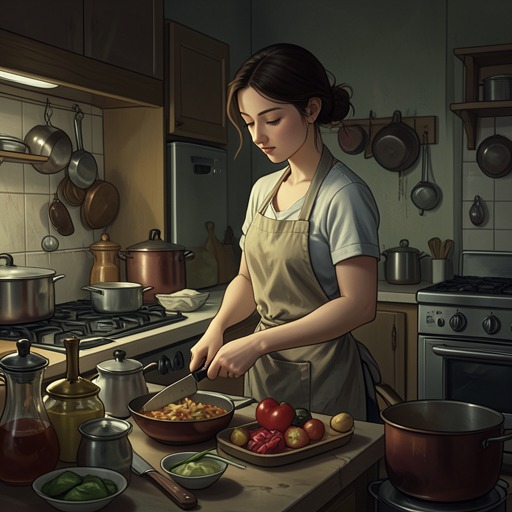
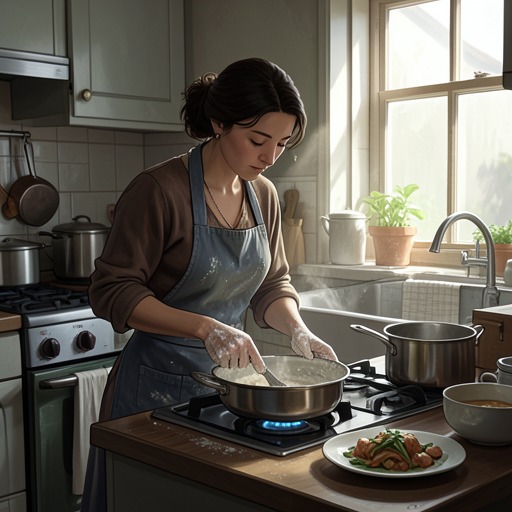
Mo makes chocolate chess squares from chess pie, a Southern custard pie thickened with cornmeal rather than flour. Her version combines the qualities of a brownie and cheesecake, and she prepares them according to Reba Reynolds’s secret recipe. The result is sufficiently rich that Mo claims grown men have wept while eating them, a deliberately cocky statement that matches her firm confidence in her own kitchen skills.
The squares also reveal how Mo’s baking operates emotionally. She bakes when upset, bored, premenstrual, or simply because it is Tuesday; baking is not an occasional hobby but a habitual response to restless energy. After the assault connected with John Teague, she spends a night baking, practicing yoga, watching bad television, and completing a detailed proposal for the Blue Glacier’s new menu. The six dozen chocolate chess squares she makes during that period convert agitation into something precise, portable, and useful.
From Private Skill to Professional Leverage
Mo initially brings the squares to work as an opening move in her campaign to improve the Blue Glacier’s bland diner food. She wants to introduce more than salt to the burger mixture and eventually proposes soups, omelets with substantial fillings, expanded desserts, and comforting dishes such as chicken noodle soup, beef stew, meat loaf, pot pie, chicken and dumplings, burgers, melts, apple-raisin pie, applesauce cake, banana pudding, and brownie a la mode. The squares therefore function as a test of whether her culinary judgment can change the saloon’s established habits.
The test succeeds. During the next lunch rush, the chocolate chess squares become a major hit. Gertie Gogan buys half a dozen, intending to take them to Nate’s office, while Abner Golightly responds by improving his offer to Mo: he promises warm feet, a permanently reclined toilet seat, and even a color television if she will move in with him. Mo kisses his cheek but declines, turning the dessert’s popularity into flirtatious attention without surrendering control of the exchange.
Even Buzz, who has resented being displaced from the kitchen, admits that the squares are “pretty damn good” and asks Mo to bring another six dozen the following day. His reluctant approval matters because Buzz’s authority had previously governed the grill and kitchen. The dessert gives Mo a form of credibility that argument alone might not have secured, while allowing Evie DuChamp to support reform without openly confronting Buzz’s pride.
The same pattern extends beyond the dessert itself. Evie finds it easier to accept Mo’s menu proposals, whether because of guilt over the assault on the saloon’s premises or because of the chocolate chess squares’ persuasive power. The squares become part of a broader labor transformation: Mo’s consistent cooking first earns her a full-time position while Buzz is recovering, then gives her enough influence to revise the menu. Evie later offers Mo a twenty-percent share in the saloon because receipts have risen by at least that amount since Mo arrived, and a nursery is prepared in the Blue Glacier’s office so she can continue working after maternity leave. The pastry is not the sole cause of that change, but it is its most recognizable edible proof.
Social Currency and Community Membership
The chocolate chess squares circulate through Grundy as a compact form of hospitality and reputation. Mo’s work in the kitchen allows her to feel part of the room without being fully exposed to it: she has privacy, hears the saloon’s friendly voices, and moves toward membership in the community by means of useful labor. The dessert makes that movement visible. Customers do not merely eat it; they carry it to offices, beauty shops, and friends, extending Mo’s presence beyond the Blue Glacier.
The squares also mediate Mo’s friendship with Susie Q. When Susie Q discovers Mo’s embarrassing full name and threatens to spread it, she demands a dozen chocolate chess squares in exchange for silence. Mo accepts the bargain and carefully wraps the dozen, declaring them on the house, while privately recognizing that the “house” is really herself. The transaction is playful, but it gives the dessert a second function: it is a bribe, a favor, and a way of preserving privacy.
Susie Q soon violates the agreement despite the payment. She takes the entire dozen to the Cut and Curl, where they are a success, and the beauty-shop women learn about Mo, including the information she had hoped to keep discreet. Susie Q blames the disclosure on the chocolate, claiming that she was not thinking straight. Mo answers by cutting her off from chess-square privileges for a month, though she still allows lemon bars. The punishment confirms that Mo controls access to the treat and can use that access to negotiate the terms of intimacy.
The squares likewise carry Mo’s reputation through the local information network. Gertie Gogan asks why Susie Q has received a full dozen, and Susie Q explains that she is helping a friend. That account prompts the beauty-shop women to hear about Mo as a transfer and newcomer, demonstrating how food moves information through Grundy’s social spaces. The dessert is simultaneously gift, advertisement, gossip vehicle, and proof that Mo has become worth talking about.
Food, Courtship, and Werewolf Culture
Chocolate chess squares gain additional meaning because Grundy interprets food as a language of desire and commitment. Evie explains that harmless flirting becomes serious when a man offers a woman actual meat. In local custom, a rump roast is the equivalent of asking someone to go steady: the man displays his ability to provide and symbolically offers to feather the woman’s nest. Chocolate chess squares form a human and Southern counterpart to that tradition. Where meat expresses provision and the werewolf sensibility toward courtship, Mo’s baked goods express skill, generosity, and control over domestic abundance.
Later, Mo learns that werewolves mark nearly every important gesture with food, including dating, proposals, and apologies. The discovery makes the earlier Grundy custom legible as more than macho local behavior: it is aligned with werewolf courtship sensibilities. Food is a social grammar joining the human town and the hidden wolf community, even before Mo fully understands the connection. The squares thus stand beside elk meat, steaks, and offered roasts in a culture where eating and bonding cannot be cleanly separated.
Their meaning also contrasts with the meat-centered identity surrounding Cooper Graham. Cooper’s breakfast consists overwhelmingly of animal products—steak, sausage, bacon, and ham, with only a token piece of toast—while Mo’s strongest culinary signature is a labor-intensive Southern dessert. The contrast does not place the two characters outside one another’s world. Instead, it establishes a comic but substantive exchange between two food systems: Cooper embodies appetite, wild game, and inherited wolf practice, while Mo brings baking, menu innovation, and a cuisine associated with memory and adaptation.
Recurrence and Lasting Significance
The chocolate chess squares recur whenever Mo needs to turn feeling into action. They help her move from shock after the Teague incident toward a concrete plan for the Blue Glacier. They win Buzz’s grudging respect, help Evie accept reform, attract unwanted but manageable offers of romance, and provide Susie Q with a reward that becomes a breach of confidence. Even when Mo is emotionally overwhelmed, baking produces something that can be shared, traded, or used to establish a boundary.
Their significance lies in that double character. The squares are comforting enough to embody Mo’s private coping mechanism, yet public enough to transform her status. They begin as an expression of excess—six dozen baked in response to distress—and become a controlled resource distributed according to friendship, secrecy, employment, and punishment. Through them, Mo does not simply feed Grundy; she learns how Grundy works, and Grundy learns to recognize what she can do.
By the time Mo has a lasting stake in the Blue Glacier and a future within the community, the squares have already performed their decisive work. They have made her competence visible without requiring her to announce herself, given her leverage in a male-dominated kitchen, and translated Southern culinary inheritance into a new local identity. In the novel’s food-centered social world, chocolate chess squares are not decorative sweets. They are Mo’s edible signature, a portable form of persuasion, and one of the clearest signs that the outsider has become part of Grundy.