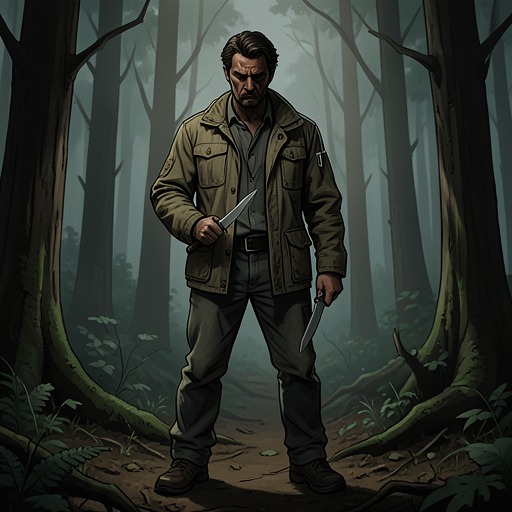
Cooper’s Self-Imposed Separation from Mo
How to Flirt with A Naked WerewolfCooper’s Self-Imposed Separation from Mo begins after Abner is found mortally wounded and becomes a test of how Cooper handles uncertainty, responsibility, and the fear that he may be dangerous to the people he loves. Unable to remember what happened during the night of the attack, Cooper suspects he may have been the wolf that mauled Abner. Rather than remain with Mo while the question is unresolved, he cuts contact, tells her to stay away, and ultimately shifts into wolf form and disappears into the woods.
Causes and Background
Cooper’s withdrawal follows the discovery of Abner on the trail. Abner’s pack was still strapped to his chest, and his loaded rifle lay unused beside him. Deep claw gashes crossed his chest near his neck, while additional wounds had dried dark on his trousers. His pulse was weak and erratic. Cooper searched the trees as Mo tried to help; Abner later died. For Cooper, the attack was not only a loss within the community but a threat he could not confidently separate from his own actions.
That fear meets an older source of guilt. Cooper had previously told Mo that, after becoming alpha, he killed all twelve members of an invading pack during a fight to defend his family and territory. He remembered killing them as a wolf and could not accept the reassurance that the attack had made him a great leader. Instead, he saw himself as someone capable of killing people, suffered nightmares, and left his family because he did not trust himself around them. His account establishes why the possibility that he had harmed Abner would feel to him like more than a question of evidence: it would revive a judgment about his own capacity for violence and his fitness to remain close to loved ones.
Withdrawal and Confrontation
After the discovery, Cooper stopped answering Mo’s calls. Checking his house became part of her evening routine, but the small signs she found offered no explanation: once, she saw him at the kitchen sink, then watched him move away from the window and switch off the light. About a week later, she encountered him loading camping gear into his truck outside Hannigan’s Grocery. He looked haggard, as though he had not slept in days. Mo’s impulse to comfort him gave way to anger at his silence, but Cooper still would not meet her eyes.
He put the truck between them and said he could not be around her. He named the attacks on Susie Q, the hikers, and Abner as the reason: if he might be responsible, he could not risk hurting Mo too. When she challenged the assumption that he had been a wolf on the night Abner was attacked, Cooper insisted that they could not know. He feared he had changed and left their sleeping bag without waking her. Abner’s apparent terror when he saw Cooper seemed, to Cooper, like another clue that the injured man recognized his attacker.
Cooper also connected the attack to a night when he had secretly left a hunting camp. Worried about being away from Mo, he had waited for the hunters to sleep, changed, and run home to check on her before returning to camp. He then heard that two children had gone missing from the preserve near her house on the same night. These circumstances intensified his suspicion, but they did not establish that he was responsible for Abner’s injuries or the other attacks. The separation is driven by the terrible possibility Cooper cannot dismiss, not by a confirmed answer.
The Break and Its Consequences
When Cooper said that, while people were being hurt, he could not see Mo, she stopped him from leaving long enough to challenge what she understood as another retreat. She acknowledged that the possibility he might be acting unconsciously had crossed her mind, but said she still believed it was not in him. Her response did not erase the danger or resolve the mystery. Instead, she confronted the pattern she saw in his choice: when a problem became difficult, he ran rather than face it with her.
Cooper recoiled at the accusation. He took a few steps, shifted in midair, landed on his paws, and ran into the woods. His howl carried back to Mo as he left. The physical transformation makes the separation unmistakably final in the scene: Cooper does not merely drive away or promise distance, but uses the form associated with the danger he fears to escape the argument. His departure leaves Mo without an answer and without the chance to decide together what the uncertainty means for their relationship.
The break also isolates Cooper from the person who had earlier accepted that he had hurt someone while protecting her. Mo had told him that she did not love him less for intervening to help her, and had compared that choice with defending his family. Yet Cooper’s fear about Abner overrides that earlier assurance. He treats the possibility of being a danger as grounds to remove himself, even though Mo is asking him to stay and face it with her. The separation thus exposes the gap between her willingness to share the burden and his conviction that distance is the safer choice.
Significance and Later Contrast
Cooper’s self-imposed separation repeats the response he described after killing the invading pack: guilt and fear lead him to distrust his place among those he loves, then to leave rather than accept their closeness. In the earlier crisis, he could not live with what he had done and believed he did not deserve his family. Here, because he cannot remember the night of Abner’s attack, uncertainty itself becomes enough to trigger withdrawal. The episode keeps suspicion distinct from proof while showing how strongly Cooper’s past shapes his interpretation of the present.
A later exchange offers a contrast to this self-condemnation. When Cooper is found staring at the ground, Mo tells him there should be no regrets or self-torture, and he agrees before drawing her into his arms and muttering that he will have to marry her. The moment does not establish that the Abner mystery caused his earlier departure or that one conversation resolves every consequence of it. It does show a later Cooper accepting Mo’s closeness rather than answering guilt with another immediate flight, giving the separation a place in a broader movement from self-punishment toward a shared future.