Cooper's Return to the Pack and Conflict with the Graham Family
How to Flirt with A Naked WerewolfCooper's Return to the Pack and Conflict with the Graham Family marks the point where Cooper's life with Mo is interrupted by a family crisis and an unresolved conflict within the Crescent Valley pack. A visit prompted by concern for his father becomes a public confrontation with Maggie; Mo's intervention makes plain that Cooper's return is not simply a homecoming, but a collision between family authority, pack loyalty, and his new relationship.
A Family Emergency
Cooper and Mo are together at home when Cooper suddenly notices something outside. He leaps from bed, scans the yard, and tells Mo to lock the door behind him before phasing and going out. The abruptness of his departure signals an urgent summons, though its cause is not yet clear to Mo.
Samson soon arrives with the explanation: Cooper's mother has sent him because Pops may have suffered a heart attack or stroke. The initial alarm is qualified by the details. Pops had briefly become disoriented and could not remember who the family members were or where he was, but he is stable. Dr. Moder wants to perform an EKG and further tests; Pops refuses to leave the village clinic because he fears that hospital staff will discover he is a wolf. The family hopes Cooper can persuade him to go, and Samson explains that they had tried calling, but Cooper had not answered at home.
The Clinic Confrontation and Mo’s Intervention
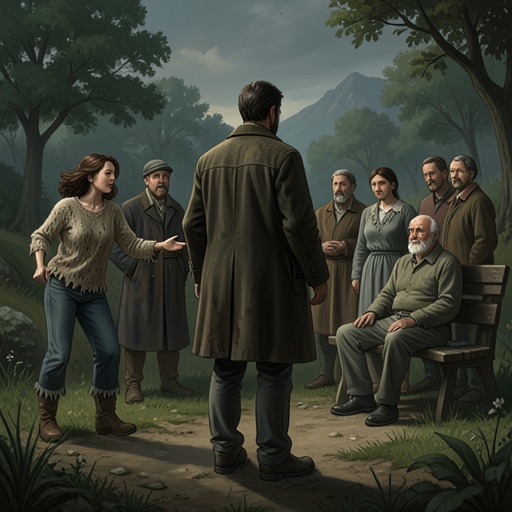
The family emergency draws Cooper back into a gathering at the village clinic, where the arrival of his sister turns concern for Pops into a confrontation. A short woman enters with an older, worried woman behind her and fixes Cooper with a look of disgust. Mo recognizes the expression as Cooper’s own, then realizes the newcomer is his sister, Maggie Graham. Gracie Graham pleads with Maggie to stop, and Cooper tries to calm her, but Maggie has already crouched to attack. She shifts into wolf form and lunges; Cooper phases just in time to meet her, but she clamps her teeth around his neck and drives him to the ground. Their fight sends family members scattering, overturns chairs, and spills coffee. Noah Graham, meanwhile, directs attention to getting Pops out of the clinic and asks that the fighters be moved outside so Dr. Moder will not have to clean up after them.
Samson refuses to join the fight, explaining that Cooper does not want help and that he has scars from intervening between the siblings before. Mo instead goes into the clinic, where she sees Dr. Moder loading Noah into Eli’s red SUV under blankets. Finding no sedatives in the waiting room, she takes the fire extinguisher from the wall, pulls its pin, and carries it outside. She sprays the fighting wolves with a cloud of white powder. They separate, but Maggie recovers first and lunges again. When another burst does not stop her, Mo strikes her with the heavy canister. The pack’s collective gasp marks the force of a human outsider’s intervention in a family fight that its own members have allowed to unfold.
Maggie turns on Mo, attacking her verbally while Cooper struggles on the ground to return to human form. Mo backs toward him with the extinguisher ready and answers Maggie’s taunts with a defiant rebuke. Maggie punches her hard enough to leave Mo disoriented; Mo nevertheless stays upright long enough to land an uppercut, before Maggie hits her again in the eye. Mo’s head strikes the pavement and she loses consciousness. The intervention has stopped the fight’s immediate direction, but it leaves Mo physically injured and exposes the danger of her position between Cooper and his sister.
The Meaning of the Fight
In the aftermath, Samson treats Maggie’s attack on Mo as more than a personal quarrel. He says that attacking Cooper’s mate is a serious offense and an insult to everyone present; Mo does not correct his assumption. Samson also explains how sharply Cooper’s response differed from their usual sibling fights: Cooper had never drawn blood from Maggie or pushed back against her, even when they were pups. Her attack on Mo changed that. Cooper was furious, Samson reports, but the fact that he had finally stood against Maggie had also knocked her down, in a sense that reached beyond the injuries of the clinic fight.
Cooper soon makes the relationship explicit himself. When Eli questions whether the family should discuss its emergency in front of Mo, Cooper says that she is his mate and has a stake in what happens. The declaration recasts her intervention: she is not merely an outsider who stepped between two wolves, but someone Cooper recognizes as connected to the pack’s affairs. Samson responds with raised eyebrows and a speculative grin, while Gracie gives a subdued smile; Mo, still uncertain what the status entails, recognizes that Cooper’s words have changed her place in the conversation.
That claim of belonging sits against the older wound behind Cooper’s estrangement from his family. He tells Mo that, about a year after he became alpha, a rival pack from outside Vancouver entered the valley and took Maggie hostage, threatening to kill her unless he surrendered control of the territory. Cooper tried to offer the newcomers a place in the valley, but their alpha refused. When the attack became unavoidable, Cooper fought to protect Maggie and the pack. In the wolf fight, he killed the rival alpha and, afterward, all twelve members of the invading pack; some of his own pack tried to help, but he snapped at them to stay away. He returned to human form surrounded by the dead.
The victory was therefore inseparable from a moral cost Cooper could not accept. Although his family praised him as a strong leader and imagined his father would have been proud, Cooper saw the dead as people, not merely wolves, and believed that his capacity to kill them made him unfit to remain with those he loved. Nightmares and distrust of himself drove him away; Maggie’s resentment deepened when he could not resume his old role as her carefree older brother. Mo answers not by denying what happened, but by placing his violence beside his effort to protect her and his family. Her acceptance does not erase his guilt, but it lets him speak of the massacre without expecting her to reject him.
Family History and the Cost of Belonging
Cooper’s account of the invading pack sits within a family history already shaped by the dangers of protecting one another. When Cooper was young, his father stayed behind to free Samson’s father from a cage trap set by researchers tracking wolves. The researchers returned while Cooper’s father was still in wolf form; after he became aggressive, one of them shot him in the head. He reached the woods so his brother could bring him home, but the family could do nothing to save him. Cooper eventually understood that the humans had faced what looked to them like an enormous, angry wolf, though anger at them had taken him a long time to relinquish. Samson’s father later left, unable to live with his guilt, and Samson—whose mother had died when he was a baby—grew up in Cooper’s household as more a brother than a cousin. The family’s idea of loyalty thus carries both devotion and injury: people risk themselves for kin, and survival can leave the survivors with burdens that divide them.
Later, Cooper’s response to his own past reaches a different note. When Mo tells him there should be no regret and no self-torment, he agrees, wraps his arms around her, and says he supposes he will have to marry her. His proposal does not undo the violence or the years of estrangement; it places his future with Mo beside the family history he had once believed he could no longer bear. The conflict’s larger movement is therefore not a simple return to his former place in the pack. Cooper’s return brings old loyalties into collision, while his bond with Mo gives him a way to remain connected without treating guilt as the only possible conclusion.