Crescent Valley
How to Flirt with A Naked WerewolfCrescent Valley is the ancestral homeland and packlands of Cooper Graham’s family, a secluded community whose geography is inseparable from werewolf instinct, bloodline, secrecy, and political authority. It is presented first as the place Cooper left behind, then as the center of the danger threatening Grundy, and finally as a community capable of revising its leadership after the collapse of its old order.
Homeland and Pack Structure
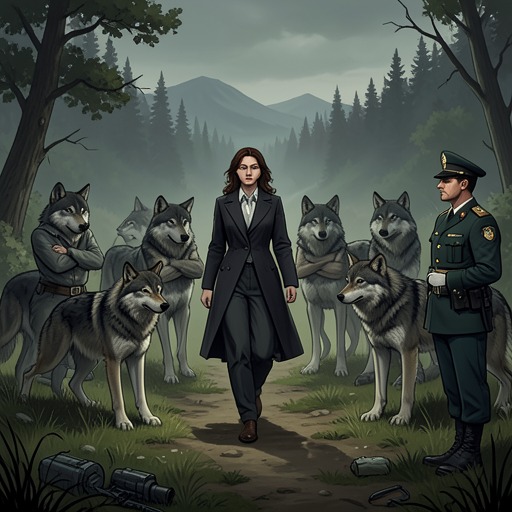
Crescent Valley is where Cooper and Evie DuChamp grew up among the werewolf families, although Evie belongs to a dead line that cannot transform. The valley’s social world includes both transforming wolves and nontransforming relatives, but the two groups do not share all knowledge equally. Matters that occur while the pack is in wolf form remain within the transforming community, because the wolves handle serious threats affecting the village and believe that limiting information protects everyone. The dead lines are loved as family members, yet they are excluded from the pack’s most consequential secrets.
The valley’s identity is also shaped by territory. Werewolf instinct directs each wolf toward a particular area of land in which to hunt, live, and protect the community. According to Evie DuChamp, that territorial attachment has governed the pack for almost a thousand years, making departure far more than an ordinary change of residence. The body itself presses the exile to return. Cooper’s decision to leave Crescent Valley and settle roughly a hundred miles away in Grundy therefore becomes an act of sustained resistance against both inherited instinct and communal expectation.
Every generation produces a pack and a leader, and Cooper was expected to become the alpha of his generation. His first transformation established him as unusually fast and strong, and the family recognized his leadership potential immediately. His eventual refusal to return leaves the valley with a structural absence: Eli can organize and command, but the pack’s members still regard Cooper as the leader they love and instinctively trust.
Cooper’s Departure and the Valley’s Wound
Crescent Valley is not merely Cooper’s former home; it is the setting of the experience that made home unbearable. About a year after he became alpha, an outside pack led by Jonas entered the valley and abducted Maggie Graham. Jonas threatened to kill Maggie unless Cooper surrendered control of the territory. The invaders had already studied the packlands, the village layout, the number of fighters, and Cooper’s perceived weakness as an alpha, turning the valley’s familiar geography into a tactical vulnerability.
Cooper’s response became the central trauma attached to Crescent Valley. Surrounded by his family, he offered the invading pack a place in the valley and proposed sharing the territory, but Jonas refused while holding Maggie by the neck. Cooper froze. Maggie, confident that her brother would protect her, initially looked at him as if he were certain to act; when she recognized that he had no plan, the look remained with him as a source of nightmares. Maggie ultimately escaped by biting Jonas’s arm, kicking him, and insulting him, but her courage did not erase Cooper’s sense that he had failed the role the valley had assigned him.
That failure explains why Cooper’s separation is both geographical and emotional. After leaving, he avoids discussion of the pack, the family, and returning home, withdraws from friendship, and appears changed even when physically well. Crescent Valley has become a place of belonging that also continually recalls helplessness. Its pull is therefore double: instinct draws Cooper back toward the land, while memory makes the land difficult to face.
Return, Conflict, and Community Boundaries
Cooper eventually returns to Crescent Valley because his grandfather is ill and because the attacks near Grundy have made silence dangerous. He wants to see his grandfather and speak with Eli about the wolf attacks, particularly because Grundy residents are discussing organized hunts. The journey from Grundy takes two strained hours, with Samson Graham restless and eager to run rather than drive, while Cooper questions him like a commander seeking a briefing. The physical trip dramatizes Cooper’s divided status: he is traveling toward home, but he does so as an uneasy outsider within his own family.
At the valley clinic, Cooper’s arrival with Mo Duvall-Wenstein produces open shock. His relatives stare at them in silence, revealing how completely he has severed ordinary contact with the community and how unexpected it is that he would bring an outsider into the family’s guarded space. Yet the encounter also confirms that the valley remains emotionally organized around him. His mother welcomes him, his relatives respond with relief, and Eli later acknowledges that merely seeing Cooper has calmed the pack.
Cooper warns Eli that the pack must keep away from Grundy because people have been injured, two children are missing, and wolf prints have been found at their campsite. If residents see another wolf nearby, a pack member could be killed. Eli says he has ordered the wolves to give Grundy a wide berth, while also urging Cooper to move home, arguing that the valley would protect him and that the pack needs its true alpha. The exchange makes Crescent Valley a refuge and a claim at once: it offers safety, but it also asks Cooper to resume an identity he no longer wants.
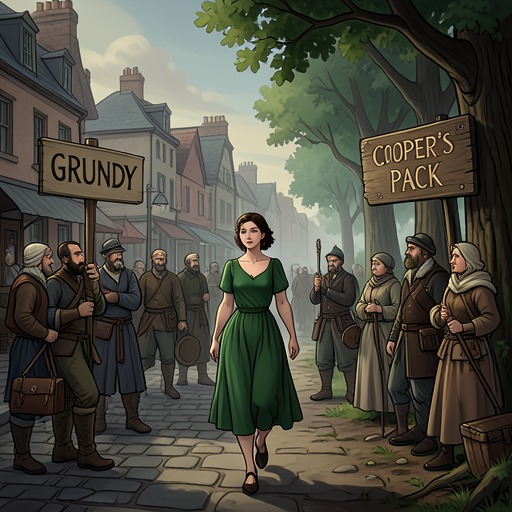
The boundary between valley and town is consequently a boundary of knowledge as well as distance. Grundy’s residents fear the wolves without understanding the pack’s internal rules, while the pack withholds information from its dead-line relatives and outsiders. Crescent Valley protects itself by controlling movement and speech, but that secrecy also allows suspicion to grow beyond its borders.
Leadership and Final Reorganization
Cooper does not regain the alpha position. Even after Eli’s loss, he remains unwilling to become the pack’s formal leader, although he visits the packlands more often. His repeated presence signals a changed relationship with Crescent Valley: he no longer accepts its authority over his entire life, but he also no longer treats separation as absolute. His connection to the valley becomes selective, negotiated through family, danger, and responsibility.
The pack ultimately adopts a more democratic method of choosing its alpha: a secret ballot. Maggie wins by a landslide after Samson Graham is nominated but regarded as too unserious for the position. Maggie’s election transforms the political meaning of the valley. Leadership is no longer presented as an unavoidable consequence of Cooper’s inherited status; the community makes a collective choice, and Maggie assumes authority through judgment and the confidence of the pack.
Maggie handles the role effectively despite lacking the genetic conditioning associated with an alpha. Her decisions are described as fair, swift, and generally directed toward the interests of her people. The fear she inspires is part of her authority, but it is no longer the only measure of her relationship to the family. By the end, she can even offer Mo Duvall-Wenstein a restrained smile during a visit, a small gesture that marks the easing of hostility toward the outsider who has become Cooper’s mate and the mother of his child.
Narrative Significance
Crescent Valley represents the tension between ancestry and chosen belonging. It is the place that defines Cooper’s bloodline, physical instincts, family obligations, and public role, yet it cannot provide a simple homecoming because its demands are bound to the memory of his failure as alpha. The valley’s territorial order explains his isolation from Grundy, while its secrecy helps generate the misunderstanding and danger surrounding the wolf attacks.
At the same time, Crescent Valley is not static. Its people include transforming wolves and dead-line relatives; its leader changes from expected hereditary authority to elected authority; and its relationship with Mo Duvall-Wenstein moves from guarded exclusion to practical incorporation through her bond with Cooper and pregnancy. The valley therefore becomes the larger community against which private love is tested. Cooper’s final position—connected to the packlands, protective of the people, but unwilling to surrender his chosen life in Grundy—shows that belonging can be maintained without total submission to inherited place or office.