Jacob Bennett
How to Flirt with A Naked WerewolfJacob Bennett is a nineteen-year-old visitor to the Grundy area whose disappearance, alongside Craig Ryan, becomes a decisive piece of evidence in the novel’s expanding pattern of violence. Although Jacob never receives a sustained on-page presence, the account of his absence, the desperate search for him, and the eventual recovery of his remains give the wolf attacks a human cost that the town can no longer treat as rumor or misfortune.
Identity and Introduction
Jacob is identified through the notices brought to the Blue Glacier Saloon by his parents after he and Craig fail to return from an excursion into the preserve. The two young men had visited the saloon, attempted to use fake identification to buy beer, and planned to go into the mountains to play at survival before the severe weather arrived. Their age—nineteen—makes the photographs on the missing-person fliers especially stark: they are described as still looking like children, with braces-perfect teeth, scattered acne, and the confident smiles of youth. Jacob therefore enters the narrative not as an individualized speaker but as a recognizable image of youthful invulnerability confronted by a landscape and a predator the visitors do not understand.
His parents’ arrival at the saloon changes the emotional meaning of the disappearance. Mrs. Bennett urgently asks whether the boys had been there, whether Buzz spoke with them, and whether they seemed all right. Evie and Buzz agree to display the neon-yellow fliers, which are already covering the town’s available surfaces. The public visibility of Jacob’s face turns the case into a communal obligation: his absence is no longer an abstract report from the state police but a family’s demand for information placed directly before the people who may have seen him last.
Disappearance and Search
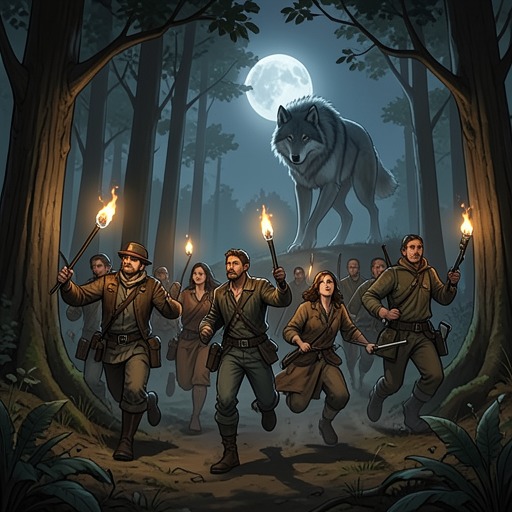
Jacob’s disappearance first becomes a matter for organized investigation when the state police notify Alan Dahling that two hikers are missing at the far northwestern edge of the Evanston Game Reserve. The boys’ intended campsite is found in disarray: the tent has been torn apart, sleeping bags and food have been scattered, and large tracks surround the site. Blood smears cover the ground, yet no bodies or recognizable remains are present. The physical evidence suggests that Jacob and Craig fought back and were dragged away, despite carrying rifles. Alan Dahling finds the scene especially disturbing because the attack appears coordinated rather than like the work of one sick or frightened animal; the predator seems to have entered, taken what it wanted, and avoided injury. The absence of bodies prolongs uncertainty while making the threat seem deliberate, and volunteer searchers return without finding the boys.
Recovery, Aftermath, and Narrative Significance
The disappearance remains unresolved until Alan Dahling finds what is left of Jacob and Craig roughly a mile from their campsite, in a ravine exposed after the snow clears. Their bodies have been reduced to scattered bones, gnawed by numerous animals, and the recovery is grave enough that Buzz DuChamp contacts the state medical examiner while Alan stays at the scene to ensure that the remains are treated decently. For Jacob’s parents, who have come to the Blue Glacier Saloon with photographs and neon-yellow fliers, this discovery converts anxious hope into irreversible mourning. For Mo Duvall-Wenstein, it makes the earlier bloodstained campsite newly terrible: the missing boys were not merely lost in bad weather but became casualties of an attack whose organization and unknown perpetrator remain central to the town’s growing fear.
Narrative Function and Human Cost
Jacob Bennett’s limited direct presence is itself part of the novel’s treatment of violence. He is known through traces—an attempted purchase of beer, a planned climb, a ruined campsite, blood, tracks, a mother’s questions, and finally bones—so the reader encounters him through the community’s effort to reconstruct a life that the attack has erased. The evidence also exposes the limits of official protection. State police alerts, volunteer searches, wildlife reinforcements, and the later involvement of the medical examiner establish an institutional response, yet none of these measures prevents the attack or restores Jacob. The danger is repeatedly individualized or explained away: warnings tell people to be more careful, while the physical evidence points toward an organized predator capable of choosing human targets. Jacob’s case therefore widens the novel’s moral field beyond Mo Duvall-Wenstein’s immediate survival. His death, alongside Craig Ryan’s, makes clear that the violence is not an isolated threat directed at one waitress or one unlucky resident; it reaches outsiders who enter the preserve believing that youth, rifles, and confidence will be enough. The neon-yellow fliers preserve Jacob’s smiling face in public memory, while the scattered remains show the cost of failing to understand the force moving through the forest.