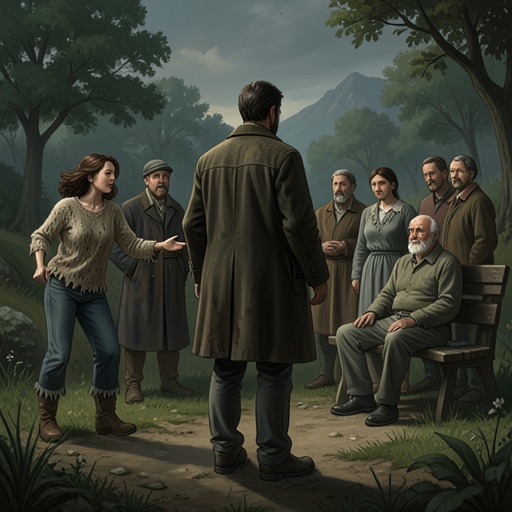
Maggie reconciles with Cooper
How to Flirt with A Naked WerewolfMaggie reconciles with Cooper after years of anger, hurt, and mutual avoidance. The event repairs the central sibling relationship within the Graham family, but it does more than end a personal quarrel: it forces both siblings to reinterpret the pack conflict that drove Cooper away and Maggie’s subsequent hostility. Reconciliation becomes possible only when violence is acknowledged as traumatic rather than treated as proof of either sibling’s moral failure.
Causes and Background
Maggie’s resentment began with the attack by Jonas’s pack, when Jonas threatened to kill her unless Cooper surrendered control of the valley. Cooper changed before Maggie, fought to protect her, and ultimately killed Jonas and the other members of the invading pack. Twelve opposing wolves were dead when he returned to human form. Although the Graham pack praised him as a strong leader, Cooper understood the event as the killing of men and women who were people despite their wolf forms. He suffered nightmares, distrusted himself, and left his family because he believed he did not deserve them.
Maggie experienced the same night from the opposite emotional position. She had been terrified, but she also believed her older brother would save her, and she had continued fighting Jonas even while Cooper tried to keep her away. After Cooper withdrew, she interpreted his departure as shame directed at her and at the very abilities he had once encouraged her to value. She had depended on him as a brother and a father, so his disappearance felt like the removal of the person who had made her feel safe and proud of what she was. Her anger therefore mixed grief, abandonment, and a conviction that Cooper’s moral horror condemned her as well.
The estrangement was prolonged by Eli. Maggie admits that she wanted to believe the worst about Cooper because doing so was easier than examining how she might have hurt him, and Eli encouraged that interpretation. Cooper, meanwhile, used Maggie as an excuse to remain away instead of explaining his pain or confronting the family conflict. Each sibling thus maintained a simplified story: Maggie treated Cooper’s absence as betrayal, while Cooper treated his own inability to return as evidence that he was dangerous to those he loved.
Maggie’s Confession to Mo
The reconciliation is prepared by Maggie’s private conversation with Mo while Mo is pregnant. Maggie first checks whether Mo can tolerate the meeting, revealing a concern that sits awkwardly beside her usual physical directness. She explains that hunting and fighting come easily to her, whereas talking about distress does not; striking something has seemed simpler than articulating pain. Her admission gives the conflict a bodily vocabulary: the same capacity that made her an effective defender also became her habitual substitute for emotional speech.
Maggie then accepts responsibility for the years after Cooper’s departure. She calls herself selfish and admits that she treated him cruelly because she believed her own suffering entitled her to see him suffer more. Cooper’s apparent recovery made her anger worse, especially when Mo’s presence seemed to show that he had escaped the punishment Maggie thought he deserved. She had not understood that he missed her or that his apparent composure concealed continuing pain. Her question to Mo is not whether she was justified, but whether Cooper can forgive her, and the question makes her seem suddenly young beneath the aggressive persona.
Mo does not absolve Maggie or reduce the matter to an easy apology. She tells Maggie that the siblings need to talk and that Cooper misses her, while also indicating that unresolved issues must be addressed directly. The exchange changes the emotional value of the conflict: Maggie moves from defensive accusation toward accountability, and Mo becomes a witness who can connect the estranged siblings without pretending that the past did not happen.
Maggie leaves the conversation by walking into the woods, followed by a long howl. The gesture preserves her wolf identity and her difficulty with ordinary verbal intimacy, but it no longer functions solely as aggression or withdrawal. Her departure is a movement toward action after confession, and the howl marks the beginning of an attempt to find Cooper rather than another escalation against him.
The Sibling Meeting
Maggie tracks down Cooper’s hunting party. Before the conversation begins, she makes clear that she is not planning to cause him lasting physical harm, a qualification that reflects both their history and the pack’s tendency to express conflict through force. The siblings then have a long conversation, repeatedly described as exceptionally long, and straighten out the misunderstandings that had governed their relationship.
Maggie recognizes that Eli manipulated her by feeding her anger and confirming the interpretation she most wanted to believe. Cooper, for his part, admits that he failed to stay and explain himself and used Maggie as a reason to avoid returning. The reconciliation therefore depends on reciprocal disclosure rather than a one-sided confession. Maggie acknowledges the harm caused by her resentment; Cooper acknowledges that his flight deprived her of the explanation and relationship she needed.
Their discussion also broadens from family grievance to the danger facing Grundy. They begin assembling evidence against Eli: his repeated trips into Dearly, the timing of attacks in Grundy, the attack on Cooper’s father, and the heart attack suffered by Pops. The pattern suggests that Eli’s supposed reluctance to lead concealed an active effort to keep Cooper away. Maggie and Cooper’s renewed cooperation consequently becomes investigative and protective as well as emotional. Their restored trust helps them recognize the wider conspiracy that had exploited their division.
Cooper returns to the camp to tell his clients that he is leaving and hears Mo’s messages there. When he realizes that Mo is alone with Eli, he runs back to her, outrunning Maggie for the first time. The detail is comic on the surface, but it also gives the reconciliation a practical consequence: Cooper can once again act within a network of family obligations without allowing guilt over past violence to paralyze him.
Consequences and Significance
The event restores Cooper’s connection to Maggie without erasing the massacre or his responsibility for leaving. Its ethical force comes from holding two truths together: Cooper acted to save his sister and defend the valley, and he was psychologically devastated by what he did. Maggie was a victim of the attack and had reason to feel abandoned, yet she converted that pain into years of punishment. Reconciliation becomes a form of moral integration, replacing the opposing absolutes of heroic defense and unforgivable violence with a shared recognition of injury.
Cooper’s renewed relationship with Maggie also supports his return to the family and the pack. After the danger passes, Mo tells him not to torture himself or feel guilt, and Cooper agrees that he has no regrets before embracing her and joking that he will now have to marry her. The immediate result is not merely romantic reassurance for Mo; it is the emotional foundation for Cooper’s renewed participation in family life. By accepting that he can be loved without being innocent of violence, he becomes able to remain present rather than choosing exile as a substitute for accountability.
Maggie’s change is equally consequential. She does not become gentle or verbally fluent overnight, and the parting banter preserves her combative personality, but she has moved from treating Cooper as an enemy to seeking an honest conversation with him. The reconciliation makes kinship an active practice rather than an automatic bond: the siblings must name manipulation, abandonment, grief, and fear before family loyalty can function again. In the broader narrative, their repair weakens Eli’s control, reunites divided defenders of Grundy, and turns a wound that once fragmented the pack into a source of cooperation.