Mo and Cooper marry
How to Flirt with A Naked WerewolfMo and Cooper marry in a small civil ceremony held in Mo’s front yard, a month before Mo and Cooper arrive at Dearly Airport to meet her parents. The marriage takes place during Mo’s pregnancy and turns a relationship shaped by danger, secrecy, and werewolf custom into an openly recognized household. Its decisive significance lies in the way it joins intimate commitment to community belonging: Mo becomes Cooper’s wife without abandoning the human town that has become her home, while Cooper accepts a family future without returning to the leadership role his wolf lineage once expected of him.
Causes and Background
The wedding follows a relationship that has developed inside several overlapping pressures. Mo has been attacked by John Teague, has lived through the shock of Susie Quinn’s wolf mauling, and has struggled with the danger represented by Cooper’s wolf nature. Cooper, meanwhile, carries the memory of his father’s death while trying to separate himself from the violent obligations and inherited hierarchy of the pack. His father was shot in the head after staying behind in wolf form to help free an uncle caught in a research trap; the incident left Cooper angry at the humans involved before he gradually came to understand that they had been confronting a huge, aggressive wolf. That family history makes Cooper’s marriage to a human woman more than a private romantic choice: it places trust, domesticity, and future parenthood against a legacy of fear and injury.
The marriage also grows out of Mo’s gradual acceptance of Grundy. At the Blue Glacier Saloon, Evie DuChamp explains that local men traditionally offer actual meat, sometimes a rump roast, as a courtship gesture—the equivalent of asking someone to go steady. Mo’s integration into town is marked by food, work, and shared ritual rather than by a single declaration. After the attack on John Teague and the distressing return to the alley where it occurred, she responds by working through the night on a menu proposal for the saloon, including chicken noodle soup, beef stew, meat loaf, pot pie, chicken and dumplings, burgers, melts, and expanded desserts. Her work gives her a durable place in the community, and the later marriage extends that belonging into family life.
The town’s communal practices provide the emotional setting for the ceremony. On Mo’s thirtieth birthday, the Blue Glacier is decorated with pink and white streamers, a homemade birthday banner, paper hats, noisemakers, and an enormous stack of doughnuts. The surprise initially frightens her because the darkened saloon resembles the beginning of another threat, but the reveal changes fear into relief and affection. Similarly, the annual Big Freeze party gathers Grundy residents before severe winter conditions isolate them from one another. Even after Susie Quinn leaves town for medical care in West Texas, the community plans to continue the celebration with her photograph, a candle, and her favorite beer. The wedding belongs to this same pattern: a private milestone is made meaningful through collective recognition.
Ceremony and Participants
Mo wants the wedding to be traditional, though the union between a human woman and a pregnant werewolf’s bride cannot be entirely ordinary. She wears a white dress and flowers in her hair, preserving familiar wedding imagery while the circumstances expose the limitations of conventional categories. The ceremony is civil and takes place in her front yard rather than in a church or a formal public venue. Its modest scale emphasizes chosen intimacy rather than spectacle, even as the surrounding relationships give it a broad social reach.
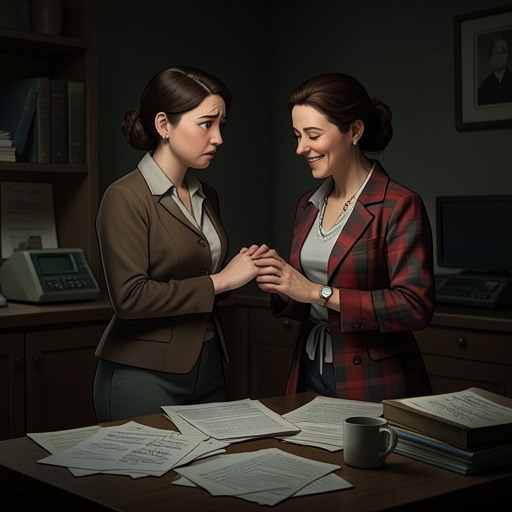
Nate Gogan oversees the ceremony, beaming as he performs the civil role. Kara Reynolds makes what is described as a once-in-a-lifetime journey from Mississippi and serves as Mo’s maid of honor. Her presence links Mo’s new life in Alaska to the family and friendships she left behind, preventing the marriage from reading as a total severing from her earlier identity. Kara remains in the area afterward, and the wedding also becomes the point at which she and Alan Dahling begin openly exchanging romantic looks. Alan, having learned from his earlier hesitation with Mo, is more direct with Kara and asks her to stay for the coming Big Freeze party.
The gathering therefore confirms more than one relationship. Mo and Cooper’s vows establish the central marriage, while Kara and Alan’s mutual attraction signals another pairing taking shape around them. The scene’s social energy is not confined to the bride and groom: it gathers human friends, town connections, and the consequences of Cooper’s wolf ancestry into a single domestic setting. The wedding’s traditional surface thus contains an unusual network of affiliations.
Pregnancy and Domestic Future
Mo’s pregnancy is already visible and becomes a subject of teasing conversation among the wedding guests. People make good-natured jokes about a shotgun wedding and feign outrage at the expectant bride’s supposed fallen state, yet the scandal quickly loses force. By the time the reception ends, even the guests’ mock indignation has dissolved into celebration. The humor allows the community to acknowledge the unconventional timing without treating pregnancy as a reason to deny the marriage’s legitimacy.
The pregnancy also changes the marriage from a declaration about the present into a plan for the future. Four months into the pregnancy, Mo’s belly is already large enough that strangers might guess she is seven or eight months along if it were a human pregnancy. Dr. Moder assures her that the baby will not be born with a tail, although the possibility of a full set of teeth remains a comic source of anxiety. The accelerated timetable distinguishes werewolf pregnancy from ordinary human expectations while keeping the pregnancy otherwise healthy and recognizable as an impending family life.
Cooper responds to the coming child with protective enthusiasm and exaggerated paternal anxiety. He talks about showing off his son, then turns green and mutters about setting traps around the house when a daughter reaches thirteen. These reactions make his future fatherhood concrete: the former prospective alpha is not being drawn back into power by the marriage, but forward into the everyday responsibilities and absurdities of parenthood.
Material Consequences
The marriage has immediate practical consequences at the Blue Glacier. Evie DuChamp and Buzz DuChamp give Mo a twenty-percent share in the saloon, explicitly connecting the offer to her success in increasing receipts by at least that amount since her arrival. They have also created a small nursery in the Glacier’s office so Mo can continue working after maternity leave. The arrangement makes the saloon both workplace and extended household, merging economic independence with childcare and community support.
The nursery is deliberately incongruous—Mo recognizes that having a baby in a bar seems wrong—but the town’s social fabric makes it workable. Patrons are expected to cuddle and coo over the child, and Cooper’s presence promises that the baby’s father may himself be displaying the child to anyone willing to watch. The practical plan shows that Mo’s marriage does not remove her from the life she built in Grundy. Instead, the wedding stabilizes her position within it and gives her a material stake in the business.
Cooper’s family and pack obligations also change, though not in the straightforward way that earlier expectations might suggest. He still has no interest in becoming the pack’s alpha. After Eli’s loss, however, he visits the packlands more often, and the pack adopts a more democratic method for choosing its leader: a secret ballot. Maggie Graham wins by a landslide. Cooper’s marriage therefore coincides with a reorganization of authority that leaves him free to remain Mo’s husband and the child’s father rather than becoming the hereditary leader his abilities once seemed to designate.
Narrative Significance and Aftermath
As a narrative event, the marriage converts several forms of uncertainty into durable affiliation. Mo’s arrival in Grundy begins with guardedness and a desire for an idle life, but work at the Blue Glacier makes her feel that she is taking a first step into the community. The birthday surprise then reveals how fully the town has claimed her as one of its own. The wedding completes that progression in domestic form: the outsider is no longer merely employed, befriended, or celebrated; she is married into a family and given an economic future.
The ceremony also revises the meaning of danger. The same story that includes a man twisting Mo’s arm behind her back and shoving her face against rough brick, and that leaves her haunted by images of blood and fire after John Teague’s death, does not make marriage a cure for trauma. Mo’s return to the alley triggers bodily memories of Teague’s breath, blood, and violence, while the attack on Abner and Cooper’s fear that he may have been the wolf responsible expose how unstable safety can remain. Against that history, the front-yard ceremony does not erase violence; it publicly establishes a relationship through which protection, accountability, and recovery can continue.
The marriage’s ending is therefore a continuation rather than a final disappearance of conflict. Mo and Cooper meet her parents at Dearly Airport while preparing for the birth, and Cooper buttons her jacket while running his fingers protectively over her growing belly. Their future includes the Blue Glacier nursery, Mo’s share of the saloon, a child whose biology may not follow human expectations, and Cooper’s renewed but limited contact with the packlands. The event closes the romance’s movement toward commitment while opening a family and community life in which human custom, wolf tradition, work, friendship, and pregnancy must coexist.