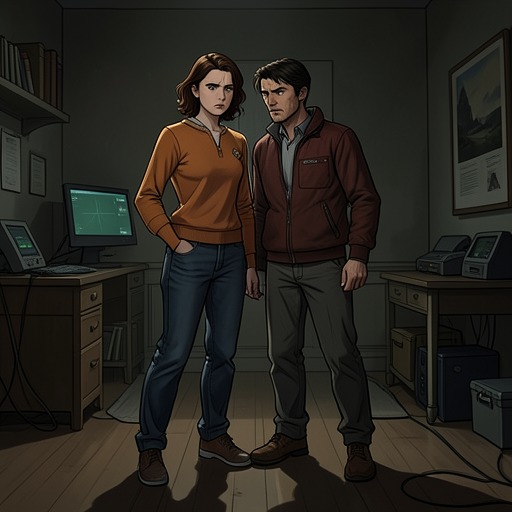
Mo and Cooper's First Night Together
How to Flirt with A Naked WerewolfMo and Cooper's First Night Together is the turning point at which their dangerous, teasing attraction becomes an acknowledged intimate relationship. The encounter follows Cooper's return in wolf form, transforms Mo's fear of the supernatural into chosen desire, and produces an immediate domestic consequence: Cooper stays through the morning and begins discussing what they will do together. In retrospect, the night is also the beginning of the bond that leads to their marriage and Mo's pregnancy.
Causes and Preparation
The night develops out of a relationship already shaped by secrecy, danger, and flirtation. Mo has learned that Grundy men may signal serious romantic interest by offering meat, a local provider tradition that makes courtship both comic and materially specific. Cooper's own identity is more consequential: Evie DuChamp explains that he comes from a werewolf line in which every member can change, that he was unusually fast and strong when he first phased, and that he was expected to become the alpha of his generation. His departure from the packlands to Grundy therefore represents not casual relocation but a painful break with the role prepared for him.
Mo's decision to be intimate with Cooper is also made against a background of physical fear. John Teague's assault has left her with intrusive images, bodily distress, and a heightened alertness to danger. Returning to the alley where Teague attacked her makes her feel his breath and the warmth of his blood again, while later memories include the wolf's intervention and the possibility that violence might return. That history does not disappear when Cooper comes to her; instead, the scene makes safety a question that must be answered through his conduct and Mo's continued ability to choose.
The Encounter
When something tears through the woods behind Mo, she expects the bear that has already frightened her, but immediately recognizes Cooper's wolf form. He phases to human while running, crosses the cold ground barefoot, leaps onto her porch, and kisses her before pushing both of them inside. The movement from wilderness to house gives the scene its central reversal: the creature associated with threat enters not as an attacker but as Cooper, an intimate partner who closes the door behind them.
Cooper's desire is urgent and physically assertive, yet Mo remains an active participant rather than a passive recipient. Their clothes are discarded as he carries her into the living room, and his attention to her produces an intense sexual response. The encounter retains comic self-awareness alongside erotic force: Mo realizes that she is about to have sex with a werewolf and worries about his control, possible injury, and the absurd prospect of canine sexual mechanics. Rather than surrendering those concerns, she tests the situation by reversing their positions and pinning him beneath her.
Consent and mutual responsiveness become explicit when Cooper pauses over the question of safe sex. Mo opens a condom, tells him to choose happiness, and rolls it on herself before straddling him. Cooper remains still while she adjusts to him, watching her rather than assuming permission, and she then initiates the movement that resumes the encounter. The scene therefore makes the supernatural difference between them erotically significant without allowing it to erase Mo's agency. Her surprise at her own low growl and Cooper's delighted reaction turn instinct into a shared language rather than evidence that either of them has lost control.
Immediate Aftermath
The night continues as repeated, athletic sex, and the next morning confirms that its meaning is not limited to a single impulsive encounter. Mo wakes in her own bed with Cooper curled around her, warming her after the blankets have been kicked to the floor. His sleepy movement—throwing an arm around her, drawing her back against his chest, and resting his chin over her shoulder—converts the charged physicality of the previous night into ordinary tenderness.
Cooper's presence the next day supplies the clearest relational consequence. He asks Mo what she wants to do, and she recognizes that he wants to stay. Her competing impulses are rendered humorously as a rational desire to know him better and a more immediate hunger for further sex, but both impulses point toward continuation rather than retreat. When she notes that he has no clothes at her house, the practical problem becomes evidence that the relationship has already entered domestic space: Cooper is no longer merely visiting as a mysterious man or wolf; he is occupying her home and planning time with her.
Relationships and Wider Stakes
The encounter joins private desire to the social and biological systems surrounding Cooper. Evie DuChamp knows that Cooper's family line can phase while hers is a “dead line,” a branch unable to become wolves, and she describes Cooper's expected alpha status as part of a generational pack order. Mo's intimacy with him therefore crosses not only a human-supernatural boundary but also the boundary between an outsider and a highly consequential werewolf lineage.
Cooper's history makes that crossing emotionally costly. His father died after remaining in wolf form to free an uncle caught in a research trap; when humans returned with a rifle, they shot him in the head. Cooper spent years angry at the humans involved before acknowledging that they had been confronted by a huge, aggressive wolf. His father’s death, his guilt, and his later estrangement from the pack help explain why closeness with Mo carries both refuge and risk. The first night offers him a human relationship outside the packlands, while offering Mo a relationship with someone whose inherited identity can never be reduced to ordinary small-town courtship.
The town's rituals provide a contrasting public frame for the private event. Grundy's flirtation customs, the Big Freeze party, and Mo's surprise thirtieth-birthday celebration all turn food and communal presence into signs of belonging. The first night is different because its decisive exchange occurs behind a closed door, yet it eventually becomes part of the same social trajectory. Cooper and Mo marry in a small civil ceremony in her front yard a month before the later airport scene, and the wedding is accompanied by gossip about an expectant bride. Their private intimacy thus becomes a recognized domestic alliance, even as the community treats the scandal with joking familiarity.
Consequences and Significance
The event changes the value at stake from attraction to commitment. Before it, Mo must interpret Cooper's behavior while living with the possibility that his wolf identity makes him dangerous. During it, she establishes boundaries, chooses protection, and discovers reciprocal pleasure. After it, Cooper remains, sleeps beside her, and participates in the practical question of the next day. The relationship has not become simple, but it has become real in a way neither flirtation nor rescue could accomplish.
Its later consequences are substantial. The marriage follows quickly, and Mo is pregnant with a rapidly developing child by the time her parents arrive at Dearly Airport. Cooper buttons her jacket and touches the growing bump protectively, while Dr. Moder has reassured them that the baby will not be born with a tail, though a full set of teeth remains possible. Evie DuChamp and Buzz DuChamp prepare a nursery in the Blue Glacier Saloon office and offer Mo a twenty-percent share after her menu work increases the saloon's receipts by at least that amount. The first night therefore initiates not merely sexual fulfillment but a new household, a public marriage, a mixed human-werewolf family, and Mo's strengthened place in Grundy's community.
As a narrative event, the night also balances comic romance against accumulated violence. Mo has been attacked, frightened, and forced to imagine death; Cooper carries inherited grief and the burden of an abandoned alpha destiny. Their intimacy does not cancel those histories. Instead, it creates a scene in which bodily trust, humor, restraint, and continued presence answer the novel's recurring question of whether the unfamiliar must be feared. The decisive transformation is not that Cooper becomes human, but that Mo can recognize the wolf and the man as belonging to the same chosen relationship.