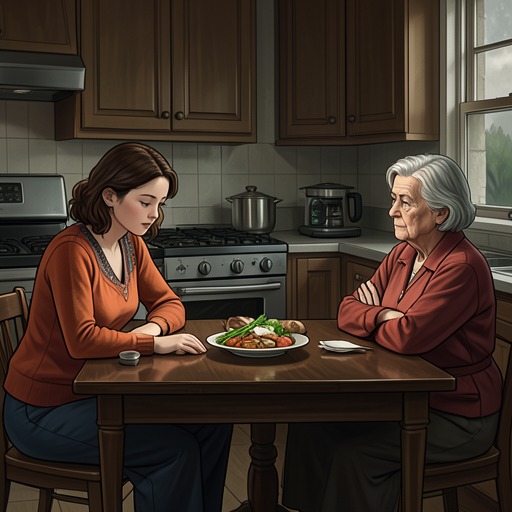
Mo’s Confrontation with Saffron
How to Flirt with A Naked WerewolfMo’s Confrontation with Saffron is the decisive telephone argument through which Mo defends her flight from her parents and establishes the first deliberate boundaries of her independent life. The confrontation is not merely a quarrel between an unhappy daughter and a worried mother. It exposes the central contradiction in Mo’s family relationship: Saffron Wenstein’s love is genuine, but it is expressed through surveillance, guilt, unsolicited intervention, and an assumption that parental concern entitles her to access. Mo’s answer is frightened, angry, and imperfect, yet it marks a necessary act of self-definition.
Circumstances and Initiation
The call occurs after Mo has delayed contacting her parents for too long. Two more Tums, an hour of yoga, and a chocolate chess square are required before she feels mentally prepared to dial the family number. She knows that Saffron has a general search area and fears that her mother may take drastic measures to find her, so the call is a preemptive attempt to control the situation before her parents can reassert control over it. Even before Saffron speaks, Mo understands the emotional terrain: Ash Wenstein is not the reasonable parent, but he is an amateur compared with Saffron when it comes to lecturing and guilt.
Saffron answers with an immediate accusation that Mo has run away and asks what her disappearance is doing to her father and to both parents. Her distress is real, but the form it takes places Mo on trial. The mother’s first demand is not an inquiry into what Mo needs; it is a challenge to justify having left. The scene therefore begins with competing definitions of the same act. Saffron interprets separation as abandonment, while Mo understands it as a necessary escape from enmeshment.
The Charges Against Saffron
Mo’s anger gives the confrontation its concrete evidence. She accuses Saffron of entering her kitchen and throwing away half her food because she has decided it is unhealthy, of calling Mo’s boss about taking time off for Burning Man without Mo’s agreement, and of forcing Mo to explain Burning Man to her employer. She also recalls Saffron’s attempt to obtain the results of Mo’s annual gynecological examination from the doctor’s receptionist. Each incident crosses a different boundary—food, employment, medical privacy—but together they form a consistent pattern of unauthorized management.
The most humiliating example is Saffron’s intrusion into Mo’s sex life. Saffron walked into Mo’s apartment unannounced, found Mo in bed with Ray Ridley, and remained there rather than withdrawing. She then discussed the benefits of tantric sex while sitting on the foot of the bed beside the naked couple. The incident clarifies why Saffron’s behavior cannot be excused simply as warmth or involvement. What Saffron regards as harmless openness is, to Mo, an assault on privacy and ordinary social limits.
Saffron answers that any man Mo dates must accept loving, involved parents as part of the package, and she invokes Tom as an example of a relationship she never believed would work. Mo corrects her—his name was Tim Galloway—and rejects the premise that romantic partners should be expected to date an entire family. Her point is not that she wants to hide every flaw, but that intimacy already requires finding someone willing to accept her; adding two intrusive parents makes the burden intolerable.
Mo’s Claim to Independence
Mo insists that she did not leave merely because of an awkward sexual intrusion or any single parental offense. She needs to be alone long enough to discover who she is away from Saffron, to obtain space, and to breathe. The language of breathing makes independence bodily rather than abstract: the family’s closeness has become something Mo experiences as pressure, and distance is presented as the condition under which a separate self can exist.
Saffron denies having exerted meaningful influence, pointing ironically to Mo’s use of plastic grocery bags as proof that Mo has always made her own choices. Mo counters that the issue is not the lessons her parents tried to teach, but what she wants to do with her own life. The disagreement also reveals a political and cultural divide. Ash and Saffron want to fight the system; Mo prefers the practical benefits of the system, including electricity, schools, and Ben and Jerry’s available at a local Wal-Mart. Her position is deliberately ordinary and material. She refuses to let her parents’ idealism define her morality or make conformity to their principles a condition of belonging.
Saffron attempts to reclaim moral authority by reciting a meditative declaration that she is the master of her feelings, while a gong sounds faintly in the background. She then announces that she will not lecture Mo about slaughterhouses or the effects of eating animal flesh on the colon. The performance of calm only emphasizes the conflict between Saffron’s self-image and her conduct. Her restraint is immediately followed by an appeal to her status as the woman who gave Mo life, suckled her, nurtured her, and loved her. Maternal sacrifice becomes an argument for access.
The Boundary and Its Cost
The practical climax comes when Saffron asks for Mo’s new address and telephone number. Mo remains silent because she knows that giving her home number would allow Saffron to call morning, noon, and night. The silence is therefore strategic rather than passive. Mo identifies information as one of the few forms of control still available to her and chooses not to surrender it.
Mo offers a compromise: she will call when she can, and Saffron can email her. Mo recognizes the cruelty of this proposal because her parents have not yet invested in a computer and apparently believe that emails arrive in envelopes from a disk drive. The offer is knowingly impractical, but it preserves a channel that Mo can regulate. She can switch off her cell phone or send calls to voicemail; a home telephone would make constant intrusion physically unavoidable.
Saffron raises the possibility of an emergency, including another episode suffered by Ash, and finally begs Mo not to do this. Mo ends the call while hearing her mother plead. The act produces no triumph. She blinks back tears and feels guilty, even while recognizing that she is not wrong to want a life on her own terms. The scene’s emotional resolution is consequently double-edged: Mo succeeds in maintaining a boundary, but independence does not free her from the pain of disappointing her parents.
Significance in Mo’s Trajectory
The confrontation establishes the emotional logic behind Mo’s relocation and her later determination to remain in Grundy. She is not simply fleeing a place or seeking novelty; she is testing whether a self can survive outside the interpretive system imposed by Saffron Wenstein and Ash Wenstein. The call makes that test explicit. Mo must decide whether contact with her parents will be governed by their anxiety or by her consent, and she chooses the latter even though the choice feels like betrayal.
The exchange also foreshadows the broader pattern by which Mo will negotiate danger and intimacy. Later threats make bodily autonomy painfully literal: John Teague twists Mo’s arm behind her back, shoves her face against brick, and offers violence as a false choice. Afterward, the memory returns through sensory triggers—the pavement, the sour Dumpster smell, the heat of blood on her shoulder—and Mo has to rebuild agency through work, baking, yoga, and a new menu proposal. The family call belongs to the same larger movement, though its violence is emotional rather than physical: Mo names the invasion, limits access, and accepts the cost of protecting herself.
In this sense, Mo’s Confrontation with Saffron is a conflict over who may define care. Saffron understands love as involvement without permission; Mo insists that love must coexist with privacy. The call does not resolve their relationship, and it does not make Saffron understand Mo’s position. Its achievement is narrower and more important: Mo speaks the terms of separation aloud, refuses to provide her address and home number, and begins to inhabit the life she has chosen rather than merely running from the one her parents designed for her.