Mo’s first encounter with the Grundy wolf
How to Flirt with A Naked WerewolfMo’s first encounter with the Grundy wolf establishes the central contradiction of her move to Grundy. She has escaped the strain of her parents’ expectations and begun imagining the cabin as a private, manageable home, yet the surrounding wilderness immediately presents a predator that is both physically terrifying and disturbingly aware. The encounter is not merely a wildlife sighting: it becomes the first visible sign that Grundy’s natural world contains a hidden intelligence, a danger that will later be connected to the werewolf pack and to Cooper Graham.
The Night at the Cabin
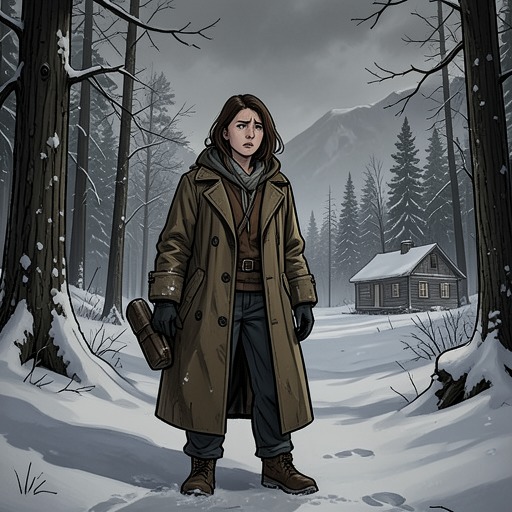
Mo is startled awake by frantic bleating and the crash of bodies moving through the brush. Still disoriented in the darkness, she reaches for her glasses, strikes the wall while trying to find the bedroom door, and stumbles toward the front entrance. She opens it expecting an injured sheep, an assumption that reflects both her half-asleep confusion and her lack of familiarity with the local wilderness. Instead, the full moon reveals an injured elk lying less than twenty feet from the cabin, panting in panic while blood from a neck wound darkens the grass.
The Wolf and the Elk
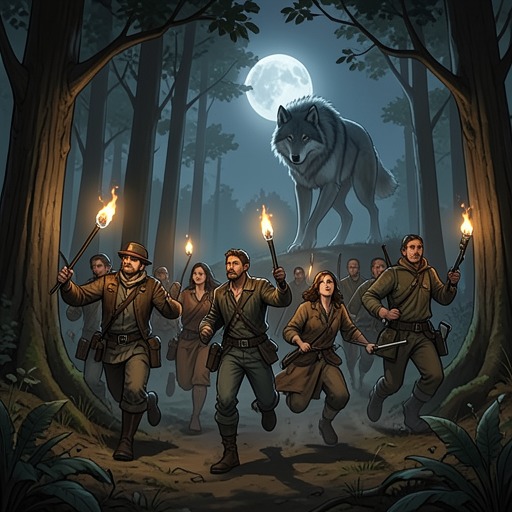
Hunched over the elk is the largest black wolf Mo has ever seen. The animal is wholly absorbed in its dying prey and initially appears not to notice her. Its jaws are poised over the elk’s throat, making the scene a stark encounter between predation and helpless observation. Mo retreats into the shadows but cannot immediately close the door. Her fear is practical as well as instinctive: she considers whether the cabin’s door could withstand the predator and searches mentally for weapons, including the fireplace poker and the elk antlers hanging above the fireplace.
The scene turns when Mo screams, “No!” The wolf lifts its head and looks directly at her. Its eyes are wide, blue-green, and described as glowing with angry intelligence, an expression that makes the animal seem capable of judgment rather than simple instinct. The elk uses the interruption to stagger upright and crash back through the brush. The wolf appears to glare at Mo for disturbing its meal, then pauses when it hears the elk fleeing. After an apparent burst of frustrated huffing, it springs away from the cabin and follows the bleeding animal into the woods.
Immediate Aftermath
Mo watches the wolf stare at the closed door before its attention shifts back to the elk. Once the predator leaves, she sinks to her knees and crawls toward the bed, already certain that sleep will not return that night. The encounter therefore changes the cabin from a prospective sanctuary into a vulnerable threshold: the door offers only uncertain protection, the woods conceal the animal’s movements, and the ordinary boundary between domestic safety and wilderness has proved alarmingly thin.
The incident also gives Mo an image that will recur through later fear and uncertainty. When John Teague attacks her, she remembers the unnatural way he scrambles away from the wolf, the three slashing wounds across his shirt, and the blood that soaks through the scene. Later, while recovering from the assault, she sits outside scanning the tree line for the “furry black savior” she imagines may have intervened. The original encounter thus becomes entangled with trauma: the wolf is at once a predator that threatened the elk, a possible protector who helped end Teague’s assault, and an unanswered presence Mo continues to expect in the woods.
The Encounter’s Hidden Pattern
The encounter acquires wider significance as later revelations make the wolf’s intelligence and movements legible within Grundy’s concealed social order. Cooper Graham explains that a werewolf pack functions not simply as a group of animals but as a village governed by an alpha, with members responsible for defending families and driving away threats. He also describes the danger posed by scientific trapping: when researchers returned to check a cage trap holding one of his uncles, Cooper’s father remained in wolf form to help free him, was shot in the head, and died after reaching the woods. That history places the cabin sighting within a landscape where humans, wolves, research, and territorial protection repeatedly collide. The later discovery of Abner Golightly badly mauled near the campsite sharpens the pattern: Abner’s loaded rifle remains unused, his chest and trousers are marked by deep claw wounds, and Cooper admits that he cannot remember the night well enough to exclude the possibility that he phased while asleep. The first sighting therefore changes retrospectively from an isolated disturbance into the opening image of a dangerous, morally complicated conflict in which the question is not only what the wolf can do, but whether the boundary between wolf and person can be trusted.
The encounter’s significance deepens because it introduces a recurring uncertainty about whether violence in Grundy belongs to nature, human beings, or a concealed community that crosses both categories. Cooper Graham later explains that the pack operates as a village under an alpha, whose responsibilities include making decisions for families and driving away threats such as wild animals and criminals. His account makes the black wolf’s apparent intelligence more consequential: the creature is not simply an anonymous predator but may belong to a social order organized around protection, territory, and obedience. That order is also vulnerable to human interference. Cooper recalls that his father died after remaining in wolf form to free an uncle from a cage trap set by researchers tagging wolves; when the researchers returned, they shot him in the head after he became aggressive. The memory links the wilderness outside Mo’s cabin to a history of mutual fear, mistaken classification, and lethal encounters between humans and werewolves.
Retrospective Significance
The encounter’s meaning expands as later revelations place it within Grundy’s concealed social and territorial order. Cooper Graham explains that the werewolf pack functions as a village led by an alpha, whose responsibilities include making decisions for families and driving away threats such as wild animals, criminals, and other unwanted intruders. That account makes the black wolf’s apparent intelligence more consequential: the animal may belong to a community organized around protection, territory, authority, and collective obligation rather than existing as an isolated predator. The wilderness beyond Mo’s cabin is likewise marked by human interference. Cooper recalls that his father died after remaining in wolf form to free an uncle from a cage trap set by researchers tagging wolves; when the researchers returned, they shot him in the head after he became aggressive. The memory connects the cabin sighting to a history of mutual fear, mistaken classification, and lethal encounters between humans and werewolves, while preserving the original question of whether the danger Mo witnessed belonged to nature, to people, or to a hidden society that crosses both categories.
The Encounter’s Retrospective Meaning
The first sighting gains a more troubling significance when Cooper Graham explains that a werewolf pack is structured as a village under an alpha, with responsibilities that include protecting families and driving away wild animals, criminals, and other threats. The black wolf’s apparent intelligence therefore suggests more than unusual animal behavior: it may reflect a social order governed by territory, authority, and collective obligation. Cooper’s account of his father’s death adds a history of reciprocal danger to the landscape. Researchers had set cage traps to tag wolves and track their movements; when one of Cooper’s uncles was caught, his father stayed behind in wolf form to free him, then was shot in the head after becoming aggressive when the researchers returned. The story links Mo’s cabin to a world in which humans and werewolves repeatedly misread one another, and in which the boundary between wildlife encounter, communal defense, and lethal violence remains dangerously unstable.
Retrospective Meaning
The first sighting also foreshadows the moral confusion that later surrounds violence in Grundy. Cooper Graham describes the pack as a village whose alpha makes decisions for families and whose members confront wild animals, criminals, and other threats; this framework makes the black wolf’s apparent intelligence seem potentially social and purposeful rather than merely instinctive. Yet the same protective order produces devastating consequences. Cooper recounts that his father stayed in wolf form to free an uncle from a researchers’ cage trap, then was shot in the head when the researchers returned and encountered an aggressive wolf. Later, after Abner Golightly is found with a loaded but unused rifle and deep claw wounds across his chest and trousers, Cooper admits that he cannot remember the night well enough to rule out having phased while asleep. These disclosures transform the cabin encounter into the beginning of a larger uncertainty: the danger around Mo is neither safely classifiable as wildlife nor readily separable from human responsibility, family loyalty, territorial defense, and the concealed werewolf community.
Retrospective Meaning
The first sighting foreshadows the moral confusion that later surrounds violence in Grundy. Cooper Graham describes the pack as a village whose alpha makes decisions for families and whose members confront wild animals, criminals, and other threats; this framework makes the black wolf’s apparent intelligence seem potentially social and purposeful rather than merely instinctive. Yet the same protective order produces devastating consequences. Cooper recounts that his father stayed in wolf form to free an uncle from a researchers’ cage trap, then was shot in the head when the researchers returned and encountered an aggressive wolf. Later, after Abner Golightly is found with a loaded but unused rifle and deep claw wounds across his chest and trousers, Cooper admits that he cannot remember the night well enough to rule out having phased while asleep. These disclosures transform the cabin encounter into the beginning of a larger uncertainty: the danger around Mo is neither safely classifiable as wildlife nor readily separable from human responsibility, family loyalty, territorial defense, and the concealed werewolf community.
Retrospective Significance
The first sighting foreshadows the moral confusion that later surrounds violence in Grundy. Cooper Graham describes the pack as a village whose alpha makes decisions for families and whose members confront wild animals, criminals, and other threats; this framework makes the black wolf’s apparent intelligence seem potentially social and purposeful rather than merely instinctive. Yet the same protective order produces devastating consequences. Cooper recounts that his father stayed in wolf form to free an uncle from a researchers’ cage trap, then was shot in the head when the researchers returned and encountered an aggressive wolf. Later, after Abner Golightly is found with a loaded but unused rifle and deep claw wounds across his chest and trousers, Cooper admits that he cannot remember the night well enough to rule out having phased while asleep. These disclosures transform the cabin encounter into the beginning of a larger uncertainty: the danger around Mo is neither safely classifiable as wildlife nor readily separable from human responsibility, family loyalty, territorial defense, and the concealed werewolf community.