Noah Graham
How to Flirt with A Naked WerewolfNoah Graham, whom Cooper Graham and the family call Pops, is the elderly patriarch whose illness brings Cooper back to the packlands and forces the family’s private rules into the open. Though physically vulnerable enough to become disoriented and require cardiac testing, Noah remains a figure of unusual authority. His resistance to ordinary medical treatment, his insistence on protecting the pack’s secret, and his eventual willingness to go to the hospital show an elder balancing ancestral survival with love for his grandson.
Identity and Family Position
Noah Graham is introduced as Cooper Graham’s grandfather, the older man at the center of a family emergency. Samson reports that Noah has seemed confused, unable to remember who people are or where he is, and that Dr. Moder believes he needs an EKG and further tests. Noah refuses to leave the village clinic because he fears that hospital staff will recognize him as a wolf. The crisis therefore identifies him not merely as an aging relative but as a custodian of a dangerous collective secret.
When Cooper arrives, Noah is resting in a hospital bed, but his appearance contradicts ordinary expectations of frailty. At eighty-two, he has a tanned, leathery face, iron-gray hair, and a body that still appears compact, solid, and capable. His blue-green eyes resemble Cooper’s, while the physical strength radiating from him makes age seem less decisive than lineage. Cooper explains that the men in his family age well because constant phasing produces resilient bodies and abundant collagen. Noah’s condition is serious enough to alarm the family, yet his presence still carries the bodily authority associated with the Graham werewolf line.
The Hospital Crisis and Return Home
Noah’s illness becomes the immediate cause of Cooper’s return to his family and valley. Samson comes to Mo Duvall-Wenstein’s home to summon Cooper, explaining that the family believes Noah may have suffered a heart attack or stroke. Dr. Moder has not found an acute episode, but Noah’s temporary disorientation makes further examination necessary. The family’s concern is intensified by the practical danger of transporting a werewolf into a public hospital, where unfamiliar staff might notice something abnormal.
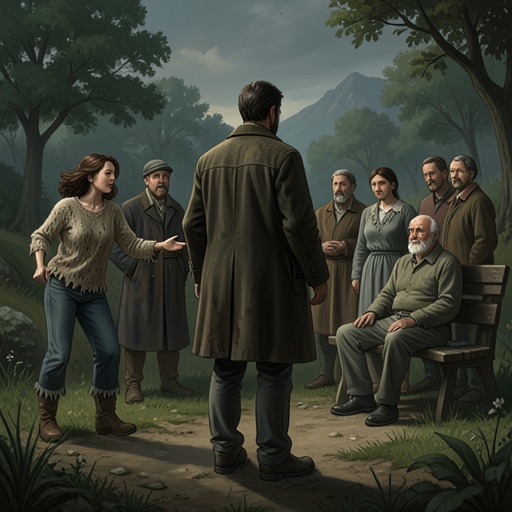
The medical dispute reveals the limits of Noah’s authority as well as its force. He initially refuses to be moved, while Cooper argues that other pack members have gone to hospitals without difficulty. Noah frames the issue in stark collective terms: protecting the secret matters more than extending the life of any single pack member. His position places the survival of the werewolf community above individual medical security, even his own. The principle is not presented as a private eccentricity; relatives gather outside the room and listen as Cooper challenges him, making the argument a family and pack-wide matter.
Cooper eventually appeals to Noah as a grandson rather than as a dissenting pack member, asking him to go to the hospital for Cooper’s sake. That request succeeds where repeated practical arguments have failed. Noah agrees to leave the clinic, and Dr. Moder arranges his admission at St. Martin’s Hospital. The resolution preserves both sides of the conflict: Noah’s fear of exposure is taken seriously, but his attachment to Cooper permits medical care to proceed.
Authority, Secrecy, and the Pack’s Past
Noah’s authority is grounded in age, lineage, and the knowledge attached to both. He tells Cooper that the family and pack have missed him and treats Cooper’s return as more than a visit: it is a partial restoration of a severed connection. Noah also recognizes that Cooper has brought Mo with him, takes her hands, and begins treating her as someone who must be incorporated into the family’s understanding rather than kept at its threshold.
His insistence on secrecy clarifies the governing logic of the pack. Werewolf identity is not simply concealed to avoid embarrassment; it is protected as a condition of collective survival. Noah’s refusal to risk public exposure demonstrates how secrecy disciplines ordinary decisions about illness, movement, hospitals, and kinship. The rule also explains why Cooper’s departure from the packlands has been so painful. Cooper belongs to a lineage shaped by centuries of instinct, territorial attachment, and mutual defense, while Noah represents the older generation that expects those forces to remain binding.
The family history associated with Noah extends beyond personal recollection. Cooper explains that his grandfather believes the first wolf-sons emerged after a Northern Man crossed the frozen oceans, entered the valley, and married a woman there. During a bitter winter, the man’s older son wished so intensely for the strength of a wolf that he transformed and hunted enough food for the starving village; his brother followed him. This origin story places Noah within an inherited account of lycanthropy as a response to communal need. The werewolf condition is therefore linked to survival, provision, and service to a village before it becomes a source of secrecy or danger.
Relationship with Cooper Graham
Noah’s relationship with Cooper combines affection, disappointment, pressure, and trust. He openly tells Cooper that the pack and family have missed him, making the younger man’s absence a wound in the collective rather than a neutral act of independence. At the same time, Noah is pleased that the crisis has brought Cooper home, even suggesting that he would endure the whole ordeal again if it meant Cooper returned to his place among them.
Cooper responds to Noah with a mixture of tenderness and sternness. He is relieved to see his grandfather alive, yet he refuses to accept Noah’s refusal of treatment as final. Their argument is not a simple clash between tradition and modernity. Cooper understands the need for secrecy, but he also believes that the pack’s rules should not require an elder to gamble with his health. Noah’s eventual concession shows that family affection can modify, though not erase, the authority of ancestral custom.
Noah’s recognition of Mo is also important to Cooper. Cooper introduces her with evident pride, and Noah immediately draws her into the family encounter. His interest marks the beginning of a broader kinship connection between a human outsider and the Graham pack. Later, Cooper and Mo’s relationship becomes permanently binding through werewolf marking, pregnancy, and marriage; Noah’s first meeting with Mo thus stands at an early point in the movement from secrecy and suspicion toward family inclusion.
Change and Narrative Significance
Noah does not undergo a large personal transformation, but the hospital episode changes what his character makes visible. At first, he appears to embody an uncompromising older order: protect the secret, remain in the village, and accept personal risk rather than expose the pack. By agreeing to go to St. Martin’s for Cooper’s sake, he demonstrates that the pack’s rules are negotiated through relationships as well as enforced by instinct.
His presence also gives the Graham lineage a human scale. The pack is associated with phasing, territorial compulsion, alpha succession, and bloodline continuity, but Noah is simultaneously an eighty-two-year-old grandfather who can become confused, resist doctors, tease his grandson, and welcome a new companion into the family. That combination prevents the supernatural inheritance from becoming an abstract system. It is carried in aging bodies, family arguments, medical emergencies, and acts of care.
Noah’s significance continues after the immediate crisis through the political consequences surrounding the pack. Cooper remains unwilling to become alpha, but after Eli’s loss he visits the packlands more often. The pack eventually adopts a secret-ballot process, and Maggie Graham wins the leadership decisively. Noah’s generation is associated with inherited hierarchy and the instinctive protection of the secret; the later democratic selection of Maggie suggests that the community can preserve its continuity while revising how authority is assigned. Noah therefore functions as a living link between the pack’s ancestral past and its emerging, more deliberate political future.