Saffron Wenstein
How to Flirt with A Naked WerewolfSaffron Wenstein, originally Lynn Duvall of Brownsville, Texas, is the mother whose love forms the emotional center and pressure point of Mo Duvall-Wenstein’s early life. She is a committed environmental radical, an uncompromising vegan, and a self-appointed guardian of health and principle; yet her care repeatedly becomes surveillance, intrusion, and guilt. Through Saffron, the novel makes family affection inseparable from the struggle for bodily autonomy, privacy, and the right to define adulthood outside a parent’s worldview.
Identity and Background
Saffron met Ash Wenstein at a recycling seminar in Chicago in 1975, and the two remained together thereafter. They never held a conventional wedding. Instead, their closest equivalent was a naming ceremony in which Lynn became Saffron and Ash received the name Ash Wenstein. The name’s association with a spice that stains and clings becomes an apt description of her presence in Mo’s life: Saffron’s convictions and habits remain difficult to remove even when Mo has physically left home.
Saffron and Ash established Sunrises, their self-sufficient, ecologically responsible commune for forward-thinking, government-hating vegans. The community occupied a barely refurbished old barn with literally no walls in Mo’s childhood home. Ash eventually changed the commune’s name because people repeatedly abandoned drugged-out teenagers at its gate, mistaking it for a rehabilitation center. The household therefore combined political idealism with practical disorder, communal openness with a lack of privacy, and an intense family culture with a constantly changing population.
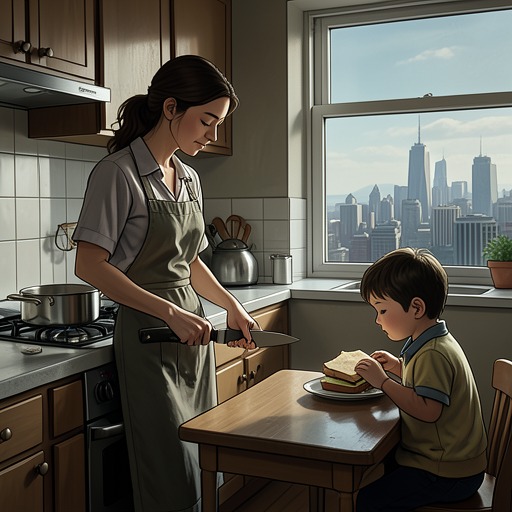
Saffron’s principles excluded religion, television, junk food, Western medicine, and pets. The prohibition on pets came from Ash’s allergy rather than animal-rights politics, but the larger pattern was unmistakable: ordinary domestic choices were treated as ethical decisions. Saffron’s parenting made ideology part of everyday life, while her vivid, eccentric public behavior gave Mo a childhood filled with unusual experiences. She could take Mo to a nuclear-energy protest dressed as a radioactive Statue of Liberty, and the family could suddenly spray-paint its Volkswagen van Easter-egg purple. Mo loved Saffron’s generosity, attention, and energy, and loved being the center of her parents’ world even as that centrality later became a form of confinement.
Control, Care, and the Departure from Home
The commune’s constant movement taught Mo not to form lasting friendships. People drifted in and out, often leaving after only a few months when they could not adapt to Saffron and Ash’s definition of responsible living. The instability did not erase the pleasure of Mo’s childhood, but it made attachment precarious. Saffron offered abundant attention while the surrounding community remained transient, creating a family world that was emotionally intense but difficult to leave without guilt.
As Mo grew older, Saffron continued to interpret control as protection. When Mo enrolled at the University of Mississippi, Saffron used a security pass to enter her dormitory and later her off-campus apartment building whenever she wished. She removed lunch meat, nonorganic produce, chemical cleaning products, and other items she considered harmful. When she discarded a bulk-sized box of Hostess Sno Balls, Mo began locking junk food in a plastic tub; Saffron then took the tub to a recycling center. She replaced forbidden food with nine-grain bread, tofu dogs, and carob cookies, reproducing the approved diet of Mo’s childhood while treating Mo’s adult preferences as problems to be corrected.
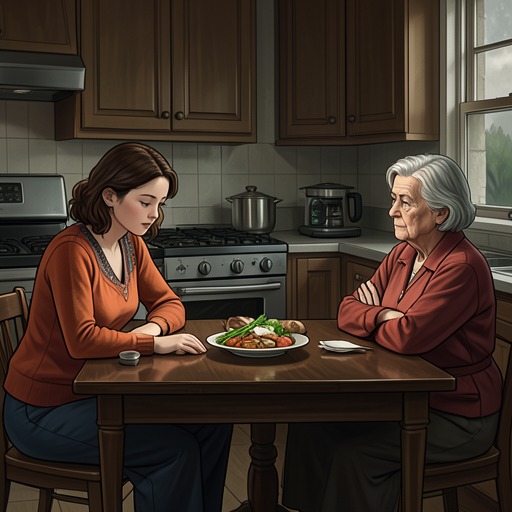
Mo recognizes that Saffron believes she is doing what is best, which makes resistance harder. Saffron’s interference is not presented as simple malice: she is thinking about Mo’s health, but she does so through a self-centered certainty that leaves no legitimate space for Mo’s judgment. Arguments become impossible to resolve because Saffron changes tactics whenever Mo seems close to establishing a boundary. Mo therefore studies hard and dreams of using her marketing degree to move far away, imagining Illinois, New York, or California as places where she might own a home her parents could not enter with a spare key.
The conflict reaches a decisive point around Mo’s graduation. Saffron considers the ceremony an overblown and meaningless expression of elitism and prefers attending a conference on pharmacological waste’s effect on the water supply. When Mo asks her to set aside her principles for one morning, Saffron’s refusal exposes the imbalance in their relationship: Saffron expects Mo to accommodate her convictions, while Mo’s milestones are treated as morally suspect. Ash embraces pacifism so thoroughly that he refuses to place himself between them, leaving Mo and Saffron to confront the conflict directly.
Pursuit and Boundary-Making
After Mo leaves for Grundy, Saffron fills Mo’s voice mail with anxious messages, complaints, and recriminations. She insists that the family has respected Mo’s need for her own space even while treating the distance as an abandonment that must be corrected. Her worry about Mo’s safety is genuine, but it arrives bundled with accusations and with the repeated demand that Mo call. Even her concern about cell-phone radiation becomes another means of occupying Mo’s attention: Saffron warns that the phone may cause a brain tumor while expecting Mo to remain available through it.
When Saffron learns that Mo has run away, she demands an explanation and asks for Mo’s new address and phone number. She frames the request through motherhood, invoking the fact that she gave Mo life, nursed her, nurtured her, and loved her. Mo refuses to surrender the home phone number because she knows it would ring constantly. The cell phone can be switched off or sent to voice mail; a home number would place access to Mo’s domestic life in Saffron’s hands. Mo offers e-mail instead, knowing that her parents do not even own a computer. The maneuver is deliberately unfair, but it also marks a crucial change: Mo begins managing contact rather than merely enduring it.
That change becomes possible because Grundy gives Mo a social identity separate from her parents. After she starts working at the Blue Glacier Saloon, neighbors call her “Mo from the Blue Glacier.” She becomes a contributing member of the community, recognized for work, conversation, and competence rather than for Saffron’s beliefs. The contrast clarifies what Mo has been trying to escape. Saffron’s home made Mo the center of her parents’ world; Grundy allows Mo to become a person among other people.
Contrast with Mo’s New Community
Saffron’s model of care is controlling and ideologically prescriptive, whereas the women around Mo demonstrate more reciprocal forms of practical support. Gertie Gogan sends a pot roast, potatoes, and berry cobbler to welcome Mo after her long drive, saying that a woman should not have to cook for herself after traveling so far. Evie DuChamp offers Mo full-time work and responsibility for baking because Mo is steady, capable, willing to help, and trustworthy with the tip jar. Later, Gracie Graham arranges for Dr. Moder to visit Mo at home during her pregnancy, protecting her privacy while ensuring that she receives appropriate care.
These gestures do not erase Saffron’s influence, but they provide a standard against which Mo can measure it. In Grundy, help can strengthen independence: food welcomes Mo without claiming authority over her, work gives her a place of her own, and medical assistance supports her choice to keep the pregnancy private until she can tell Cooper Graham. Saffron, by contrast, presents assistance as evidence that she should retain access to Mo’s choices. The distinction is not between loving and unloving behavior, but between care that recognizes another person’s agency and care that treats agency as a dangerous lapse.
Saffron is also implicitly contrasted with the women who sustain Mo’s later life. Evie and Buzz DuChamp offer Mo a twenty-percent share in the saloon after her work increases its receipts, and they create a nursery in the office so she can return after maternity leave. Gracie helps Mo through the shock of discovering that she is pregnant and connects her with Dr. Moder, who explains the shortened gestation of a werewolf pregnancy and gives her a specialized reference pamphlet. These women help Mo inhabit adulthood; Saffron repeatedly tries to restore her to the role of a daughter who must be corrected.
Thematic Significance
Saffron represents the complicated inheritance from which Mo must separate without denying that it contained real love. Her politics are not empty: recycling, ecological responsibility, opposition to waste, veganism, and suspicion of institutional medicine all arise from convictions she has practiced consistently. But the novel places those convictions beside the damage caused when principle becomes a license to override another person’s consent. Saffron’s environmental and health ethics cannot justify entering Mo’s home, destroying her possessions, or demanding unrestricted access to her whereabouts.
Her relationship with Mo also exposes the gendered labor beneath idealism. Saffron feeds, monitors, advises, and emotionally pressures her daughter, making domestic and bodily care the medium through which authority is exercised. The same broad category of care looks different in Grundy: Gertie’s cooking, Evie’s employment offer, Gracie’s pregnancy support, and the saloon’s nursery convert care into community infrastructure rather than private domination. Saffron’s version binds Mo to the family; the later network enables Mo to choose where and with whom she belongs.
Mo’s eventual permanence in Grundy confirms the significance of that choice. She buys the house that becomes the first place she truly considers her own home, decides she cannot imagine raising her baby elsewhere, reconciles with Cooper, and marries him in a small civil ceremony in her front yard. Kara Reynolds visits from Mississippi, while Alan Dahling begins a relationship with her, and Evie and Buzz extend Mo’s place in the Blue Glacier into ownership and future employment. Saffron is not shown participating in this new domestic order, but her absence is meaningful: Mo’s life has reached a stage where family, work, pregnancy, and home are organized by Mo’s decisions rather than by Saffron’s rules.
Saffron therefore remains a formative presence even when she is offstage. She gives Mo an inheritance of energy, generosity, eccentricity, and fierce commitment, but also the burden of guilt and the need to defend every boundary. Mo’s achievement is not simply moving away from Saffron; it is learning to preserve affection without surrendering authority over her own body, home, work, relationships, and future.