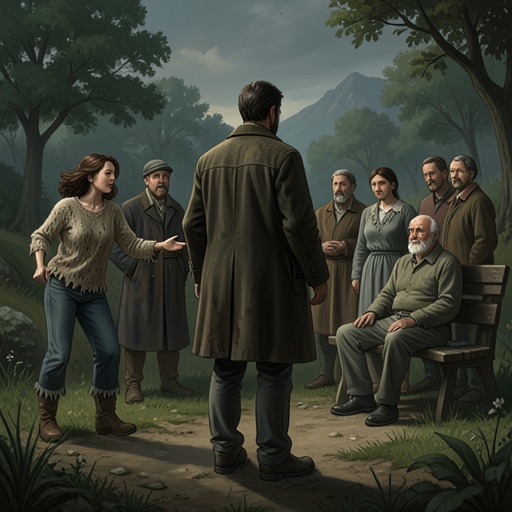
Samson
How to Flirt with A Naked WerewolfSamson is Cooper Graham’s cousin, but the novel presents him as something closer to a brother: after the death of Cooper’s father and the disappearance of Samson’s own father, Samson grew up in the Graham household and remained bound to Cooper by an unusually intimate family loyalty. He is also one of the story’s most important human-facing members of the werewolf community, translating pack customs into hurried explanations, affectionate jokes, and acts of immediate care. His mixture of physical power, emotional softness, and comic awkwardness gives the Crescent Valley pack a less intimidating face than its violence and hierarchy might otherwise allow.
Identity and Family Background
Samson’s place in the family is shaped by loss. Cooper explains that his father died while trying to free Samson’s father from a cage trap set by researchers tracking wolves. Cooper’s father was shot after becoming aggressive in wolf form; Samson’s father later left because he could not bear seeing the family and feeling responsible for the death. Since Samson’s mother had died when he was a baby, he moved in with the Grahams. Cooper therefore describes Samson as more brother than cousin, a relationship grounded not merely in blood but in shared upbringing and mutual dependence.
The broader werewolf system also places Samson within a hereditary structure. Evie DuChamp identifies her own family line as a dead line, unable to phase, while Cooper’s line has retained the ability to transform across generations. Samson belongs to that continuing wolf lineage and participates in its collective memory: Cooper cites him as the kind of cousin who can remind a wolf of what he did while transformed, when individual memory is incomplete. Samson thus represents both the biological continuity of the pack and the social mechanism by which its members remember, interpret, and sometimes excuse one another’s behavior.
Temperament and Introduction
Samson first appears in a scene that turns werewolf strength into farce. He arrives at Mo’s house naked, powerfully built, and blinded by bear mace after Cooper treats what Samson considers a customary greeting as an attack. His physical presence is imposing, but his behavior is not predatory. He is distracted by the burning in his eyes, jokes about Cooper’s scent, and then delivers urgent news: Cooper’s grandfather, known as Pops, may have suffered a heart attack or stroke and needs medical attention at the Crescent Valley clinic.
The emergency reveals Samson’s practical role within the family. He has run to Cooper for help almost instinctively, without first collecting every detail, and he is more concerned with getting back than with presenting a coherent report. The two-hour drive to the valley is strained because Samson keeps insisting that they would already have arrived if they had run, while Cooper questions him like a commander preparing for battle. Samson’s answers are incomplete, but his presence carries the message that the family needs Cooper immediately. He is a messenger whose urgency matters more than his precision.
Mo responds to Samson’s attempt to prevent her from coming by ordering him into Cooper’s truck. Samson peers past her to grin weakly at Cooper and says that he likes her. The remark marks his rapid acceptance of Mo into the family’s emotional field. Cooper answers that he likes her too, though his bleak tone suggests that affection has become a complication he cannot escape. Samson’s approval is therefore both comic and consequential: it helps position Mo not as an outsider being inspected by the pack, but as someone Samson is already willing to claim.
Relationships and Care
Samson’s relationship with Cooper combines brotherly affection, dependence, and blunt familiarity. Cooper relies on him for information about the family, even when Samson’s instinctive dash to Grundy leaves him poorly briefed. Samson, in turn, treats Cooper’s return to the valley as a matter of family necessity rather than personal preference. Their exchanges are full of teasing, but the teasing rests on an underlying assumption that either cousin can call on the other in a crisis.
His connection with Mo develops through the same directness. While she is recovering from a head injury in Gracie Graham’s home, Samson marvels that a human woman could take such a punch and jokingly proposes marrying her if things do not work out with Cooper. Mo replies that his size might break her in half, an exchange that emphasizes both his formidable body and his harmlessly affectionate manner. The joke is vulgar and absurd, but it also confirms that Samson regards Mo as sufficiently familiar to flirt with and sufficiently protected to welcome into the family without ceremony.
Samson remains part of Mo’s support network after Cooper leaves. When Mo fears that she may have to raise her unborn child without its father, Gracie tells her that there is a family around her: Gracie herself, Samson, and the rest of the pack, at least until Cooper returns. Samson is therefore not merely a comic cousin in the background. His anticipated presence becomes evidence that Mo and the baby will not be abandoned, even during Cooper’s self-imposed separation.
Place in Pack Politics
Samson’s affection for hunting does not translate into a desire for domination. Maggie Graham describes him as loving the hunt while hating fighting, and characterizes him as “cuddly” rather than confrontational. That distinction matters in a pack organized around strength, speed, obedience, and alpha authority. Samson possesses the bodily capabilities associated with the werewolf community, but he does not embody its most aggressive version of masculinity or leadership.
After Eli’s loss, the pack adopts a democratic method for choosing an alpha. Samson is nominated, but the wolves do not believe he would take the position seriously, and Maggie wins by a landslide instead. The outcome does not make Samson irrelevant. It clarifies his function by contrast: he is trusted as a beloved family member and dependable companion, but not imagined as the person who should carry the institutional burden of rule. His softness is not treated as a defect in private life, yet it disqualifies him, in the pack’s judgment, from the seriousness required by political leadership.
This contrast gives Samson a distinctive place in the pack’s social order. Maggie’s authority is secured through strength, speed, intelligence, and fear; Samson’s influence comes through attachment, humor, and his ability to make difficult family ties feel ordinary. He is not the alpha, but he helps make the pack legible to Mo and makes its collective care visible when its formal structures are under stress.
Narrative Role and Significance
Samson functions as a threshold figure between Mo’s human life and the werewolf world. His arrival brings news from the hidden valley, his explanations connect Cooper’s personal history to pack custom, and his acceptance helps turn Mo’s relationship with Cooper into a relationship with an extended family. Even when he appears in comic circumstances, he carries information about kinship, memory, medical fear, and political succession.
His physicality also repeatedly unsettles simple distinctions between danger and safety. He is huge, naked, and capable of running where a truck would be used, yet he is the cousin who dislikes fighting and the family member who offers emotional reassurance through jokes. That tension echoes the novel’s broader treatment of the werewolves: bodies associated with violence can also be bodies of care, and belonging is established as much through ordinary companionship as through blood or phasing.
By the end, Samson has not become an alpha, nor does the narrative suggest that he secretly wanted the role. His value lies elsewhere. He remains part of the network surrounding Mo, Cooper, and their child, a warm and imperfect link between household intimacy and pack solidarity. In a story where leadership is repeatedly contested, Samson represents a different form of social power: the ability to arrive, carry urgent news, make room for an outsider, and remain present when family members are frightened, divided, or in need.