Tast-E-Grill Drive-In
How to Flirt with A Naked WerewolfTast-E-Grill Drive-In is the formative workplace of Mo Duvall-Wenstein’s adult independence: a roadside restaurant where she first confronts the foods her mother rejected, earns money for a self-fashioned life, and acquires the short-order cooking skills that later make her indispensable at the Blue Glacier Saloon. Its importance is less architectural than developmental. The drive-in becomes the place where appetite, labor, rebellion, and competence converge, giving Mo a practical identity that survives her family’s attempts to define her.
Setting and Function
Tast-E-Grill Drive-In is remembered as a conventional American food establishment, serving the substantial, familiar fare that Mo later recognizes in the Blue Glacier Saloon’s original menu: burgers, fries, enormous pancakes, bacon, eggs, and repeated orders of steak. The restaurant’s plainness matters because it contrasts sharply with the dietary principles of Mo’s parents, Ash Wenstein and Saffron Wenstein. For Mo, its food is not merely nourishment; it is evidence that she can enter the ordinary social world from which her upbringing had left her unprepared.
Mo’s first experience of the drive-in’s food is physically comic but symbolically important. On her first afternoon, she eats a bacon cheeseburger and promptly vomits. Rather than treating that failure as proof that she belongs to her mother’s world, Bernie Harned, the owner, patiently helps her build tolerance for processed foods and fats, eventually leading her to Frito Pie. The drive-in therefore functions as a training ground in more than cooking. It teaches Mo to acquire tastes, routines, and forms of participation that her family had treated as morally suspect.
Mo’s Work and Independence
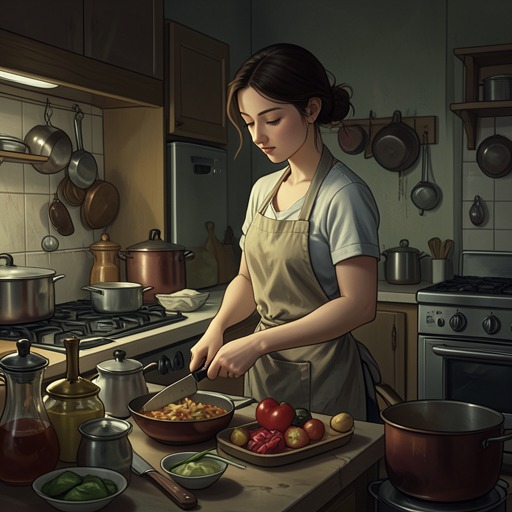
Mo begins at Tast-E-Grill Drive-In as a car hop after school and works her way up to manning the grill. The progression gives her an earned competence distinct from the intellectual or ideological identities imposed by her household. She uses her wages to buy new clothes, CDs, makeup, and junk food, keeping these “forbidden little treasures” in an old steamer trunk at the foot of her bed. The objects purchased with drive-in money become a private archive of self-determination: small, material choices through which Mo constructs a life her parents cannot fully supervise.
The work also becomes part of Mo’s long rebellion against the pressure to remain “normal” in a way that satisfies others. Her mother’s reaction to the restaurant’s meat-centered labor is so severe that, after discovering Mo had been cooking at Tast-E-Grill for six months, Mo had to raise money for People for the Ethical Treatment of Animals as penance. Yet the punishment does not end the employment. Once Mo turns eighteen, she returns to the drive-in after school and during college summers, making the restaurant a recurring site of resistance rather than a brief adolescent experiment.
Skills Carried to the Blue Glacier
The drive-in’s most consequential legacy appears when Mo encounters the failing kitchen at the Blue Glacier Saloon. Buzz DuChamp is incapacitated after his bottle-cutting accident, Pete is unable to manage the rush consistently, and Evie DuChamp needs someone who can take control without panicking. Mo immediately recognizes the kitchen’s basic structure and explains that she worked through school at a drive-in, where she learned short-order cooking. Because the patties are already shaped and the vegetables prepared, she can step directly into the work.
That experience makes Mo more than emergency help. Evie identifies her as a solid, consistent cook who does not faint at blood, helps a near stranger, and leaves the tip jar untouched. Mo, in turn, discovers that the kitchen offers a rare combination of useful labor and privacy: she feels part of the room without being exposed to its entire social pressure. Accepting the job becomes a tentative entry into Grundy’s community, and the competence formed at Tast-E-Grill becomes the bridge between an outsider’s planned isolation and a public role in town.
Food, Labor, and Menu Authority
At the Blue Glacier, Mo expands the practical repertoire first developed at the drive-in. When Buzz tests her with elk meat, she does not recoil from the strange-smelling, almost purple cuts. She proposes either grinding it for meat loaf or marinating it in Coca-Cola to soften the gamey flavor, then prepares two large pans under Buzz’s supervision. Her familiarity with wild game, acquired through a broader cooking history that includes deep-fried alligator and chitlins, earns even Buzz’s restrained approval.
After the attack by John Teague, Mo channels her sleepless, unsettled energy into a detailed menu proposal. She researches recipes, costs, and shopping plans, then presents Evie with a program of reasonably priced comfort food: chicken noodle soup, beef stew, meat loaf, Sherry’s pot pie, chicken and dumplings, burgers, and melts. She also expands the dessert offerings with apple-raisin pie, chocolate chess squares, applesauce cake, banana pudding, and brownie à la mode. This is the drive-in’s legacy transformed rather than copied: familiar food becomes a deliberate business strategy and a means of making the saloon busier.
Evie supports the reform even though Buzz still controls the kitchen. The two women plan to replace the menus under the excuse that Pete dropped them in the sink, a small act of deception that reveals the workplace’s existing hierarchy. Mo’s cooking skill gives her influence, but the menu change requires Evie’s authority and their shared management of Buzz’s resistance. The drive-in thus echoes through a later transfer of labor power: the employee trained in a roadside kitchen becomes the person whose judgment changes an entire establishment.
Community and Long-Term Consequences
The social function Mo finds at the drive-in reappears at the Blue Glacier. At Tast-E-Grill, work provides money and access to the ordinary world; at the saloon, cooking provides routine, conversation, and a position within Grundy’s social network. The transition is especially significant because Grundy’s food culture carries meanings beyond the menu. Men express courtship by offering meat, and werewolves mark important gestures with food, including dating, proposals, and apologies. Mo’s early education in cooking and meat-centered service therefore places her close to the material language through which Grundy forms relationships.
Her work at the Blue Glacier ultimately produces an economic transformation that Tast-E-Grill makes possible. After Mo increases the saloon’s receipts by at least twenty percent, Evie and Buzz offer her a twenty-percent share. They also prepare a nursery in the saloon’s office so she can continue working after maternity leave. The trajectory from car hop to grill worker, from emergency cook to menu strategist, and finally to co-owner gives the drive-in a retrospective importance: it is the first institution to convert Mo’s food knowledge into independence, while the Blue Glacier converts that knowledge into recognized authority and ownership.
The drive-in also remains a point of contrast with Mo’s mother. Saffron Wenstein associates animal flesh, processed foods, commercial products, and conventional consumption with moral and bodily danger; Mo learns, through work, that these same materials can become wages, skills, hospitality, and belonging. Tast-E-Grill Drive-In does not erase the conflict between them, but it gives Mo a durable language for answering it. Its burgers, fats, grill work, and paycheck become the practical vocabulary of a self she builds one shift at a time.