The Wolf’s Elk Hunt
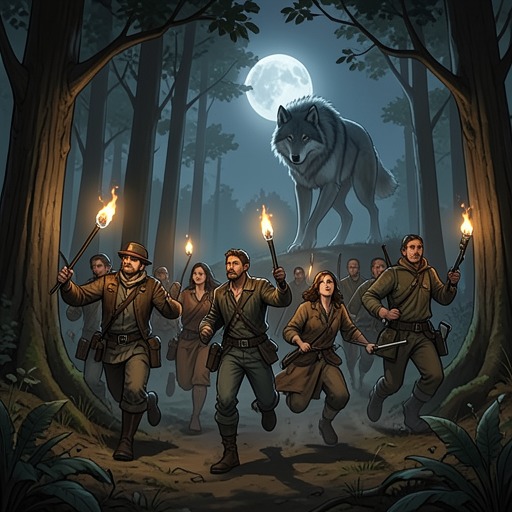
How to Flirt with A Naked WerewolfThe Wolf’s Elk Hunt is the decisive first sighting of the black wolf by Mo Duvall-Wenstein: an encounter in which an injured elk, a full moon, and a predator of extraordinary size turn her new home into the threshold of the unknown. The scene introduces the wolf not as a distant rumor but as a physically immediate danger, while its restraint, awareness, and striking blue-green eyes complicate the category of “wild animal.” Mo’s instinctive refusal to let the hunt continue becomes the first small act in the relationship and conflict that will define her life in Grundy.
Circumstances and Setting
The hunt takes place soon after Mo Duvall-Wenstein has moved into her cabin in Grundy. She is still orienting herself to the unfamiliar interior: awakened in darkness, she reaches for her glasses, mistakes the location of the bedroom door, and runs headlong into a wall before finding the front door. Her confusion and half-sleep make the scene feel initially domestic and almost absurd, but the sounds outside—frantic bleating and bodies crashing through brush—pull her across the boundary between shelter and wilderness.
Mo opens the door expecting an injured sheep, although she has no idea why a sheep would be nearby. Instead, the full moon illuminates an injured elk less than twenty feet from the house. The elk is panting and panicked, blood running from a wound in its neck and darkening the grass, while the largest black wolf Mo has ever seen is hunched over it. The proximity matters: the hunt is not merely something Mo observes at a safe distance. It has arrived at the edge of her home, making Grundy’s natural world an intimate and potentially invasive force.
The Encounter
The black wolf is initially unaware of Mo. Its attention is fixed on the dying elk, with its jaws poised over the animal’s throat. Mo retreats into the shadows but cannot immediately close the door. Her fear is sharpened by the wolf’s scale and concentration: it is not a fleeting glimpse of an animal passing through the trees, but a sustained confrontation between a human observer and a predator absorbed in its prey.
Without thinking, Mo screams, “No!” The interruption produces the scene’s first reversal. The wolf’s head snaps up, revealing wide eyes of an unearthly blue-green that seem to glow with angry intelligence. The elk takes advantage of the distraction, struggles to its feet, and crashes back into the brush. The wolf appears to narrow its eyes at Mo as though silently reproaching her for interfering, giving the encounter an almost conversational quality without making the animal less threatening.
Mo finally manages to close the door and watches through the window as the wolf stares at it. She considers possible weapons inside the cabin, including the fireplace poker and elk antlers hanging above the fireplace. The antlers suggest a grimly fitting defense against a creature that has just attacked an elk, but the imagined weapons also reveal how little control Mo actually possesses. The wolf could perhaps tear through the door; Mo has no reliable assurance that the barrier will protect her.
The confrontation ends because the elk makes more noise in the bushes, not because Mo defeats or drives off the wolf. The predator perks up, emits a frustrated huff, and springs away from the house to pursue its bleeding meal. Mo collapses to her knees and crawls toward the bed, convinced that sleep will be impossible for the rest of the night. The wolf’s departure therefore provides only temporary relief: the immediate danger recedes, but the knowledge of its existence remains inside the cabin with her.
Foreshadowing and Recurrence
The hunt becomes the foundational image through which Mo interprets later violence. After John Teague attacks her, the memory of the black wolf returns alongside the attack itself. Mo remembers Teague’s smirk, the way he scrambled away from the wolf, and the three long slashes of blood across his shirt. Her mind also generates imagined versions of Teague’s death in the truck and ravine, showing how the earlier sight of the predator has become fused with her fear, guilt, and attempts to understand what saved her.
The sensory aftermath of Teague’s attack brings the wolf encounter back indirectly. In the alley behind the Blue Glacier Saloon, the pavement and the sour smell of the Dumpster trigger memories of Teague’s breath, blood, and physical proximity; Mo then thinks of honeysuckle and the cotton-hauling trucks of her childhood while scanning the tree line for either her “furry black savior” or the imagined ghost of Teague. The elk hunt thus foreshadows a repeated pattern in which the wolf represents both terror and protection, while Mo’s body responds before her rational understanding catches up.
Later evidence complicates the apparent separation between ordinary predation and supernatural danger. Cooper Graham explains that researchers once trapped wolves to tag and track them, and that his father died after remaining in wolf form to free an uncle from a cage trap. He also describes the pack’s role in defending its territory and families from wild animals and criminals. These revelations recast the black wolf’s behavior within a larger world of wolf identity, territorial duty, and human misunderstanding. The first hunt is consequently not an isolated natural-history episode; it is the opening image of a hidden social order that Mo initially mistakes for an unusually large animal.
Consequences and Significance
The immediate consequence of the hunt is Mo’s loss of uncomplicated safety in her new home. She has moved to Grundy hoping for independence, quiet, and uninterrupted sleep, but the first night teaches her that the cabin’s door is a fragile line between domestic life and the surrounding wilderness. Her final retreat toward the bed is not a return to comfort so much as an acknowledgment that the world outside has changed the meaning of the room.
The episode also establishes Mo’s defining instinct to intervene. She does not plan a rescue or assess the danger; she sees the elk and objects. That impulsive “No!” saves the elk only temporarily, since the wolf pursues it, but the gesture reveals the moral reflex that later shapes her responses to Cooper Graham, Abner’s injuries, and the violence surrounding the wolf pack. Mo’s compassion is active rather than abstract, yet it repeatedly places her close to forces she cannot control.
For the novel’s larger structure, the hunt is an encounter with concealed identity before Mo has the language to recognize it. The wolf’s intelligence, its apparent irritation at being interrupted, and its decision to leave only when the elk’s movement calls it away create tension between animal instinct and human-like intention. That ambiguity allows the scene to function simultaneously as a frightening wildlife encounter, a first supernatural revelation, and a quiet beginning to Mo’s bond with Cooper Graham. The black wolf first appears over a dying elk, but its lasting importance lies in the fact that it has already noticed Mo—and that Mo, frightened and defenseless, has chosen to speak to it.