Wolves
How to Flirt with A Naked WerewolfWolves are first encountered in Grundy as an uncertain physical threat: enormous tracks, a badly injured resident, and no clear way to identify the animal responsible. As the search expands, the evidence points beyond an ordinary wildlife problem, while fear and public attention create dangers of their own.
Tracks, Attacks, and an Uncertain Search
While looking around Susie Q’s yard for evidence that might clear Cooper Graham of the attack on the postmaster, Mo finds huge paw prints in the mud near the driveway. They could be Cooper’s, but she cannot rule out a bear. The tracks offer evidence that a large animal has passed through, not a reliable identification of which creature it was.
Susie Q survives her attack but remains in intensive care with extensive damage to her trachea and jaw, broken ribs, internal injuries, and two missing fingers from trying to fend off the wolf. Unable to write more than a few words for state police, she reports that a big wolf bit her. The injury makes the danger immediate, but her limited account does not establish what kind of wolf attacked her.
Alan Dahling searches around Susie Q’s house and later spends weeks following signs through Grundy. He finds tracks circling through town, but no animal remains, scat, or other confirming evidence, and never sees an actual wolf. The trail disappears a few miles into the woods; its repeated passage near Mo’s house makes the search personally unsettling without resolving the animal’s identity.
Seeking expert guidance, Alan learns that a wolf may attack a lone, defenseless person caught outside at night. Such an attack would ordinarily be preceded by warning signs, such as livestock killings or pets going missing, which Mo has not heard about. An animal that is sick or wounded may be unpredictable, and Alan wants to find it before residents take matters into their own hands. He fears that frightened neighbors could organize a hunt and injure themselves or one another rather than catch the animal.
The Missing Hikers and the Limits of Animal Behavior
When two young hikers disappear, the search gives Alan stronger evidence of violence but no clear account of the attackers. Their campsite is wrecked: the tent is torn apart, their food and sleeping bags are scattered, and large tracks surround the site. Blood is smeared across the ground, yet no bodies or remains are found there. Alan identifies the tracks as those of the same kind of wolf implicated in Susie Q’s attack, but the apparent coordination troubles him. The boys had rifles, and he believes more than one wolf would have been needed to surprise and kill two grown men; even so, Wolves normally avoid humans when they can escape. The attack seems organized, as if an intelligent predator entered the camp and took what it wanted without being injured.
The absence of bodies leaves the missing hikers’ fate unresolved while intensifying the search. State wildlife reinforcements prepare to go farther into the forest than Alan had been comfortable taking volunteers. When the remains are eventually located, they lie about a mile from the campsite, scattered as bones in a ravine and gnawed by multiple animals. Alan stays at the site while the coroner gathers them, giving the families some closure. Snowmelt has erased the tracks, and the scavenging makes it impossible to know whether any trail would lead to the right wolf. The discovery confirms the hikers’ deaths but does not identify who attacked them or explain the earlier signs of deliberate, coordinated violence.
Fear, Surveillance, and the Human Response
The investigation turns the wolf from a possible animal hazard into a focus for public fear. Alan worries that residents will respond to danger by organizing their own hunt, risking harm to one another as well as to whatever they believe they are pursuing. His concern is practical: he wants to locate the animal before frightened people take weapons into the woods. After Mo describes a bear encounter, he plans more traps near her home and offers her a map marked with orange hunter’s tape, warning her to watch where she and Oscar walk. The response meant to protect the town also makes ordinary movement around Mo’s property more hazardous.
The search yields no sighting that could settle the question. Alan finds tracks circling through Grundy and repeatedly passing Mo’s house, but no remains, scat, or other corroborating signs; the trail vanishes in the woods. That pattern heightens suspicion without producing an answer. Meanwhile, Cooper is close enough to the investigation for the wolf signs near Mo’s home to carry a private danger, yet Alan’s tracking never identifies him. The gap between the tracks and the tracker’s conclusions becomes one of the crisis’s defining tensions: evidence accumulates, but the person searching cannot interpret it correctly.
Mo’s research likewise places the attacks outside the familiar pattern of wildlife encounters. She finds that the last proven mauling within a hundred miles occurred in 1987, when a hunter tried to drive a hungry wolf from an elk he had shot; injuries from bears or moose are more common. She also looks for a state wolf species resembling Cooper, whose wolf form appears to combine black fur with the coloring of a common gray wolf, and studies wolf body language to read him more accurately. One signal she learns is that folded-back ears and a lowered head indicate fear—a detail that complicates the assumption that a powerful predator is never vulnerable.
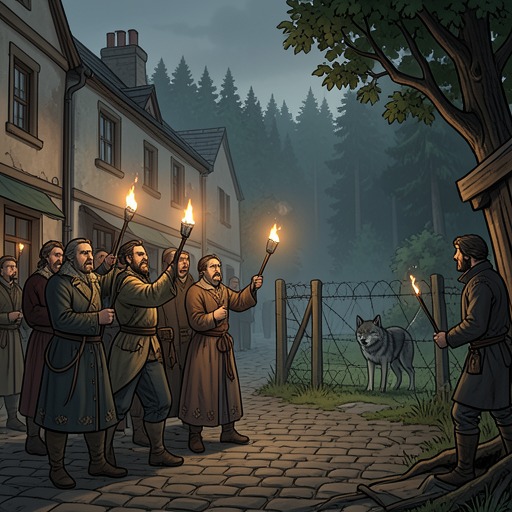
Grundy’s danger spreads beyond the original searches. Once the story of the missing hikers attracts morbid curiosity, outsiders arrive with illegal, powerful weapons, while visitors to the saloon ask for accounts of the monster wolf and directions to the attack site. Alan spends more time protecting people from their own pursuit of a trophy than tracking the animal. The influx also confines Cooper: unable to run long distances safely, he patrols only near the house, chasing rabbits while Oscar tries to keep pace. The wolf’s movements are restricted not only by territory and instinct, but by a human spectacle that makes the woods dangerous for anyone who enters them.
Packs, Predation, and the Meaning of the Tracks
The investigation’s central uncertainty is not only which animal left the tracks, but what kind of agency those tracks conceal. Cooper explains that his family belongs to a line in which members can change into wolves, and that pack life follows a generational order: each pack has a leader, or alpha. Cooper was expected to lead his generation. He had been among the first of its children to become a wolf, and his speed and strength made his future role apparent to the pack. His move roughly a hundred miles from the packlands to Grundy was therefore more than a change of residence. Wolf instinct tied him to the land where his family hunted and lived, making distance a persistent strain.
The pack’s authority is also practical and political. Its alpha makes important decisions for the village and its families, while the pack drives away threats ranging from wild animals to criminals and other people deemed unwelcome. Cooper recalls that he took too much responsibility for sending those he cared about into danger, and that he hurt many people. In this context, the distinction between a wolf attack and a human decision made by a wolf-shaped person becomes crucial: tracks can identify a form without explaining the intention behind it.
Cooper’s account of the rival pack reveals how quickly that distinction can collapse in violence. About a year after he became alpha, a pack from outside Vancouver entered the valley. Its leader, Jonas, had exhausted the group’s own hunting grounds and wanted the better range of Cooper’s territory. The intruders had studied the valley, its village, and the number of fighters available. They seized Maggie and threatened to kill her unless Cooper surrendered control. Cooper first offered to share the valley; when Jonas refused and moved to attack Maggie, both packs changed form and fighting began. Maggie killed one opponent, while Cooper killed the other twelve, including Jonas, in a fight remembered by Cooper with unusual clarity in wolf form.
Cooper does not regard those deaths as the simple defeat of dangerous animals. He insists that the wolves he killed were people, like the members of his own pack. Afterward, he was praised as a strong leader, but he woke screaming from nightmares, could not bear to be with his family, and came to believe that he did not deserve them. His separation from the pack and his departure for Grundy followed from that moral and emotional rupture. When Mo accepts his account without withdrawing from him, her response offers an alternative to the pack’s celebratory account of victory: protection and killing can belong to the same act, without erasing the human cost.
The rival-pack conflict also had an internal political dimension. Eli later admits that he had supplied the outsiders with information for months as they prepared a coup, then pretended to be surprised when their plan went wrong. His ambition rested on the belief that Cooper’s fairness and restraint made him weak, and that the pack needed strength instead. After Eli’s loss, however, the pack does not simply restore Cooper to the leadership he once held. Cooper remains unwilling to become alpha, and the members choose a new leader by secret ballot. Maggie wins decisively and proves capable of governing with swift, generally fair judgment. The tracks that once seemed to promise only an animal to be hunted thus belong to a world of territory, family, violence, and contested leadership—one in which recognizing a wolf does not by itself reveal who is responsible, or what the pack will do next.