1975 Year Vampire Plague
I Am LegendThe 1975 vampire plague is the central disaster of the novel: a fast-moving epidemic that converts ordinary people into vampire hosts, empties communities, destroys families, and leaves Robert Neville isolated in a world governed by infection and fear. Its decisive significance lies in the reversal it produces. What appears to be a supernatural invasion is gradually explained as a disease process involving bacteria, insects, blood, decomposition, and social panic; yet the scientific explanation does not make the catastrophe less terrible, because it also reveals how completely the disease has remade human life.
Causes and Early Spread
The plague first appears to those living through it as an unexplained public emergency. In one conversation, a woman reports that half the people on her block have the illness and that more than half the plant is absent, while no one has identified the germ. The uncertainty allows several explanations to compete: a virus, the bombings, dust storms, and the sudden evolutionary changes Robert Neville describes as organisms jumping over many small evolutionary steps. The disaster is therefore experienced before it is understood, and its uncertainty becomes part of its power.
The speed of the outbreak is one of its most important clues. Neville realizes that nightly attacks by vampires alone could not explain the plague's geometrically mounting victims or its spread across the world. Flies and mosquitoes provide a more convincing mechanism, carrying the disease mechanically from host to host. The remembered appearance of mosquitoes, flies, and sand fleas gives the epidemic an ordinary biological infrastructure beneath its extraordinary visible symptoms. The same world that produces dust storms and bombing-related disruption also produces the conditions in which infection can move rapidly beyond anyone's control.
The disease is intensified by the way people interpret it. Near the end of the plague, yellow journalism spreads a nationwide dread of vampires through sensational and pseudoscientific articles. The press turns fear into a commercial instrument even while the population dies, and a revivalist movement offers primitive worship as an easily understood answer to an incomprehensible crisis. These responses do not stop the plague. People who seek religious certainty die as quickly as everyone else, but they die with an added terror shaped by the vampire stories circulating around them. The epidemic thus spreads through bodies and through explanations, with each reinforcing the other.
Medical Mechanism and Transmission
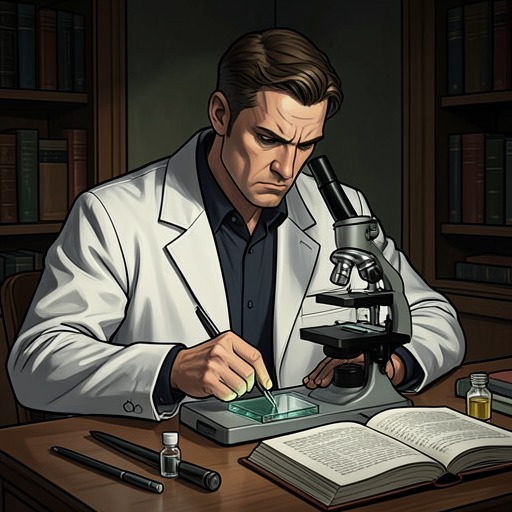
Neville's investigation replaces folklore with a disease model. Looking through a microscope at his thirty-seventh blood slide, he sees a moving germ and names it vampiris. The organism is a cylindrical bacterium, or bacillus, whose flagella propel it through the blood. This discovery gives physical form to what legend had treated as an immortal curse and establishes the plague as a process that can be observed, tested, and described.
The bacillus lives on fresh blood and alters the host's physiology. It creates an isotonic solution in the blood, slows circulation, activates bodily functions, and supplies energy, explaining the vampire's dependence on blood and its unnatural activity. When deprived of fresh blood, the organism either produces self-killing bacteriophages or sporulates. The spores preserve the basic ingredients of the vegetative bacterium, and when an infected host decomposes, they are released to seek new hosts, germinating and multiplying after entering the body.
This mechanism also explains the plague's connection with dust storms. If an infected body decomposes without entering a protective coma, the bacillus may sporulate; the resulting spores can be blown through the air, lodge in tiny skin abrasions produced by scaling dust, and multiply by fission. As the infection advances, surrounding tissue is destroyed and channels become plugged with bacilli. The breakdown of cells and bacteria releases poisonous decomposed matter into healthy tissue until the toxins reach the bloodstream. In this account, no supernatural creature needs to hover over a sleeping victim, and no bat needs to strike against a window. The vampire remains real, but its true history is biological rather than magical.
The novel's medical explanation does not erase the old vampire phenomena; it redistributes their causes. Daytime inactivity can be understood as a coma imposed by the germ to protect itself from solar radiation, while the organism's dependence on blood explains the need to feed. Neville even considers whether the bacteria provide the energy associated with the traditional vampire. The plague therefore becomes a chain linking pathogen, vector, host, symptom, and social response rather than a collection of isolated supernatural rules.
Human Cost and Institutional Response
The plague destroys intimate bonds before it destroys the larger social structure. Robert Neville has lost his family, and the catastrophe leaves him unable to return from daily work to ordinary domestic life. After months of killing and disposing of vampires, he loses his appetite and abandons routine tasks such as checking the generator, cleaning broken mirrors, and finding doweling. The epidemic is not merely a historical background to his isolation; it has reorganized his body, habits, and capacity for ordinary comfort.
The treatment of the dead reveals the conflict between public health and private mourning. By law, every person who dies must be transported immediately to the fires, because only flames are believed capable of destroying the bacteria that cause the plague. Funeral parlors are closed, morticians are restricted, and the bodies of loved ones are absorbed into a system of emergency disposal. Neville understands the law's purpose, but he refuses to let the state determine the final treatment of his wife. He wraps her body in a blanket, sewing it shut until only her face remains and then covering her mouth, nose, and eyes, before carrying her away himself. His resistance preserves a personal vow against the impersonal fires, even as it places private grief against the logic of epidemic containment.
The catastrophe also produces a crisis of responsibility toward infected animals. Neville encounters a starving, limping dog roaming in daylight, an event that briefly interrupts the dead routine of his survival. He leaves milk and hamburger outside, placing a ring of garlic bulbs around the food to keep vampires away, then realizes that the garlic may also repel the dog if it carries the germ. When he finally catches the animal, it snaps weakly and whines in terror as he restrains its jaws and tries to reassure it. The plague makes the animal simultaneously a possible carrier, a vulnerable victim, and an object of care. Neville's hope of saving it exposes the emotional residue that survives after human society has largely disappeared.
Historical Meaning and Social Aftermath
As Neville reconstructs the plague, he places it beside earlier historical epidemics. He recalls the fall of Athens and sees a resemblance to the 1975 disaster: the city collapsed before effective action could be taken. He even considers whether earlier outbreaks, including bubonic plague and the Black Plague that killed three quarters of Europe's population, may have been manifestations of the same vampire-producing disease. The speculation extends the catastrophe backward through history, suggesting that vampire legend may be the cultural residue of repeated encounters with an incomprehended infection.
Yet Neville ultimately distinguishes the visible vampire from the deeper cause. The prowling, predatory figure is not the true villain but a tool of the germ, as much an instrument of transmission as the living people who were first infected. The bacillus hides behind legend and superstition, allowing fear to focus on a recognizable monster while the actual agent spreads unnoticed. This distinction transforms the plague from a war between humans and supernatural beings into an ecological and epidemiological disaster in which bodies, insects, weather, public narratives, and institutions all participate.
The plague's consequences continue after the first mass mortality. The dark-suited men who later kill vampires with pikes operate as an organized force, showing that the disaster has generated a new social order rather than simply leaving survivors in anarchy. They surround infected beings, restrain them, and dispatch them methodically, but their faces and manner appear cruel and triumphant to Neville. Their violence suggests that epidemic control has become a permanent political practice. The old world was destroyed by the disease; the emerging world defines itself by its ability to identify, capture, and kill those who no longer belong to its normality.
Narrative and Thematic Significance
The 1975 vampire plague joins scientific investigation to the collapse of shared meaning. At first, the legend swallows science: people know that something is happening but reject the possibility of vampires as superstition. Neville's microscope reverses that movement by showing that the legend has a material basis. The discovery does not simply prove or disprove folklore; it reveals how a real pathogen can be transformed into a supernatural story, and how that story can in turn shape behavior, journalism, religion, law, and violence.
The plague also destabilizes the boundary between normal and monstrous. During the disaster, Neville understands himself as one of the surviving healthy people and the vampires as the diseased remnants of humanity. But the new society that emerges from the epidemic possesses its own methods, categories, and sanctioned violence. The men killing vampires outside his house make that reversal visible: what Neville sees as brutal slaughter may be treated by the new order as necessary public defense. The disease has therefore altered not only bodies but the standard by which bodies are judged.
In this sense, the plague is both a medical event and a social reclassification. Its bacteria spread through insects, dust, blood, and decomposing tissue, while its meanings spread through rumor, sensational reporting, revivalism, and inherited legend. The compulsory fires, Neville's private burial, the starving dog, the microscope, and the pike-wielding enforcers are different responses to the same rupture. Together they show a civilization moving from uncertainty, through scientific explanation, toward a new normality whose authority rests on the exclusion and destruction of those whom the epidemic has left behind.