Ben Cortman
I Am LegendBen Cortman is Robert Neville’s former colleague, neighborly acquaintance, and most persistent nightly adversary. Once an ordinary man who drove Neville to the plant and discussed cars, baseball, politics, the disease, and their families with him, Cortman becomes a vampire who repeatedly calls from outside Neville’s barricaded home. His familiar voice, grotesquely preserved appearance, and final execution make him the human remnant at the center of Neville’s isolation: an old acquaintance reduced to a ritual threat, yet never entirely stripped of personal significance.
Identity and Former Life
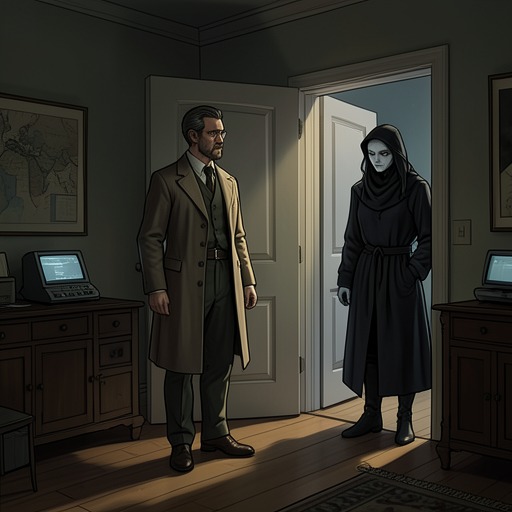
Cortman belonged to Robert Neville’s former social and working world. Before the plague, he picked Neville up each morning to drive to the plant, and the two men spoke about ordinary subjects as well as the spreading disease. Their conversations extended to Virginia and Kathy Neville and to Freda Cortman, placing Cortman within the domestic and professional network that the epidemic has destroyed. Neville’s later recognition of him is therefore not the recognition of a stranger but the shock of seeing a familiar man made alien.
When Neville watches him from the house, Cortman still has black hair, a corpulent body, and a white face. The chief visible alteration is a beard, mostly beneath the nose and thinner along the chin, cheeks, and throat. Neville remembers that Cortman had once been immaculately shaved and smelled of cologne when he collected him for work. The contrast between that carefully maintained former appearance and the bearded vampire outside the house gives Cortman’s transformation a particularly intimate force: the plague has not merely produced a monster, but has overwritten the recognizable surface of a colleague.
The Nightly Ritual of Pursuit
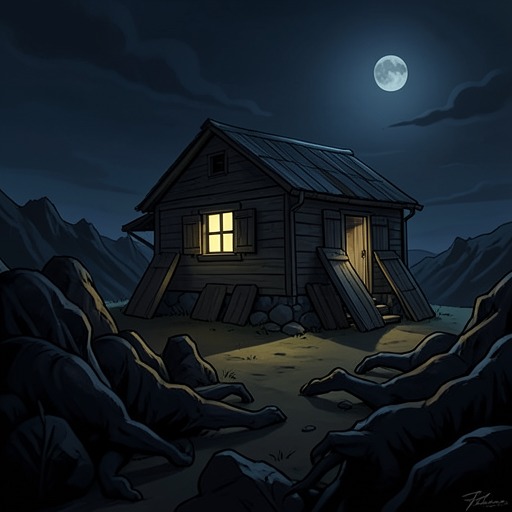
Cortman becomes the most consistent voice in the nightly assault on Neville’s solitude. At six twenty-five, when Neville is putting food on his plate, Cortman shouts from outside, “Come out, Neville!” The summons recurs with such regularity that it becomes part of the household’s hostile schedule. Neville locks and bolts the doors, slides the thick bar into place, and attempts to eat while Cortman and the other vampires remain outside. The voice reaches him even when he tries to retreat into books, music, alcohol, and the routines of domestic survival.
The ritual is not limited to speech. Stones rattle across the roof and fall into the shrubbery, while Cortman continues calling for Neville to emerge. Neville responds internally with a fantasy of revenge, imagining a stake driven through Cortman’s chest and even a specially made stake with ribbons. The thought reveals how thoroughly the repeated harassment has converted former familiarity into hatred, while also showing that Cortman’s presence remains more psychologically potent than the attacks of anonymous vampires.
Cortman’s pursuit can become physically immediate. During one escape, Robert Neville slows the station wagon and allows the vampires to gain on him. Their grayish-white faces approach with their dark eyes fixed on the car, and Cortman’s crazed face suddenly appears beside it. Neville’s instinctive attempt to accelerate fails when the clutch slips and the vehicle stalls, leaving Cortman clawing toward him. The scene compresses the nightly ritual into a direct mechanical crisis: the voice that normally reaches Neville through walls becomes a hand and a face at the car itself.
Visibility, Desire, and the House
Neville’s relationship with Cortman is mediated by controlled visibility. Early in the siege, Neville makes a peephole in the front window and watches the vampires. Once the women notice him, they strike obscene poses to entice him outside, so he stops looking. He continues to hear the women and Cortman, but refuses the visual contact that might make the scene more psychologically invasive. The peephole consequently functions as both a defensive instrument and a site of forced spectatorship: Neville observes from concealment, while the vampires perform for the possibility that he is watching.
Cortman remains the fixed male presence within this nocturnal spectacle. Neville sees him pacing on the lawn and calling for him to come out, while the women’s provocations awaken a bodily craving that Neville struggles to suppress. The division between Cortman’s voice and the women’s display does not make the house secure; it turns the house into an acoustic and visual prison in which Neville must choose between hearing his persecutors and cutting himself off from music. His efforts to soundproof the building would also silence the music he uses to resist them, so Cortman’s recurring call helps define the narrow limits of Neville’s autonomy.
Later, when Ruth asks which vampire is Cortman, Neville identifies him as the one by the lamppost and explains that he has killed most of the vampires, although they have managed to keep a few ahead of him. Cortman is thus not merely one member of the crowd but the individual whom Neville can still distinguish within it. His position under the lamppost makes him visible as an object of surveillance, while Neville’s house remains the hidden point from which the old colleague is named and tracked.
Recognition and Reversal
Cortman’s continued presence allows Neville to preserve a link to the past even as he insists that the past is dead. Looking through the peephole, Neville recalls the man who once drove him to work and discussed private and public matters with him. Yet the vampire outside is completely alien to that memory. The contradiction is central to Cortman’s role: he is both the embodiment of the lost world and proof that the lost world cannot be recovered.
Neville briefly turns Cortman into an object of dark comedy when he realizes that the vampire resembles Oliver Hardy. Cortman’s rounded body, beard, and mustache make him almost a double of the comedian, and the comparison provokes Neville’s repressed laughter. This grotesque resemblance does not erase the danger; it momentarily gives Neville a way to convert terror into an image from the old culture. Cortman becomes at once a bloodless predator, a former coworker, and a distorted remnant of the films Neville watches in the house.
The decisive reversal comes when the new society attacks Robert Neville’s house. Dark cars arrive with spotlights, guns, axes, and pikes, their beams sweeping around the corner of Cimarron Street. The attackers methodically surround and stake seven vampires, including six men and a woman. Neville had expected danger from vampires, yet the organized men’s methodical slaughter appears to him brutal and gangster-like. Their spotlights expose the vampires, and their pikes turn illumination into an instrument of capture and execution.
Neville suddenly remembers Cortman and searches the street because he does not want the men to destroy him. Cortman is found on the roof across the street, pulling himself toward a chimney where he had hidden much of the time. Neville realizes that Cortman is not theirs to put to rest. Although he has spent years defending himself from Cortman and imagining his death by staking, he now feels more deeply toward the vampires than toward their executioners. The old enemy’s identity as a person, however damaged, becomes more compelling than the authority of the new collective that claims the right to kill him.
Death and Narrative Significance
The new society shoots Cortman with a machine gun. He remains briefly upright in the hot blast, his palsied hands raised and his face twisted into berserk defiance, before his body folds, slumps forward, and rolls down the roof. Neville hears the body strike below and watches the men rush at it with their pikes. He closes his eyes and digs his nails into his palms, physically registering a grief and horror that exceed the detached response expected from his former role as vampire hunter.
Cortman’s death is the final destruction of Neville’s last personal connection to the world before the plague. Neville mutters Ben’s name as the machine gun fires, a response that restores the former colleague’s human name at the moment the executioners reduce him to flesh and a target. The death also exposes the instability of the categories governing the novel. Neville has called Cortman a bastard and imagined staking him, but when another power kills him, Neville experiences the act as an intolerable trespass. The persecuted man and the persecutor become linked by shared vulnerability to a stronger, more organized force.
After the attack, Neville is captured and wakes wounded in a small cubicle with barred windows, remembering the dark men and the assault on his house before he fully understands where he is. Cortman’s execution immediately precedes this confinement and helps frame Neville’s own fate. The men who destroy Cortman are not simply rescuers from an old threat; they are agents of a new order capable of violence, surveillance, and imprisonment. Cortman’s final appearance therefore foreshadows Neville’s own passage from observer and executioner to hunted captive.
Cortman’s repeated command, “Come out, Neville!”, begins as the sound of a vampire society demanding that its human remnant abandon safety. By the ending, the demand has acquired an ironic afterlife. The man who once called from the darkness is dead, and Neville is the one enclosed behind barriers and barred windows. Cortman’s arc gives the novel one of its sharpest reversals: the familiar monster dies as an outsider to the new order, while Robert Neville discovers that his own humanity has placed him in the same position.