Cadaver incineration pit
I Am LegendThe burning pit is a vast excavated field used to incinerate the dead during the plague. Robert Neville approaches it as part of the grim work of survival, carrying bodies from the abandoned city to the flames, yet the place is inseparable from the destruction of his family. Kathy Neville’s body is somewhere in its ashes, while Virginia Neville’s burial and the memories surrounding both deaths make the pit a recurring landscape of grief, trauma, and irreversible separation.
Definition and Physical Setting
The burning pit lies beyond the silent streets along Robert Neville’s route on Compton Boulevard, past the oil derricks and through Compton. Its scale is industrial and elemental: the whole field has been excavated into one enormous depression, and a fire burns continuously at the bottom. Smoke hangs over the earth as a sooty pall, turning the site into a permanent atmospheric stain rather than an occasional funeral pyre.
Neville must protect himself while working there. He pulls on gloves and a gas mask before leaving the car, then removes them only after driving away from the pit. Even through the mask, he feels as though he is strangling, and the visit regularly makes him sick. The protective equipment marks the location as both contaminated and officially necessary, a place where public health procedure and unbearable human loss have been forced into the same ritual.
Neville’s Work at the Pit
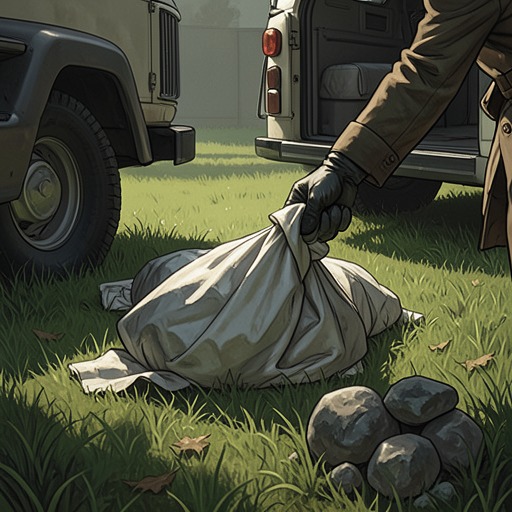
Robert Neville arrives in a Willys station wagon carrying corpses and hurries to complete the task. He opens the rear gate, drags out the first body, stands it at the edge, and shoves it down the steep incline. The body rolls into the smoldering ash below. He repeats the process with the second body, then throws a sack of rocks after it before returning to the car and speeding away.
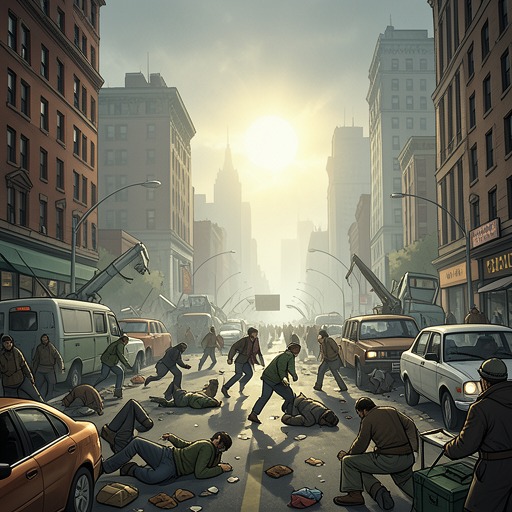
The work is repetitive, physical, and deliberately stripped of ceremony. Neville does not conduct a burial or identify the dead; he moves bodies from vehicle to fire as quickly as possible. The repetition conveys the scale of the catastrophe and the way emergency law has replaced ordinary mourning. He may have to visit the pit every day for weeks, so the site is not a single scene of horror but an imposed routine that continually reopens the same wound.
Kathy Neville and the Family Losses
The pit’s most personal significance is stated with devastating simplicity: somewhere beneath it is Kathy Neville. The knowledge links the anonymous bodies Neville handles to the child he loved. What appears from a distance to be a public disposal site is therefore also the location of his daughter’s remains, making every visit an encounter with a loss that cannot be separated from the plague’s larger body count.
A remembered scene clarifies how Kathy reached the fire. Neville sees the great yellow blaze, the dense clouds rising above it, and Kathy’s tiny body in his arms. A masked man tears her away as though taking a bundle of rags and carries her into the dark mist. Neville rushes after him with a berserk scream, but men in canvas and masks drag him back. His shoes gouge trenches in the earth as he struggles, and the memory ends with him being struck into numbness and driven away in Ben Cortman’s car while he watches the smoke rise like a black embodiment of despair.
The pit thus contains a double violence. Kathy’s death is not only the loss of a child; it is also the forced transformation of parental care into an administrative act of incineration. Neville’s inability to prevent the removal of her body leaves the fire as the final image of powerlessness, while the smoke becomes a recurring material form for the despair he cannot overcome.
Relation to Virginia Neville’s Burial
The burning pit also throws Virginia Neville’s fate into relief. Neville refuses to surrender his wife to the same flames, despite knowing that the law requires plague victims to be burned and despite asking how many families could truly follow such a command. He makes a vow that Virginia will not be burned, then sews her body into a blanket, covering her face and finally her mouth, nose, and eyes before carrying her out for burial.
The contrast is decisive. Kathy is taken from Neville and consumed within the public machinery of plague disposal; Virginia is buried by Neville in an effort to preserve a private bond and give her a form of burial that the law has denied. Yet this act does not free him from the pit’s power. His memories of the fire, Kathy’s removal, and Virginia’s later return continue to invade his consciousness. The pit remains the standard against which he measures every subsequent death: it is the place where loved ones become indistinguishable from waste.
Trauma, Memory, and Narrative Significance
The burning pit functions as a geographical trigger for intrusive memory. Neville’s recollection does not unfold as a calm explanation; it arrives in fractured images of fire, smoke, the child in his arms, masked men, physical restraint, pain, and the ride away from the field. Later, dreams of Virginia, nights of drinking, and his fixation on the bodies around him show that the past has not remained past. The pit’s events recur through sleep, sensation, and compulsive remembrance.
Its meaning expands when Virginia returns as an infected creature. Neville explains to Ruth that he buried his wife, but that she came back as an outline or shadow, no longer the woman he had known and wanting his blood. The pit and the grave therefore form opposing but connected images: fire destroys the body according to law, burial preserves it according to love, and vampiric return violates the hope that either process can establish finality.
The site also stands against Neville’s later attachment to the surviving dog. After finding a possible companion and then losing it, he regards the dog as the peak of a planet’s evolution rather than as merely an animal. His tenderness toward the sick creature briefly creates an alternative to the pit’s mechanical handling of bodies, but the dog dies within a week. That recurrence confirms the pit’s larger significance: in Neville’s world, every attempt to preserve an individual life is threatened by the same plague, and every loss draws him back toward images of ash, smoke, and forced separation.
As a location, the burning pit is therefore both public infrastructure and private tomb. It records the collapse of ordinary funeral customs, embodies the state’s emergency response to infection, and concentrates the central conflict between survival and mourning. For Robert Neville, the fire is never merely where bodies are disposed of. It is where Kathy Neville’s absence becomes permanent, where the memory of Virginia Neville’s death is given its most terrible context, and where the plague’s mass death is experienced as the singular destruction of a family.