Cimarron Street
I Am LegendCimarron Street is the central exterior space of Robert Neville’s isolation: a once-inhabited residential street reduced to charred ruins and nightly confrontation. From the fortified house that faces it, Robert Neville watches the vampires gather, measures the passage of each night, and turns the street into both a defensive perimeter and a field of investigation. Its decisive significance lies in the reversal it stages. At first, Robert Neville controls visibility from inside his house and keeps the street at bay; eventually, the people moving through Cimarron Street control the lights, vehicles, weapons, and the fate of the man within.
Ruined Residential Setting
Cimarron Street is presented as a silent length of road bordered by the burned remains of neighboring houses. Robert Neville himself destroyed the houses beside his in order to prevent vampires from using their roofs to leap onto his own, making the destruction around his home part of his defensive architecture. The street therefore records both the devastation of the plague and the practical violence of survival: the surrounding neighborhood has been transformed into a cleared zone whose emptiness is meant to protect one isolated residence.
The street’s changing weather and light mark the rhythm of Neville’s confinement. During a cloudy evening, the sky darkens, the temperature falls, and a breeze moves through his blond hair as he looks up and down the road. He retreats across the lawn, locks and bolts the door, and slides the thick bar into place. The sidewalk and lawn are physically close to the house, but the repeated act of crossing them exposes the difference between the protected interior and the dangerous public world.
Nightly Surveillance and Confrontation
Cimarron Street is the vampires’ gathering ground after dark. Robert Neville observes their dark figures standing on his lawn like silent soldiers; as dawn approaches, some move away while muttering in dissatisfaction. Their presence is not merely a sudden attack but a recurring occupation of the street’s edge, a nightly pressure that makes time itself measurable. Ben Cortman’s cry, “Come out, Neville!”, gives the confrontation a repeated verbal form, while the vampires’ disunity—sometimes expressed through attacks on one another—shows that their collective threat is driven by need rather than solidarity.
Robert Neville’s relationship to the street is structured by visibility. In the beginning, he watches the vampires through a peephole in the front window, but he stops looking at the women after they notice him and strike obscene poses to lure him outside. He continues to hear them even when he avoids seeing them, and the sound becomes an assault that he cannot entirely escape without also losing his music. Cimarron Street thus functions as an instrument of surveillance in both directions: Robert Neville watches from concealment, while the figures outside attempt to manipulate what he sees and hears.
The street also becomes a hunting ground. Robert Neville encounters Ben Cortman walking onto the lawn and answers the provocation inwardly before Cortman repeats it aloud. Later, while Robert Neville shows Ruth the vampire presence through the peephole, he identifies Ben Cortman by the lamppost and explains that he has killed most of the vampires but that a few remain beyond his reach. The lamppost is a small but significant point of orientation: it makes the street legible as a watched space, a place where individual enemies can be singled out from the larger crowd.
A Threshold of Attachment and Investigation
The street is not only associated with hostile figures. One afternoon, a wounded dog comes hobbling slowly across it, looking toward Robert Neville’s house with cautious, white-rimmed eyes. Robert Neville watches the animal drink milk and eat hamburger, and the ordinary physical actions give him an experience of warmth and normality that has almost disappeared from his life. The dog’s movement from the street toward the porch turns the exposed public space into a possible passage back toward companionship. When Robert Neville rises quickly to reach the front door, the street has briefly become a route of hope rather than an approach of enemies.
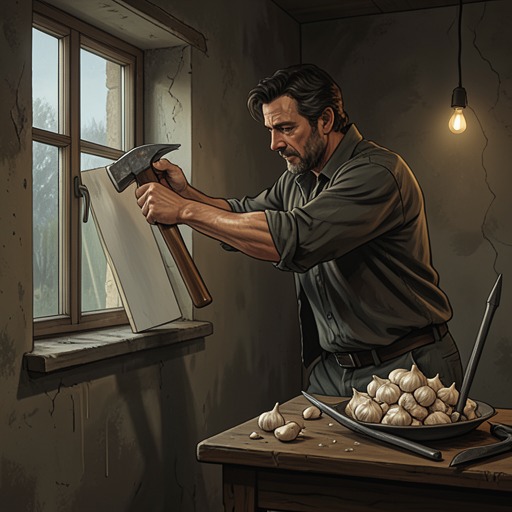
That possibility remains fragile because the street is also the setting in which Robert Neville’s methods and assumptions are tested. His work beyond the house, including his pursuit of infected bodies and his use of garlic, a stake, and a mallet, is part of the larger effort to understand and contain vampirism. His actions are shaped by isolation and by the belief that the figures outside are an undifferentiated threat, yet encounters connected to the street complicate that certainty. Ruth’s account of seeing her husband killed, losing two children to the plague, and wandering hungry and terrified reframes the apparent monster outside as a person caught within the same catastrophe. The street is consequently a zone where categories of hunter and hunted, human and vampire, are repeatedly unsettled.
Reversal and Capture
The greatest transformation of Cimarron Street occurs when the new vampire society arrives. In January 1979, dark cars approach with spotlights, guns, axes, and pikes; the beams swing around the boulevard corner and reach toward Cimarron Street. The street is no longer merely the place where isolated vampires wait outside Robert Neville’s house. It becomes the organized society’s access route, and the scattered nocturnal threat becomes a coordinated operation.
Robert Neville is sitting at the peephole when the lights strike the vampire faces outside. He has spent years making the house a place from which he can observe and defend himself, but the illumination reverses his advantage. The new force controls the powerful lights and arrives with enough men and weapons to turn the street into an overwhelming spectacle of encirclement. Robert Neville considers the pistols in his bureau and the sub-machine gun on his workbench, yet the scale and suddenness of the assault leave him trembling and uncertain.
After the attack, the spatial relation between street and house is completely reversed. Robert Neville wakes badly wounded in a tiny cubicle with barred windows, remembers the dark men attacking his house, and understands that he has been captured. The street that once marked the outer limit of his private fortress has become the approach to his imprisonment. His earlier control of the peephole, the lawn, and the neighboring ruins cannot prevent the new society from converting the entire perimeter into a mechanism of capture.
Narrative and Thematic Significance
Cimarron Street externalizes Robert Neville’s changing position in the world. Early in the novel, it is empty enough to appear conquered: burned houses, a silent road, and a lone man inspecting the ruins. At night, however, the same emptiness fills with watchers, voices, bodies, and ritualized challenges. The street makes Robert Neville’s solitude visible while also exposing its limits; no wall can prevent the outside world from returning as sound, memory, prey, or organized force.
Its recurring thresholds create a spatial history of power. The lawn and sidewalk are close enough for Robert Neville to cross them during routine tasks, but every crossing requires renewed caution. The peephole narrows the field of vision while preserving the illusion of command. The lamppost allows an enemy to be identified, whereas the final spotlights erase the advantage of darkness and reveal the new society’s superiority in coordination. By the end, barred windows replace the peephole as the defining frame of perception. Cimarron Street has changed from a defended boundary into evidence that the world outside has developed beyond Robert Neville’s understanding and control.