Come out, Neville!
I Am Legend“Come out, Neville!” is the signature cry that structures Robert Neville’s nights and measures the changing relation between the solitary survivor and the vampires outside his house. Repeated by Ben Cortman and echoed by the hostile crowd, it is at once an invitation, a threat, and a verbal form of siege: the words demand that Neville abandon the protected interior where he reads, drinks, works, and resists, and enter the world that has replaced him. As the refrain recurs, it exposes how little separation remains between physical defense and psychological captivity.
Origin and Repetition
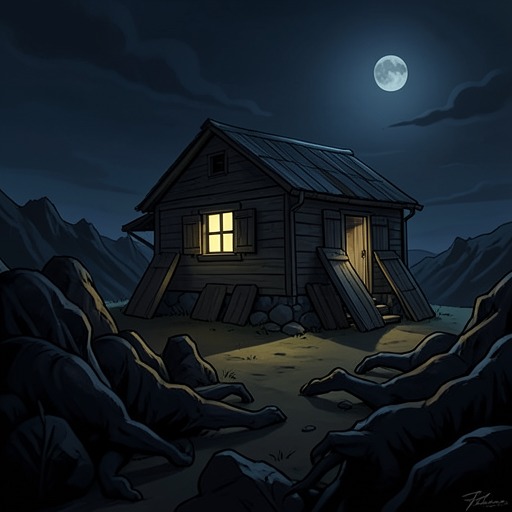
The summons first appears as part of the evening routine that governs Robert Neville’s existence. At six twenty-five, while he is putting food on his plate, he hears Ben Cortman shouting, “Come out, Neville!” Neville does not answer; he sits down and eats, attempting to preserve the ordinary sequence of dinner against the interruption. The phrase therefore enters the narrative not as an isolated piece of dialogue but as an audible marker of nightfall, the moment when the outside world becomes active and the house must be locked, bolted, and barred.
The cry returns above stones rattling across the roof and striking the shrubbery. Ben Cortman shouts it as he always does, making repetition itself part of the assault. Neville responds inwardly with fantasies of driving a stake through Cortman’s chest, even imagining a special stake decorated with ribbons. His private counter-speech cannot reach the street, but it shows that the command has produced its opposite: the more often the vampires call him out, the more intensely Neville imagines destroying the voice that calls.
A Voice Against the House
Neville tries to resist the phrase through sound, reading, alcohol, and domestic routine. He listens to Schonberg over the hallway speaker while studying physiology, hoping music will prevent the voices outside from occupying his attention. Yet soundproofing becomes difficult because blocking the vampires would also block the music; he refuses to let them force him completely into a shell, even as their calls make the house feel like a prison. The refrain thus operates spatially. It comes from beyond the walls, but it reorganizes the interior, directing Neville’s gaze, posture, memory, and movements.
At first Neville watches the vampires through a peephole. He stops doing so after the women see him and strike deliberately provocative poses to entice him outside. The summons is consequently joined to a spectacle of visibility: the vampires try to make Neville look, imagine, and respond. His refusal to watch is not freedom from their influence. He remains trapped in the cycle, with the women’s poses and Cortman’s words returning together each night, producing a physical craving he experiences as a tightening, wordless pressure in his body. He paces, drinks, eats, turns up the music, or considers setting up the movie projector, using activity to escape a desire he cannot master through reason.
Temptation, Rage, and the Threat of Assimilation
The phrase becomes most dangerous when Neville is drunk and exhausted. After rejecting the literary vampire figures associated with Van Helsing, Mina, Jonathan, and the Count, he hears Cortman call from outside and thinks of answering sarcastically that he will come out soon, once dressed for the occasion. The thought then shifts toward a more terrifying possibility: he might go out not merely to confront them, but to become one of them. “Come out, Neville!” therefore names the boundary he is repeatedly tempted to cross. The vampires’ command activates both his hatred of them and his fear that his isolation, sexuality, and exhaustion have already made him resemble them.
The cry also punctuates Neville’s struggle to suppress sexual thought. When the voices call, he imagines the women waiting outside and then recoils from the implication that they want his blood. His body becomes the battleground on which the external summons and internal craving meet. Garlic, spread through his clothing, furniture, food, and even drink, represents his deliberate countermeasure, but its omnipresence also records how completely the nightly conflict has entered his life.
Cortman and the Changing Power of the Call
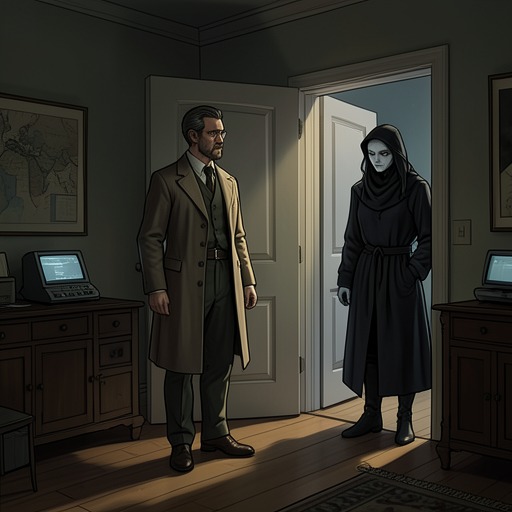
Ben Cortman gives the expression its personal force. Neville remembers Cortman from before the plague as a neatly shaved, cologne-scented man who picked him up to drive to the plant. When Cortman approaches the lawn months later, his black hair and corpulent body remain recognizable, while a beard marks the physical change wrought by his condition. Neville mutters the same words back at him, and Cortman echoes them in a loud cry. The exchange briefly reverses the direction of address, but it does not restore equality. Neville remains behind the peephole, motionless, while Cortman stands outside as the living remnant of an old social relationship transformed into persecution.
The phrase follows Neville beyond the fixed nightly scene. When he is sitting on the porch after feeding a surviving dog, Ben Cortman suddenly runs toward him shouting “Neville!” Neville flees inside and locks the door. Even when the call is shortened, its function is unchanged: it announces pursuit and drives him from exposed space into enclosure. Later, while Neville and Ruth are inside the house, the voices can still be heard through the open peephole, with Cortman again shouting, “Come out, Neville!” The words now intrude upon a supposedly private human encounter, reminding Neville that the outside community is listening, waiting, and capable of reaching him.
From Taunt to Historical Verdict
By the final assault, the command has acquired a larger political meaning. The new society comes by night in dark cars equipped with spotlights, guns, axes, and pikes, advancing along the boulevard toward Cimarron Street. Neville watches the beams fall across the vampires’ pale faces before retreating from the peephole and considering the weapons with which he might defend the house. The earlier cry has prepared this scene: what once sounded like the voice of a few tormentors has become the prelude to an organized capture.
After the attack, Neville awakens wounded in a tiny cubicle with barred windows. He remembers the dark men and the assault before fully turning toward the enclosure, and the remembered sound outside is now the confused rush of the world from which he has been separated. The demand to come out has been fulfilled in the most coercive way possible: Neville has been removed from his defended home, but he has not entered the outside world as a free man. He has been taken into a prison, where the call’s implied promise of release is exposed as a trap.
The expression’s decisive irony lies in its shifting ownership. Neville hears it as persecution because he believes himself the last normal man, yet the vampires’ persistence demonstrates that he is already an anomaly within their emerging order. The words do not merely ask him to open a door. They insist that the protected identity he has maintained through garlic, weapons, books, labor, and isolation can no longer determine what counts as normal. Repeated until it becomes ritual, “Come out, Neville!” moves from a nightly taunt to the verbal emblem of a society closing around the man who once imagined that he alone remained unchanged.